According to the Social Weather Stations, most people surveyed in 18 countries believe that globalization is mostly good for most people. This is quite an eye-opener - all along I thought most people were, at the very least, wary of globalization.
The highest "approval ratings", as it were, for globalization are found - unshockingly - in China and South Korea. Export-dependent countries both. (Goes to show you the legendary antiglobalist Korean hotheads demonstrating in every possible ocassion, are not quite representative of their countrymen.)
Interestingly, the lowest approval rating is in the Philippines. Perhaps it's the level of education - after all, it's the Philippines and India who are least approving of globalization.
However the result for the Philippines, despite low educational level of the population, should still be surprising. After all, 1 in 5 Filipino workers is employed overseas. Does the export of labor turn the remaining citizenry off of globalization, unlike the export of goods? I conjecture, "yes." The export of labor is attended with great ambivalence, from which the export of goods is spared. The latter separates the worker from the labor (which is then embodied in the product) - the product then undergoes the slings and arrows of xenophobia, while the worker takes off at five o'clock and goes - home.
Of course I'd be the last to oppose free market choices to migrate. But I'd be the first to admit - yes, my ambivalence.
Bayan ko, nahan ka
Ako ngayo'y nag-iiisa
Nais kong magbalik
Sa iyo, bayan ko
Patawarin mo ako
Kung ako'y nagkamali
Sa landas na aking
Tinahak
(My country, where are you?
I am now alone.
I wish to return to you, my country.
Forgive me,
If I have erred
In the way
I have taken. )
Saturday, May 26, 2007


Friday, May 25, 2007
Game theorists speak
Pointing you to a new book about Game Theory. Unlike other references, which present specific game theory models, this is really about the theory, its key areas, progress, empirical application, and future prospects. It is based on interviews with top scholars in the field. I have only the online excerpts to go on, but it is already mostly fascinating. The most interesting of these are of Ken Binmore, Tom Schelling, and Bob Sugden, which are all about the real world applications of game theory. Let's hear from Nobel Laureate Sugden:
Conventional game theory presupposes that each player’s motivations can be represented by numerical payoffs, assigned to the outcomes of strategy profiles, and that the combined behaviour of the players of a game can be explained by using solution concepts that use these payoffs as data. But what entitles game theory to claim that this strategy of explanation will work? It is not a self-evident truth that players are motivated by individual payoffs, or that standard solution principles, such as dominance, hold when defined relative to such payoffs.16 To know if this strategy works, we need to be shown that there is a method of assigning payoffs to real-world games such that, when it is used, the solution concepts of game theory lead to successful predictions. If this strategy doesn’t work, game theory is at fault and needs to be changed. If progress is to be possible, the first essential is that game theorists recognise that it is their job to make their theories fit the world. That is what science is all about.
Friday, May 11, 2007
The good, the bad, and the ugly
The Philippines is holding its local and legilative elections this May 14. Which of the senatorial candidates exhibit the most libertarian leanings? Let's consider their answers to a question on the importation of low cost medicines (Philippine Daily Inquirer, May 6, 2007). I've divided their answers into three categories.
The categories cut randomly across partly lines. Unlike the recent runoffs in France, where the drama was resolved in favor of the more libertarian party, there is practically no ideological distinction between the contending elements in Philippine politics. Both favor good governance and unity; each claims itself as authentic. Product differentiation descends to the level of personalities, rather than philosophies. Perhaps, in the Philippine context, this is a good thing - when products are unstandardized, there is hardly a point to reading the label.
Of the three categories, of course I favor the first; in that category I have awarded the Man-With-No-Name award for the first two. Most of the other answers are blah-blah-blah-blah, blah-blah, blah-blah-blah-blah-blah-blah-blah, blah-blah-blah, blah.
In the final category are answers I have included for your enjoyment.
***************************************************************
PRO:
Vicente Magsaysay, administration: I am for importation of low-cost medicines.
Antonio Trillanes, opposition: I support the importation of low-priced medicines.
Benigno Aquino, opposition: Im in favor of legislative initiatives seeking to amend the Intellectual Property Code to allow parallel importation of medicines as the first step toward broader access to quality health care.
Manuel Villar, administration: Under my watch as Senate President, the Senate approved the bill lowering the prices of medicines by amending our Patents Law to allow the importation and early development of patented medicines to greatly alleviate the health care needs of our people.
PRO BUT PROLIX:
Edgardo Angara, administration: Caring for ones health is a personal responsibility for most people but for me, it is my public duty. I have helped institutionalize a National Health Insurance Program thru PhilHealth, pushed for the creation of the National Institutes of Health to promote health R & D, and rallied behind the Generics Act. Ill push for the increase in the elderlys discount privileges for medicine to 34 percent by proposing amendments to the Senior Citizens Act. Ill support measures that will make available health support to an even bigger public even if it means importing quality low-priced medicines.Alan Cayetano, opposition: The Arroyo administration has neglected the health needs of the people. The cost of medicine is now beyond the reach of most Filipinos. I support the bills in Congress that call for importation of cheap drugs and for the institution of price control on certain drugs. Government purchases of drugs are also mired in corruption. This can be addressed by allowing patients to purchase medicine directly from private drugstores by issuing vouchers instead of the usual bidding that is practiced today.
Panfilo Lacson, opposition: Health is a priority in my advocacy as I have delineated in my HOPE legislative agenda. I, therefore, squarely support the policy allowing importation of low-priced medicines to enable Filipinos to have easier and fuller access to more medicines. Government, however, must ensure that unscrupulous parties that import low-priced but fake or substandard medicine are quickly punished.Luis Singson, administration: I am totally in favor of the parallel importation of low-priced medicines as it redounds to the benefit of the great majority of our countrymen. However, I also believe that we must resolutely pursue a comprehensive health program that includes allocation of substantial research and development funds for alternative herbal-based medicines or drugs made from indigenous materials that abound in the Philippines. We must develop our local pharmaceutical industry to lessen our dependence on imported medicines.
Juan Zubiri, administration: The high cost of medicine affects the poor more than the rich. Thus, it is only right and in the interest of the Filipinos for the government to find ways to lower medicine prices. This could be done by buying low-priced medicines abroad, fostering the local generic medicine industry, eliminating the monopoly of big medicine manufacturers, and placing prices of essential and life-saving medicine under government control. Not only manufactured medicine can be imported. Technologies in the manufacture of medicines with expired patents can also be adopted in the country by drug companies, so we can make cheaper medicines.
Francisco Pangilinan, independent: Because its economically beneficial for the country and people, importing low-priced medicines is a boon. If it poses a challenge to the local pharmaceutical industry, it should be taken as a chance for the industry to be more competitive. The benefit of having cheap but quality medicines for our people should prevail. These are thereasons the Senate passed the patents bill on the third reading before we ended session in February. The House of Representatives should give immediate attention to this bill when we resume session in July.
EVASIVE
Anna Dominique Coseteng, opposition: While I am not against the importation of low-priced medicines, we must ensure that these are of the same high standard of safety and potency as medicines from established drug firms. One way to lower medicine prices is to require manufacturers to put in big enough text, the manufacturers suggested retail price on the package so that consumers will know how much a drug outlet is making, over the manufacturers cost of production.Mike Defensor, administration: One of the priority programs of the government is to bring quality but affordable medicine to the public. Notwithstanding, the implementation of the generics law, we have not been successful in reducing the price of medicines. We are implementing the Botika ng Bayan and the Botika ng Barangay in coordination with theDepartment of Health and the PITC. I agree to the importation of medicine if this will benefit the public.
Francis Escudero, opposition: I am in favor of such a move if indeed it will redound to the benefit of our people. Safety nets would have to be provided, however, in connection with quality control and intellectual property rights.
Loren Legarda, opposition: The manufacture of pharmaceutical products in the Philippines is a virtual monopoly. This makes the price of medicines costly in our country, even if manufactured locally. India produces a lot of medicines comparable to those manufactured here. If importing medicine will bring down the cost of health care in the Philippines, then importation should be undertaken. Unrestricted importation, however, does not sound good. Only medicines which are genuine and which have not yet gone beyond their storage life should be imported.
Tessie Oreta, administration: The cost of medicine in the country is one of the highest in Asia. The high cost becomes a major stumbling block to improving the well-being of Filipinos. Importing low-priced medicines may be one option to address the problem. However, we must ensure that standards of quality are met. In addition, we need to strengthen the capacities of regulatory bodies such as the Bureau of Customs and Bureau of Food and Drugs in order to prevent the entry of fake and substandard medicines.
Prospero Pichay, administration: There should be a balance between the importation of low-priced medicines and the need to let the local drug industry continue to be viable. We need to import low-priced medicines to help our countrymen cope with the high drug prices but we dont also want to kill the local drug industry. So there should be a balance.
Vicento Sotto, administration: Importing low-priced medicines is a major step in addressing the problem of access to affordable and quality medicines. However, we must ensure that standards of quality are always met and are constantly kept updated. In the case of low-cost imported medicines, quality must be a priority. We also need to explore and develop more alternative and traditional medicines, which may be more affordable to the majority of our people. In addition, we need to strengthen the capability of regulatory bodies such as the Bureau of Food and Drugs in order to prevent the entry of fake and below-standard medicines.
HUH?
Sonia Roco, opposition: Are the multinationals providing reasonably priced medicines? Is the distribution of imported medicines democratized? Is the use of herbal and traditional medicine and methods sufficiently promoted and supported by the government? The 54-percent self-rated poor badly need cheap, unexpired medicines. Can they be bought at the Botika ng Bayan?
Ralph Recto, administration: Like the medicines we take, importation should be of the right dosage and kind. The challenge is not to import from India, but to copy India, which has been able to provide cheap medicines to its people by manufacturing essential drugs, to the extent of skirting patent limitations.
Cesar Montano, administration: Thats a good idea. But another option is to support locally made drugslike herbal medicines. In doing so, we are also providing jobs to our countrymen.
Richard Gomez, independent: All Filipinos should be given access to cheap medicines. Poverty is a major problem in our country. Thats why my priority is to raise the salaries of Filipinos.
Jamalul Kiram, administration: Expand the program and increase the budget allocation consistent with WHO standards and health services budget.
John Osmena, opposition: I am in favor of low-priced drugs.
Joker Arroyo, administration: No answer.
The categories cut randomly across partly lines. Unlike the recent runoffs in France, where the drama was resolved in favor of the more libertarian party, there is practically no ideological distinction between the contending elements in Philippine politics. Both favor good governance and unity; each claims itself as authentic. Product differentiation descends to the level of personalities, rather than philosophies. Perhaps, in the Philippine context, this is a good thing - when products are unstandardized, there is hardly a point to reading the label.
Of the three categories, of course I favor the first; in that category I have awarded the Man-With-No-Name award for the first two. Most of the other answers are blah-blah-blah-blah, blah-blah, blah-blah-blah-blah-blah-blah-blah, blah-blah-blah, blah.
In the final category are answers I have included for your enjoyment.
***************************************************************
PRO:
Vicente Magsaysay, administration: I am for importation of low-cost medicines.
Antonio Trillanes, opposition: I support the importation of low-priced medicines.
Benigno Aquino, opposition: Im in favor of legislative initiatives seeking to amend the Intellectual Property Code to allow parallel importation of medicines as the first step toward broader access to quality health care.
Manuel Villar, administration: Under my watch as Senate President, the Senate approved the bill lowering the prices of medicines by amending our Patents Law to allow the importation and early development of patented medicines to greatly alleviate the health care needs of our people.
PRO BUT PROLIX:
Edgardo Angara, administration: Caring for ones health is a personal responsibility for most people but for me, it is my public duty. I have helped institutionalize a National Health Insurance Program thru PhilHealth, pushed for the creation of the National Institutes of Health to promote health R & D, and rallied behind the Generics Act. Ill push for the increase in the elderlys discount privileges for medicine to 34 percent by proposing amendments to the Senior Citizens Act. Ill support measures that will make available health support to an even bigger public even if it means importing quality low-priced medicines.Alan Cayetano, opposition: The Arroyo administration has neglected the health needs of the people. The cost of medicine is now beyond the reach of most Filipinos. I support the bills in Congress that call for importation of cheap drugs and for the institution of price control on certain drugs. Government purchases of drugs are also mired in corruption. This can be addressed by allowing patients to purchase medicine directly from private drugstores by issuing vouchers instead of the usual bidding that is practiced today.
Panfilo Lacson, opposition: Health is a priority in my advocacy as I have delineated in my HOPE legislative agenda. I, therefore, squarely support the policy allowing importation of low-priced medicines to enable Filipinos to have easier and fuller access to more medicines. Government, however, must ensure that unscrupulous parties that import low-priced but fake or substandard medicine are quickly punished.Luis Singson, administration: I am totally in favor of the parallel importation of low-priced medicines as it redounds to the benefit of the great majority of our countrymen. However, I also believe that we must resolutely pursue a comprehensive health program that includes allocation of substantial research and development funds for alternative herbal-based medicines or drugs made from indigenous materials that abound in the Philippines. We must develop our local pharmaceutical industry to lessen our dependence on imported medicines.
Juan Zubiri, administration: The high cost of medicine affects the poor more than the rich. Thus, it is only right and in the interest of the Filipinos for the government to find ways to lower medicine prices. This could be done by buying low-priced medicines abroad, fostering the local generic medicine industry, eliminating the monopoly of big medicine manufacturers, and placing prices of essential and life-saving medicine under government control. Not only manufactured medicine can be imported. Technologies in the manufacture of medicines with expired patents can also be adopted in the country by drug companies, so we can make cheaper medicines.
Francisco Pangilinan, independent: Because its economically beneficial for the country and people, importing low-priced medicines is a boon. If it poses a challenge to the local pharmaceutical industry, it should be taken as a chance for the industry to be more competitive. The benefit of having cheap but quality medicines for our people should prevail. These are thereasons the Senate passed the patents bill on the third reading before we ended session in February. The House of Representatives should give immediate attention to this bill when we resume session in July.
EVASIVE
Anna Dominique Coseteng, opposition: While I am not against the importation of low-priced medicines, we must ensure that these are of the same high standard of safety and potency as medicines from established drug firms. One way to lower medicine prices is to require manufacturers to put in big enough text, the manufacturers suggested retail price on the package so that consumers will know how much a drug outlet is making, over the manufacturers cost of production.Mike Defensor, administration: One of the priority programs of the government is to bring quality but affordable medicine to the public. Notwithstanding, the implementation of the generics law, we have not been successful in reducing the price of medicines. We are implementing the Botika ng Bayan and the Botika ng Barangay in coordination with theDepartment of Health and the PITC. I agree to the importation of medicine if this will benefit the public.
Francis Escudero, opposition: I am in favor of such a move if indeed it will redound to the benefit of our people. Safety nets would have to be provided, however, in connection with quality control and intellectual property rights.
Loren Legarda, opposition: The manufacture of pharmaceutical products in the Philippines is a virtual monopoly. This makes the price of medicines costly in our country, even if manufactured locally. India produces a lot of medicines comparable to those manufactured here. If importing medicine will bring down the cost of health care in the Philippines, then importation should be undertaken. Unrestricted importation, however, does not sound good. Only medicines which are genuine and which have not yet gone beyond their storage life should be imported.
Tessie Oreta, administration: The cost of medicine in the country is one of the highest in Asia. The high cost becomes a major stumbling block to improving the well-being of Filipinos. Importing low-priced medicines may be one option to address the problem. However, we must ensure that standards of quality are met. In addition, we need to strengthen the capacities of regulatory bodies such as the Bureau of Customs and Bureau of Food and Drugs in order to prevent the entry of fake and substandard medicines.
Prospero Pichay, administration: There should be a balance between the importation of low-priced medicines and the need to let the local drug industry continue to be viable. We need to import low-priced medicines to help our countrymen cope with the high drug prices but we dont also want to kill the local drug industry. So there should be a balance.
Vicento Sotto, administration: Importing low-priced medicines is a major step in addressing the problem of access to affordable and quality medicines. However, we must ensure that standards of quality are always met and are constantly kept updated. In the case of low-cost imported medicines, quality must be a priority. We also need to explore and develop more alternative and traditional medicines, which may be more affordable to the majority of our people. In addition, we need to strengthen the capability of regulatory bodies such as the Bureau of Food and Drugs in order to prevent the entry of fake and below-standard medicines.
HUH?
Sonia Roco, opposition: Are the multinationals providing reasonably priced medicines? Is the distribution of imported medicines democratized? Is the use of herbal and traditional medicine and methods sufficiently promoted and supported by the government? The 54-percent self-rated poor badly need cheap, unexpired medicines. Can they be bought at the Botika ng Bayan?
Ralph Recto, administration: Like the medicines we take, importation should be of the right dosage and kind. The challenge is not to import from India, but to copy India, which has been able to provide cheap medicines to its people by manufacturing essential drugs, to the extent of skirting patent limitations.
Cesar Montano, administration: Thats a good idea. But another option is to support locally made drugslike herbal medicines. In doing so, we are also providing jobs to our countrymen.
Richard Gomez, independent: All Filipinos should be given access to cheap medicines. Poverty is a major problem in our country. Thats why my priority is to raise the salaries of Filipinos.
Jamalul Kiram, administration: Expand the program and increase the budget allocation consistent with WHO standards and health services budget.
John Osmena, opposition: I am in favor of low-priced drugs.
Joker Arroyo, administration: No answer.
Wednesday, May 02, 2007
Trivial economics of time allocation as applied to blogging
Why do I blog? Blogging is a matter of self-expression, mostly, along with the hope that some reader may be entertained or informed (in that order of difficulty). This is consistent with a model in which the number of posts in my blog appears as an argument in my utility function, alongside consumption of rice, housing services, transport services....
As Becker argued, utility is actually a production process involving commodities purchased in the market, as well as time. Time however is also a factor in producing the income to purchase the market goods. So the choice of time allocation and choice of goods is a compromise between competing ways of generating utility. For example, in deciding to buy a DVD, the biggest factor is time (for the dollar-per-disk variety, cost is rather trivial.)
And similarly for posting in the weblog. It is relatively easy to trace a life history of my schedule over the past couple of years. In general during months where the frequency of posting would be higher, the value of my time for income-generation was rather low (deadlines farther away).
Now is as fairly convoluted an explanation as you can get for a posting hiatus.
As Becker argued, utility is actually a production process involving commodities purchased in the market, as well as time. Time however is also a factor in producing the income to purchase the market goods. So the choice of time allocation and choice of goods is a compromise between competing ways of generating utility. For example, in deciding to buy a DVD, the biggest factor is time (for the dollar-per-disk variety, cost is rather trivial.)
And similarly for posting in the weblog. It is relatively easy to trace a life history of my schedule over the past couple of years. In general during months where the frequency of posting would be higher, the value of my time for income-generation was rather low (deadlines farther away).
Now is as fairly convoluted an explanation as you can get for a posting hiatus.
The new institutional economics (2)
As discussed earlier, early development economics tended to ascribe irrational and inefficient behaviors to the traditional agrarian economy as a reason for its underdevelopment. But analysis by economicsts such as Ted Schultz and Steve Chung began a quest for elaborating the hidden rationality underlying traditional agrarian structures and behavior. For example, the new theory of share tenancy notes that when insurance markets are imperfect or missing altogether, the tenancy contract acts as a partial insurance device. Under sharecropping, any loss is shared by both owner and tenant.
In general, according to Otsuka and associates, there is no evidence that share tenancy keeps employment of labor or other resources less productive than warranted. Agrarian contracts are found to adapt to real world enforcement problems; hence, share tenancy is more frequently observed in cases where monitoring is less costly, i.e. in closely-knit communities and families.
The need to provide work incentives and closely monitor labor to prevent shirking reveals an important advantage of the family farm as a production unit. Because of this, it is now commonly argued that economies of scale in agriculture are largely non-existent. However we do observe considerable land consolidation; such patterns may be due to market failure. Under imperfect credit markets, tenants face constraints in raising working capital from commercial sources. Banks may be more willing to lend to affluent landowners – who have collateral and a credit history – rather than to cultivators with no assets and no credit history in the formal sector. From a dynamic viewpoint, land serves as a store of wealth to smooth expenditures during income or consumption shocks. Because of these failures, the price of land remains artificially high . Furthermore land transfers are frequently motivated by “distress sales” rather than reallocation of land to more productive uses, leading to cumulative asset inequality.
To some extent, land rental markets offer an important means for improving asset inequality, as landless workers are able to climb the “agricultural ladder” of share tenancy, leasehold, and ultimately ownership.
From this perspective, land reform may have both positive and negative impacts. Conferment of ownership to cultivators may accelerate capital accumulation among the poor towards a more egalitarian and efficient distribution of assets. However redistributive land reform may incur high administrative cost; moreover, incentives to invest may be crippled during the interim period during ownership rights is yet to be transferred. Finally, controls on the rental market, including proscription of share tenancy, may deprive cultivators an important means to for sharing risk as well as foreclosing opportunities to the landless to climb the “agricultural ladder”.
In general, according to Otsuka and associates, there is no evidence that share tenancy keeps employment of labor or other resources less productive than warranted. Agrarian contracts are found to adapt to real world enforcement problems; hence, share tenancy is more frequently observed in cases where monitoring is less costly, i.e. in closely-knit communities and families.
The need to provide work incentives and closely monitor labor to prevent shirking reveals an important advantage of the family farm as a production unit. Because of this, it is now commonly argued that economies of scale in agriculture are largely non-existent. However we do observe considerable land consolidation; such patterns may be due to market failure. Under imperfect credit markets, tenants face constraints in raising working capital from commercial sources. Banks may be more willing to lend to affluent landowners – who have collateral and a credit history – rather than to cultivators with no assets and no credit history in the formal sector. From a dynamic viewpoint, land serves as a store of wealth to smooth expenditures during income or consumption shocks. Because of these failures, the price of land remains artificially high . Furthermore land transfers are frequently motivated by “distress sales” rather than reallocation of land to more productive uses, leading to cumulative asset inequality.
To some extent, land rental markets offer an important means for improving asset inequality, as landless workers are able to climb the “agricultural ladder” of share tenancy, leasehold, and ultimately ownership.
From this perspective, land reform may have both positive and negative impacts. Conferment of ownership to cultivators may accelerate capital accumulation among the poor towards a more egalitarian and efficient distribution of assets. However redistributive land reform may incur high administrative cost; moreover, incentives to invest may be crippled during the interim period during ownership rights is yet to be transferred. Finally, controls on the rental market, including proscription of share tenancy, may deprive cultivators an important means to for sharing risk as well as foreclosing opportunities to the landless to climb the “agricultural ladder”.
Monday, February 05, 2007
Land reform: the new institutional economics
Neoclassical economics has the advantage of strong theoretical foundations, in terms of individual constrained maximization and market equilibrium. However it suffers from a narrow representation of economic institutions. On the other hand, institutional economics addresses a wide variety of agrarian structures, but without deeper theoretical underpinnings. The new institutional economics or NIE seeks to ground the analysis of a wide variety of economic institutions on neoclassical foundations. This is done by broadening the types of constraints and costs, and relaxing competitive market assumptions. Key considerations in NIE are transaction costs, risk, imperfect contract enforcement, and asymmetric information.
Oliver Williamson distinguishes between first-order, second-order, and third-order economizing. First – order economizing covers the institutional environment that determines the “rules of the game”, in the areas of property rights, polity, judiciary, and bureaucracy. Second – order economizing involves governance structures and contract design. Third – order economizing is straightforward resource allocation subject to marginalist efficiency conditions, which is the traditional subject matter of neoclassical economics. Hence, while neoclassical theory specializes in third-order economizing, NIE specializes in the first two.
(To be continued)
Oliver Williamson distinguishes between first-order, second-order, and third-order economizing. First – order economizing covers the institutional environment that determines the “rules of the game”, in the areas of property rights, polity, judiciary, and bureaucracy. Second – order economizing involves governance structures and contract design. Third – order economizing is straightforward resource allocation subject to marginalist efficiency conditions, which is the traditional subject matter of neoclassical economics. Hence, while neoclassical theory specializes in third-order economizing, NIE specializes in the first two.
(To be continued)
Tuesday, January 30, 2007
Land reform - institutional economics
Neoclassical theory may be seen as a highly idealized representation of markets. A more realistic perspective, inspired by institutional economics, departs radically from this idealization. Institutional economists treat markets as one of numerous social constructs or institutions within a historical process. “Private property”, which is taken as a given in neoclassical theory, is merely one of possible configurations of property rights observed throughout history.
The task of applying institutional economics to developing country agriculture was taken up by early development economics. One important dichotomy in this literature is between traditional and modern institutions and cultural values. The classic paper of Johnston and Mellor (1961) describes possible impediments to agricultural modernization in terms of the traditional group constraints, attitudes towards change; perceptions of personal gain from the adoption of modern technologies, availability of market exchange outlets, and so on. Tenurial reform is identified as “the most essential requirement” to modernization, as traditional tenancy is the main obstacle to the formation of market – based agriculture.
Traditional tenancy is characterized by patron – client relationships and sharecropping, which are seen as institutional impediments to commercialization. Under the patronage system, the landowner offers an output share to the tenant in exchange for cultivation rights. The landowner also provides consumption loans, with effectively a transfer during times of emergency; this effectively guarantees a minimum subsistence to the tenant. The patronage system meanwhile obligates tenants in various ways, such as in rendering miscellaneous services as well as political support. These institutions characterized the manorial or feudal system in medieval Europe as well as agriculture in Southeast Asia.
The persistence of traditional structures is a serious obstacle when more commercialized transactions are superior ways to organize production. For instance, under share tenancy labor is paid below its marginal product, hence we expect a below optimum level of effort – the “Marshall critique”. A move towards either a straight wage contract or a fixed lease contract would pay factors their marginal product and improve allocative efficiency.
Between these two - neoclassical economics and institutional economics - who has a better approximation of reality? Or is it something in between?
The task of applying institutional economics to developing country agriculture was taken up by early development economics. One important dichotomy in this literature is between traditional and modern institutions and cultural values. The classic paper of Johnston and Mellor (1961) describes possible impediments to agricultural modernization in terms of the traditional group constraints, attitudes towards change; perceptions of personal gain from the adoption of modern technologies, availability of market exchange outlets, and so on. Tenurial reform is identified as “the most essential requirement” to modernization, as traditional tenancy is the main obstacle to the formation of market – based agriculture.
Traditional tenancy is characterized by patron – client relationships and sharecropping, which are seen as institutional impediments to commercialization. Under the patronage system, the landowner offers an output share to the tenant in exchange for cultivation rights. The landowner also provides consumption loans, with effectively a transfer during times of emergency; this effectively guarantees a minimum subsistence to the tenant. The patronage system meanwhile obligates tenants in various ways, such as in rendering miscellaneous services as well as political support. These institutions characterized the manorial or feudal system in medieval Europe as well as agriculture in Southeast Asia.
The persistence of traditional structures is a serious obstacle when more commercialized transactions are superior ways to organize production. For instance, under share tenancy labor is paid below its marginal product, hence we expect a below optimum level of effort – the “Marshall critique”. A move towards either a straight wage contract or a fixed lease contract would pay factors their marginal product and improve allocative efficiency.
Between these two - neoclassical economics and institutional economics - who has a better approximation of reality? Or is it something in between?
Monday, January 22, 2007
Impact of land reform: neoclassical perspective
To understand the impact of land reform, you have to view it from a theoretical perspective. The neoclassical perspective is one most familiar to economists. The neoclassical school treats land like any factor of production. The entrepreneur – an individual decision-maker - combines land, labor, capital, and material inputs, to produce output. The services of the factors of production must be purchased from other individuals who possess private property rights over the factors (unless the entrepreneur herself is the owner). The entrepreneur receives the proceeds from the sale of the output. The difference between revenue and cost (payments for all factors of production) is profit. The relationship between factors and outputs is represented by a production function, which expresses a particular state of technology. Entrepreneurial decisions are motivated by maximization of profit.
Markets are assumed to be perfectly competitive. Now suppose we define an "efficienct" allocation as follows: an allocation is efficient if any reallocation would inflict at least as much harm to losers as benefit to gainers. Neoclassical theory concludes that the way the market allocates resources, such as land, is efficient.
This all sounds very abstract. What are some practical predictions of the theory?
1. A government-administered reallocation of land from landowners to cultivators would likely reduce agricultural output.
2. Rent ceilings and transfer restrictions on agricultural land will reduce investments in land improvement, and encourage conversion to non-agricultural land.
The first opposes the claim that land reform would lead to a more efficient allocation of land. The second hypothesizes that agricultural land productivity and supply of agricultural land would decline under land reform.
Obviously the blokes who thought about land reform were not reasoning from a neoclassical perspective. What was the theoretical underpinning of land reform? Next week.
Markets are assumed to be perfectly competitive. Now suppose we define an "efficienct" allocation as follows: an allocation is efficient if any reallocation would inflict at least as much harm to losers as benefit to gainers. Neoclassical theory concludes that the way the market allocates resources, such as land, is efficient.
This all sounds very abstract. What are some practical predictions of the theory?
1. A government-administered reallocation of land from landowners to cultivators would likely reduce agricultural output.
2. Rent ceilings and transfer restrictions on agricultural land will reduce investments in land improvement, and encourage conversion to non-agricultural land.
The first opposes the claim that land reform would lead to a more efficient allocation of land. The second hypothesizes that agricultural land productivity and supply of agricultural land would decline under land reform.
Obviously the blokes who thought about land reform were not reasoning from a neoclassical perspective. What was the theoretical underpinning of land reform? Next week.
Sunday, January 14, 2007
University of the philistines
The raging issue in my alma mater is the increase in tuition fees. Long held at 300 pesos per unit (a little over US$ 6), in real terms this is now a little less than a third of its value when it was first set years ago. The proposal therefore is to raise it to about P1,000 (in the largest campuses) and thereby recover lost value. (Please check out this page and links to learn more about this issue.)
Of course, I should not expect the buyers (students) to take this lightly. It is an opportunity to rehash tired old bromides as the following:
Mr. Alfonso, has been quoted as saying that it is wrong to use students as a “source of income” for the university. “They tell us that it’s not the government’s role to subsidize tertiary education, but we believe otherwise.” (PDI, 24 November). During the congress of student councils held in Davao, which I personally attended, Mr. Alfonso declared that the difference between the students’ position and that of the UP administration was “philosophical.” In other words, their position is that tertiary education should be entirely subsidized.
Me too! It is my position that economists be entirely subsidized. Heck, it is my position that people who blog should be subsidized, as well as people with a fondness for Booksale pocketbooks. Furthermore, I demand as my unique inborn right to be subsidized because I am, er, in my mid-thirties. Yes, I demand to be subsidized because I take the MRT and I don't have a pet! That's my philosophy. Now if I can just round up a posse to lynch opponents of my sacred subsidies, I would demonstrate the depth of the values inculcated into me by my alma mater. So let us sing our school song:
UP naming mura, pamantasang hirap.
Ang bariya namin,
Sana'y iyong tiisin.
Malayong lupain,
Hasikan man ng lagim
'Di rin magbagago ang palamunin (2x)
Luntian at pula
Sakim kami kailanman
Ipagdiwang natin
Bulwagan ng hangal.
Humayo't ipagkait
Ginto at katapatan
Mabuhay ang pagpapakasasa sa pondo ng bayan (2x)
Of course, I should not expect the buyers (students) to take this lightly. It is an opportunity to rehash tired old bromides as the following:
Mr. Alfonso, has been quoted as saying that it is wrong to use students as a “source of income” for the university. “They tell us that it’s not the government’s role to subsidize tertiary education, but we believe otherwise.” (PDI, 24 November). During the congress of student councils held in Davao, which I personally attended, Mr. Alfonso declared that the difference between the students’ position and that of the UP administration was “philosophical.” In other words, their position is that tertiary education should be entirely subsidized.
Me too! It is my position that economists be entirely subsidized. Heck, it is my position that people who blog should be subsidized, as well as people with a fondness for Booksale pocketbooks. Furthermore, I demand as my unique inborn right to be subsidized because I am, er, in my mid-thirties. Yes, I demand to be subsidized because I take the MRT and I don't have a pet! That's my philosophy. Now if I can just round up a posse to lynch opponents of my sacred subsidies, I would demonstrate the depth of the values inculcated into me by my alma mater. So let us sing our school song:
UP naming mura, pamantasang hirap.
Ang bariya namin,
Sana'y iyong tiisin.
Malayong lupain,
Hasikan man ng lagim
'Di rin magbagago ang palamunin (2x)
Luntian at pula
Sakim kami kailanman
Ipagdiwang natin
Bulwagan ng hangal.
Humayo't ipagkait
Ginto at katapatan
Mabuhay ang pagpapakasasa sa pondo ng bayan (2x)
Monday, January 08, 2007
Doctors, nurses, economists, and fools
An old story (dating back to 2004) has been picked up and updated in the major US news services (example). It's about the medical exam topnotcher, Elmer Jacinto, who is now working as a nurse in New York.
The article draws attention to a major Filipino daily, who called Elmer a "sellout," and a columnist who condemns his "deplorable ambition". (Parallel Universes excerpt from these reactions.)
Such condemnation is foolish, ignorant, and stupid. Elmer is simply exercising his right to make a living, wherever and however he sees fit, without exercising fraud or violence. To say that he is "depriving" the Philippines of his medical skills, presumes that Filipinos have the right to demand Elmer to supply his services to them. There is no such pre-determined right. The right to demand Elmer his services belongs solely to his buyers, because of his standing promise to exchange services for fees.
It does however appear odd that a very bright medical doctor is spending his time dressing wounds and sticking needles into buttocks. Elmer is very likely to be more capable than many of the doctors ordering him about. Are markets stupid? No - government intervention is. The modern professional licensing system, firmly entrenched everywhere (including the United States), is preventing Elmer from being deployed in the job where the value of his service is highest. That's all there is to it. Contrary to popular belief, the United States is not an apostle of free markets, but rather a major heretic.
I am very thankful I belong to a profession that does not have licensing requirements. On the downside, a lot of fake "economists" though are getting away with pretty idiotic public pronouncements. Still, we seem to be doing pretty well even without the market distorting props of professional licensure.
We economists like to practice what we preach.
The article draws attention to a major Filipino daily, who called Elmer a "sellout," and a columnist who condemns his "deplorable ambition". (Parallel Universes excerpt from these reactions.)
Such condemnation is foolish, ignorant, and stupid. Elmer is simply exercising his right to make a living, wherever and however he sees fit, without exercising fraud or violence. To say that he is "depriving" the Philippines of his medical skills, presumes that Filipinos have the right to demand Elmer to supply his services to them. There is no such pre-determined right. The right to demand Elmer his services belongs solely to his buyers, because of his standing promise to exchange services for fees.
It does however appear odd that a very bright medical doctor is spending his time dressing wounds and sticking needles into buttocks. Elmer is very likely to be more capable than many of the doctors ordering him about. Are markets stupid? No - government intervention is. The modern professional licensing system, firmly entrenched everywhere (including the United States), is preventing Elmer from being deployed in the job where the value of his service is highest. That's all there is to it. Contrary to popular belief, the United States is not an apostle of free markets, but rather a major heretic.
I am very thankful I belong to a profession that does not have licensing requirements. On the downside, a lot of fake "economists" though are getting away with pretty idiotic public pronouncements. Still, we seem to be doing pretty well even without the market distorting props of professional licensure.
We economists like to practice what we preach.
Monday, January 01, 2007
The transformation of Negros
Last month I visited Negros island, in West-Central Philippines, the country's "sugar bowl". The west part especially (Negros Occidental) is covered with vast sugarcane areas, previously organized into haciendas, large estates under one landowner. Here enormously rich hacenderos accumulated enormous wealth, while poor resident workers lived on their vast estates. These workers grew to depend on the hacendero for their daily needs, depending on the vale (cash advance) for medical emergencies and other consumption needs. Sometimes the workers formed communities (complete with church and school) right on the hacienda. Meanwhile the hacendero class grew to wield great political power, entrenched itself at the forefront of the traditional elite of the country. It was a textbook example of modern-day feudalism, alive and kicking in the developing world.
In 1988, the Philippines embarked on its last and most extensive program of land reform, the Comprehensive Agrarian Reform Program (CARP). The CARP implements a law imposing a five hectare limit to total agricultural landholdings, with the excess to be distributed - with compensation - to tenants and other qualified beneficiaries. Unlike previous programs, the CARP would cover everything - including the hitherto untouchable haciendas.
The modern feudal lords have battled the redistribution program. Negros Occidental, which has the country's largest potential area for land reform (over 280,000 ha), has the lowest redistribution accomplishment (about 55%). Yet land reform has gone farther than most had expected in the late 1980s, forever transforming the face of the Negros countryside.
Not always for the better. First, land reform prohibits the transfer of land from beneficiaries to other parties (except by inheritance), for ten years after award of the land. In the medium term this has taken land away from enterprises with access to working capital (the haciendas) to enterprises without such access (the beneficiaries' farms). Sugarcane yields have reportedly dropped, as ideal input intensity cannot be achieved in the beneficiaries' farms. Second, the miscellaneous consumption financing offered by traditional sugarcane landlords did serve a useful function - which is completely disabled by land redistribution. Post-feudal forms of finance (i.e. the commercial banking system) has so far failed to deliver adequate financing to the new class of landowners.
But has land reform been a complete catastrophe? Far from it. Sugarcane yields do not seem to have seriously suffered owing to land reform. Check out the following graph, which shows the average yield in tons of cane per ha per year in the Philippines.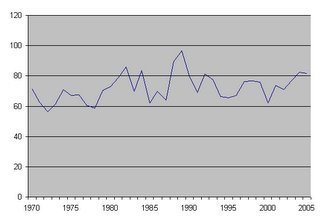 Despite all the problems, somehow the sugarcane industry, post-CARP, is still doing well. That means the new landowners are probably enjoying a higher standard of living than without the program – they receive the profits from the land, rather than just wages. I am getting much of this information from my land markets study, a sub-component of a bigger study assessing the impact of agrarian reform in the Philippines. I can confirm that many of the new landowners do lease out their lands to big sugarcane planters, and end up earning wages from the leased out land. Despite the apparent irony of the situation, it is clear that they are better off than before the program, because they receive lease rental in addition to wage. Furthermore, most who practice this do not in fact lease out all their land, and seldom is this practiced on a permanent basis.
So are the sugarcane workers better off with than without the Program? I wouldn’t know the answer to that – yet. But I do know that a lot of distortions is poisoning the discussion about the future of land reform. The last thing this country needs is policymaking by hyperbole.
In 1988, the Philippines embarked on its last and most extensive program of land reform, the Comprehensive Agrarian Reform Program (CARP). The CARP implements a law imposing a five hectare limit to total agricultural landholdings, with the excess to be distributed - with compensation - to tenants and other qualified beneficiaries. Unlike previous programs, the CARP would cover everything - including the hitherto untouchable haciendas.
The modern feudal lords have battled the redistribution program. Negros Occidental, which has the country's largest potential area for land reform (over 280,000 ha), has the lowest redistribution accomplishment (about 55%). Yet land reform has gone farther than most had expected in the late 1980s, forever transforming the face of the Negros countryside.
Not always for the better. First, land reform prohibits the transfer of land from beneficiaries to other parties (except by inheritance), for ten years after award of the land. In the medium term this has taken land away from enterprises with access to working capital (the haciendas) to enterprises without such access (the beneficiaries' farms). Sugarcane yields have reportedly dropped, as ideal input intensity cannot be achieved in the beneficiaries' farms. Second, the miscellaneous consumption financing offered by traditional sugarcane landlords did serve a useful function - which is completely disabled by land redistribution. Post-feudal forms of finance (i.e. the commercial banking system) has so far failed to deliver adequate financing to the new class of landowners.
But has land reform been a complete catastrophe? Far from it. Sugarcane yields do not seem to have seriously suffered owing to land reform. Check out the following graph, which shows the average yield in tons of cane per ha per year in the Philippines.
 Despite all the problems, somehow the sugarcane industry, post-CARP, is still doing well. That means the new landowners are probably enjoying a higher standard of living than without the program – they receive the profits from the land, rather than just wages. I am getting much of this information from my land markets study, a sub-component of a bigger study assessing the impact of agrarian reform in the Philippines. I can confirm that many of the new landowners do lease out their lands to big sugarcane planters, and end up earning wages from the leased out land. Despite the apparent irony of the situation, it is clear that they are better off than before the program, because they receive lease rental in addition to wage. Furthermore, most who practice this do not in fact lease out all their land, and seldom is this practiced on a permanent basis.
 So are the sugarcane workers better off with than without the Program? I wouldn’t know the answer to that – yet. But I do know that a lot of distortions is poisoning the discussion about the future of land reform. The last thing this country needs is policymaking by hyperbole.
Monday, December 25, 2006
Monday, October 09, 2006
Edmund Phelps: Bank of Sweden Winner for 2006
No honor in economics is more prestigious than the Bank of Sweden Prize, a.k.a. the "Nobel" prize in economics.
Winner for 2006 is Edmund Phelps (one of the rare single winners).
Frankly I just dimly recall Phelps from the "Friedman-Phelps" expectations-augmented Phillips curve. Then after reading the press release, I remember his name associated with the "golden rule" of growth theory. To summarize: he won for examining long-run trade-offs, between inflation and unemployment, and between consumption and investment.
For the inflation-unemployment trade-off he said: no such thing in the long run. Rather unemployment is held at the "natural rate" (later defined by Friedman as the unemployment rate "ground out by Walrasian equilibrium"P.
For the consumption-investment trade-off he said: if you don't believe in intergenerational discounting, you can adopt the "golden rule" in which equalized per capita consumption is maximized forever. Neat. This was a direct inspiration of the "sustainable development" idea of current consumption that does not sacrifice future consumption.
Just one problem: Phelps' prize is way overdue, and therefore dated. He could have won with Friedman, or Lucas, or some other monetarist-RBC type; or like Hayek and Myrdal, share it with Taylor or Modigliani (except he shared it with Miller already) or some other Keynesian-type.
The Committee should have been more forward-looking and rewarded recent work. Bhagwati, Krugman (trade), Fama (finance), Roemer (growth), Williamson, Baumol (industrial orgn.) I guess they tired of that already with the past 3 or 4 years of Bank of Sweden prizes.
Nevertheless my warmest congratulations.
Winner for 2006 is Edmund Phelps (one of the rare single winners).
Frankly I just dimly recall Phelps from the "Friedman-Phelps" expectations-augmented Phillips curve. Then after reading the press release, I remember his name associated with the "golden rule" of growth theory. To summarize: he won for examining long-run trade-offs, between inflation and unemployment, and between consumption and investment.
For the inflation-unemployment trade-off he said: no such thing in the long run. Rather unemployment is held at the "natural rate" (later defined by Friedman as the unemployment rate "ground out by Walrasian equilibrium"P.
For the consumption-investment trade-off he said: if you don't believe in intergenerational discounting, you can adopt the "golden rule" in which equalized per capita consumption is maximized forever. Neat. This was a direct inspiration of the "sustainable development" idea of current consumption that does not sacrifice future consumption.
Just one problem: Phelps' prize is way overdue, and therefore dated. He could have won with Friedman, or Lucas, or some other monetarist-RBC type; or like Hayek and Myrdal, share it with Taylor or Modigliani (except he shared it with Miller already) or some other Keynesian-type.
The Committee should have been more forward-looking and rewarded recent work. Bhagwati, Krugman (trade), Fama (finance), Roemer (growth), Williamson, Baumol (industrial orgn.) I guess they tired of that already with the past 3 or 4 years of Bank of Sweden prizes.
Nevertheless my warmest congratulations.
Thursday, October 05, 2006
Agriculture, development, and the Green Revolution
Johnston and Mellor’s vision of a broad-based yet labor-intensive technological change in Asian agriculture was to materialize in the form of the “Green Revolution”. The ex post impact of the Green Revolution have been evaluated by Evenson and Gollin (2003), in a Science paper. The Green Revolution began with the introduction of varieties of wheat and rice that could respond to greater application of fertilizer and water with much higher yields. Dissemination of improved varieties of rice, wheat, and corn became widespread in the 1960s and 1970s, while varietal improvement programs also began for other crops.
Yield of cereals, roots and tubers, and pulses jumped dramatically. From 1961 to 1980, production of these crops grew by 3.65% per year in developing Asia; only 14% of this can be attributed to area expansion – the rest is due to yield increases. Of the latter, the contribution of the improved variety was 22%, and the remainder is attributed to input intensification.
Food model simulations indicate that in the absence of a Green Revolution, crop yield and production in developing countries would have been much smaller compared to the actual figure for 2000, and agricultural area higher. Conversion of natural habitats to farm area would have had adverse environmental impacts: Lower supplies would have meant more expensive food and decreased calorie intake.
Yield of cereals, roots and tubers, and pulses jumped dramatically. From 1961 to 1980, production of these crops grew by 3.65% per year in developing Asia; only 14% of this can be attributed to area expansion – the rest is due to yield increases. Of the latter, the contribution of the improved variety was 22%, and the remainder is attributed to input intensification.
Food model simulations indicate that in the absence of a Green Revolution, crop yield and production in developing countries would have been much smaller compared to the actual figure for 2000, and agricultural area higher. Conversion of natural habitats to farm area would have had adverse environmental impacts: Lower supplies would have meant more expensive food and decreased calorie intake.
Tuesday, September 26, 2006
Agriculture optimism and pessimism: the perrenial debate
I dusted off a copy of the classic article by Johnston and Mellor in 1961 on The Role of Agriculture and Development (in the American Economic Review). Reading it now I realize how remarkable it was - much of the later insight on agriculture and development were presaged in its pages. The emphasis on broad-based technological change; the possibility of financing industrial investment through agricultural savings; and the compatibility of high labor use with a modernized, high-yielding agriculture (departing from the Western model of highly productive, but also highly mechanized farms).
Just to let you know: there is an ongoing debate in the literature between agriculture optimism (or agriculture fundamentalism) and agriculture pessimism (or agriculture skepticism). The former advocates an agriculture-led strategy of growth; the latter holds that in some (or perhaps many) cases agricultural development can essentially be bypassed in the process of economic development. Johnston and Mellor themselves were not so fundamentalist in their advocacy of agriculture (though later Mellor was to turn hardcore).
Just to let you know: there is an ongoing debate in the literature between agriculture optimism (or agriculture fundamentalism) and agriculture pessimism (or agriculture skepticism). The former advocates an agriculture-led strategy of growth; the latter holds that in some (or perhaps many) cases agricultural development can essentially be bypassed in the process of economic development. Johnston and Mellor themselves were not so fundamentalist in their advocacy of agriculture (though later Mellor was to turn hardcore).
Saturday, September 23, 2006
Updates
As I promised, I got around to updating my home page. I've uploaded some of my new papers, including my latest, coming out in Fish and Fisheries, "Projecting Future Fish Supplies Using Stock Dynamics and Demand." That's where I argue that economists' supply-demand models should be synthesized with biologists' ecological models; I sketch a prototype model with numerical simulations to show just how this might be done. Another recent paper is a "Eating for a Lifetime: A Policy Assessment of Philippine Fisheries."
Check it out and download to your heart's content, as long as it's for personal use.
Check it out and download to your heart's content, as long as it's for personal use.
Thursday, September 21, 2006
The importance of a good analogy
When I was a college student (even in economics!!!) I took it for granted that industrialization is the key to development. Agriculture is backward and plays no role in development, except to give up its workers for manufacturing (and thereby shrink). What a shame if we can't produce our own hammers, screwdrivers, cars, computers, and all that marvellous stuff made in those big macho factories.
Now as a professional economist I find myself arguing otherwise: in most cases, development of agriculture is a prerequisite to industrialization. What changed my mind? A lot of research, thinking, and exposure to data. Lots of data.
And a good analogy. Some analogies have become abused and have led to catastrophic policies. Like the Big Push and the Take-off, or the analogy between national power and economic power.
One good analogy is "flying geese." Succinct and accurate. A better analogy (and perhaps the best): the "ladder" of development. What better way to encapsulate the idea of accumulating physical and human capital and know-how? How else to demonstrate the folly of getting to the top without passing through the rungs in between? So is economic development. You don't get there by making cars and buses and computers at once, and all by your lonesome (without those pesky foreign investors, who are sooooooooo demanding about your roads and bridges and power supply and sticking to your policies and...)
The first step up involves: rice, corn, coconut, chromium, and all that unsexy stuff. But then this allows a country to accumulate wealth and know-how, and climb up. At the end of the ladder: cellphones, MP3 players, medical instruments, even smart missiles, passenger jets, and sattelites. And last, but not the least, the end of poverty. One rung at a time.
Now as a professional economist I find myself arguing otherwise: in most cases, development of agriculture is a prerequisite to industrialization. What changed my mind? A lot of research, thinking, and exposure to data. Lots of data.
And a good analogy. Some analogies have become abused and have led to catastrophic policies. Like the Big Push and the Take-off, or the analogy between national power and economic power.
One good analogy is "flying geese." Succinct and accurate. A better analogy (and perhaps the best): the "ladder" of development. What better way to encapsulate the idea of accumulating physical and human capital and know-how? How else to demonstrate the folly of getting to the top without passing through the rungs in between? So is economic development. You don't get there by making cars and buses and computers at once, and all by your lonesome (without those pesky foreign investors, who are sooooooooo demanding about your roads and bridges and power supply and sticking to your policies and...)
The first step up involves: rice, corn, coconut, chromium, and all that unsexy stuff. But then this allows a country to accumulate wealth and know-how, and climb up. At the end of the ladder: cellphones, MP3 players, medical instruments, even smart missiles, passenger jets, and sattelites. And last, but not the least, the end of poverty. One rung at a time.
Tuesday, September 19, 2006
Less is more
Here is a column by Federico Pascual from the Philippine Star, about fisheries in the Philippines. Since the Star is not known for permalinking, let me reproduce the column below in full (except for those pesky asterisks).
Full disclosure: I have just written a policy paper on fisheries in the Philippines, for the Economic Policy Reform and Advocacy Project of Ateneo de Manila and the USAID. Plenty of what I've written disagrees with the column. (When I have time I'll revamp my personal site and upload that paper.)
First, a few minor points: The writer blames the depletion of fish resources on "lazy Filipino fisherman." So it's possible to overfish while being lazy? That sounds fishy. The truth is a fisherman's life has usually been hard, because they are competing with other fishers to catch the limited fish. Therein lies the abuse of fish stocks, that is by no means unique, either to Filipino fishers, lazy fishers, or diligent fishers. Also: the net method is limited to small tunas. The large tunas - which is the bulk of tuna catch in the country - are caught by handline (fishing reel and rod) or longline (a long fishing line with a series of hooks).
Okay moving on to something more substantive: market-wise, isn't aquaculture obviously a threat to capture fisheries? This seems to have been completely missed by the writer. Farmed fish and wild-caught fish are substitutes. Now if fishers are able to switch to fish farming, then aquaculture would simply be a continuation (or even improvement) of their livelihoods. In practice though the skills for fishing and for fish farming are very different; one is neither a necessary not a sufficient preparation for the other.
Is fish marketing dominated by powerful traders dictating the price? A study by the ADB suggests that, contrary to this knee jerk opinion (the typical newspaper columnist sees monopoly power always and everywhere), fish trading is a competitive market.
Finally we get to the main point of the article, which has been provoked by a recent rationalization plan (which I have read) for the Department of Agriculture (DA). The plan calls for streamlining the DA bureaucracy as a whole (not specific to the fisheries bureau). That is, the principle is getting the DA out of private sector functions and local government functions. Now in the Philippines, fisheries management of inshore waters (0 - 15 km from the shore) has been delegated to local governments. Furthermore agricultural extension - including for aquaculture - has similarly been devolved. The rationalization simply calls for a structure more consistent with these realities. Moreover the DA will be renamed the Department of Agriculture and Fisheries, the more to emphasize the parity between crops/livestock and fish in the various functions of the reorganized Department.
The writer belongs to the all-too-common school of thought, that "more government" is the answer to every problem. Consider this telling quote: "The way to do it is certainly not to shrink BFAR. On the contrary, we should expand it and assign it food and industry targets commensurate to its upgraded status." Man oh man does that make me wince. Unfortunately this perspective misses the fact that government is often part of the problem. One of the best things that could happen to a society is breaking this culture of control.
**********************************************************
Full disclosure: I have just written a policy paper on fisheries in the Philippines, for the Economic Policy Reform and Advocacy Project of Ateneo de Manila and the USAID. Plenty of what I've written disagrees with the column. (When I have time I'll revamp my personal site and upload that paper.)
First, a few minor points: The writer blames the depletion of fish resources on "lazy Filipino fisherman." So it's possible to overfish while being lazy? That sounds fishy. The truth is a fisherman's life has usually been hard, because they are competing with other fishers to catch the limited fish. Therein lies the abuse of fish stocks, that is by no means unique, either to Filipino fishers, lazy fishers, or diligent fishers. Also: the net method is limited to small tunas. The large tunas - which is the bulk of tuna catch in the country - are caught by handline (fishing reel and rod) or longline (a long fishing line with a series of hooks).
Okay moving on to something more substantive: market-wise, isn't aquaculture obviously a threat to capture fisheries? This seems to have been completely missed by the writer. Farmed fish and wild-caught fish are substitutes. Now if fishers are able to switch to fish farming, then aquaculture would simply be a continuation (or even improvement) of their livelihoods. In practice though the skills for fishing and for fish farming are very different; one is neither a necessary not a sufficient preparation for the other.
Is fish marketing dominated by powerful traders dictating the price? A study by the ADB suggests that, contrary to this knee jerk opinion (the typical newspaper columnist sees monopoly power always and everywhere), fish trading is a competitive market.
Finally we get to the main point of the article, which has been provoked by a recent rationalization plan (which I have read) for the Department of Agriculture (DA). The plan calls for streamlining the DA bureaucracy as a whole (not specific to the fisheries bureau). That is, the principle is getting the DA out of private sector functions and local government functions. Now in the Philippines, fisheries management of inshore waters (0 - 15 km from the shore) has been delegated to local governments. Furthermore agricultural extension - including for aquaculture - has similarly been devolved. The rationalization simply calls for a structure more consistent with these realities. Moreover the DA will be renamed the Department of Agriculture and Fisheries, the more to emphasize the parity between crops/livestock and fish in the various functions of the reorganized Department.
The writer belongs to the all-too-common school of thought, that "more government" is the answer to every problem. Consider this telling quote: "The way to do it is certainly not to shrink BFAR. On the contrary, we should expand it and assign it food and industry targets commensurate to its upgraded status." Man oh man does that make me wince. Unfortunately this perspective misses the fact that government is often part of the problem. One of the best things that could happen to a society is breaking this culture of control.
**********************************************************
Upgrade fisheries bureau to dep't, not downgrade it
BIG JOB AHEAD: Instead of downgrading the Bureau of Fisheries and Aquatic Resources (BFAR) as planned by supposed experts at the agriculture department, the administration should upgrade it into a full-fledged department.
Humanity having despoiled the land, the future of the world’s food supply is the sea. There lie in our waters untapped resources that far exceed the food (among other) requirements of the growing population.
Surrounded by one of the world’s richest marine food banks, and with a rice-and-fish-eating population facing a coastline twice as long as that of the United States, we cannot overemphasize the need to conserve and develop our fisheries and aquatic resources.
The way to do it is certainly not to shrink BFAR. On the contrary, we should expand it and assign it food and industry targets commensurate to its upgraded status.
The Arroyo administration may want to have the distinction of having originated a two-pronged approach to the stubborn food problem -- agriculture (land-based) and aquaculture (water-based).
AQUA VERSION: In agriculture -- as in farming -- we prepare the soil, plant, tend to the crops, wait, then harvest. That takes time, and time is not always an element that we can compress.
Out there in the open sea (at least in those areas still teeming with fish), our fishermen simply go out, throw their nets and pull in the fish. No planting, no waiting.
The simplicity of the operation is probably one of the reasons why many lazy Filipino fishermen had taken the sea for granted and abused it. Now the children of these misguided fishers have to sail out farther to catch anything.
Aquaculture is akin to agriculture in at least one sense: We also prepare a fish farm or aquatic site, choose the seedlings, plant, wait and harvest the fish (or such crustaceans as crabs and shrimps or some shellfish) after caring for them over a certain period.
The fish (used here as a generic term to include crabs, shrimps, shellfish and the like) are taken care of or cultured in man-made cages, pens or ponds or some other controlled enclosure.
The fish farmer operates in a controlled environment that more or less ensures predictable results -- provided no extraneous elements such as pest, poisoning, or such weather disturbances as typhoons wreck the plans.
RIVERS OF TUNA: The case of tuna fishermen is one good argument for giving our fisheries industry the attention and assistance it deserves.
Countless tuna swim together like a giant current, like a surging river, in known paths or patterns in the open sea. Their number is so great it defies counting.
It so happens that that great river of tuna passes right through our territorial waters! Allah is good, indeed!
Our fishermen know where these rivers of tuna pass in an endless current. If properly-equipped, all that our fishermen have to do is go to the site, throw their nets across the passing tuna and haul in as much as their boats can carry.
These fishermen do not have to plant and wait -- like farmers -- before they can harvest to their satisfaction.
But this Pinoy operation is almost primitive from the point of view of modern-day deep-sea fishing. For one, while our fishermen know the sea intimately, they are handicapped by their lack of adequate vessels, gear and marketing network.
A full-time fully-empowered aquaculture department can do wonders in making our fishermen fishers for the region and beyond.
PUEDE NA?: Inland, where we have lakes, rivers and impoundments, we have scattered family-owned farms that raise hito, tilapia, crabs, shrimps and other common species sold in wet markets and served in restaurants.
On their own, they may be “puede na” with their small-scale operation, but there is a dearth of research and development and state assistance that could enable them to improve techniques, increase yield and boost their income.
These small operators do not get the assistance and protection they deserve as contributors to the national food supply. This is just talking from an inward perspective, not yet dreaming of having these producers grow into exporters.
They cannot go into research as there is no time or money for that. Many of them just ask around, attend seminars and generally play it by ear. There should be a better organized government effort to reach out to them so they could become more productive.
LAKE PENS : In Laguna de Bay, the biggest lake in the country and the closest to the national capital, a confusion of fishpens and corrals is choking it.
Small fishermen whose families have depended for generations on the lake for their livelihood have found themselves shunted away from their traditional grounds.
Efforts to remove illegal and improperly built or located fishpens have failed, because some operators are too powerful to be touched.
I do not know if this is still true, but there was a time when even presidential guards were being used by some people close to Malacanang to guard their fishpens.
Environment and Natural Resources Secretary Angelo Reyes said days ago he was serious about restoring sanity to the lake, meaning he would remove pens that should not be there. But until we see results, we should treat that as just one of those plans.
LESSONS LEARNED: As in agriculture where most farmers do not have the means to take their produce to the market, small fish farm operators have to depend on middlemen to buy their catch at prices that the merchants dictate.
This is not to say that the government should usurp the role of private middlemen, but there should be some way to enable small operators to develop a marketing network of their own.
A full-blown aquaculture department will be in a better position to devise ways to give small operators access to easy credit, better seedlings (fry), better techniques. A department can help them work out a more efficient marketing scheme.
A new aquaculture department can learn many parallel lessons from the agriculture department under which it now functions.
VILLAFUERTE OBJECTS: In Congress, Camarines Sur Rep. Luis Villafuerte, chairman of the House committee on fisheries and aquaculture, has rejected the plan to downgrade the BFAR, calling the idea “ill-considered and foolish.”
“Our sense is that diminishing BFAR would be highly counterproductive,” the Bicol congressman said. “We may in fact have to eventually upgrade the agency and establish a new, full-grown department dedicated entirely to developing fisheries.”
He added: “Being an archipelago, fishing and allied industries are of strategic importance to the national economy. By our geographical nature, thousands of coastal communities also subsist daily on our marine resources.”
“In fact, in terms of value, fisheries now account for almost 25 percent of our total agricultural output. And going forward, we are counting on the sector to further enlarge its share (of gross agricultural yield).”
Data from the Bureau of Agricultural Statistics indicate that the country’s fisheries production grew rapidly from just 2.6 million metric tons in 1998 to over four million MT in 2005.
BFAR UNITS: Villafuerte pointed out that less and less land is becoming available for farming. “Thus, we really have no choice but to increasingly rely on fisheries and aquatic resources to produce adequate food supply, fight hunger and ease poverty.”
The agriculture department earlier disclosed a plan to lower BFAR from a line to a mere staff bureau, and to transfer its regulatory services to a new, smaller office. Its field offices, now self-operating, would be put directly under DA regional directors.
The Fisheries Code, also known as RA 8850, upgraded BFAR from a staff to a line bureau in 1998.
At present, BFAR also oversees the Fisheries Technology Center, National Freshwater Fisheries Technology Center, National Inland Fisheries Technology Center, National Marine Fisheries Development Center, National Integrated Fisheries Technology and Development Center, National Seaweed Technology and Development Center, Fisheries Biological Center and the Mindanao Freshwater Technology Center.
Wednesday, September 13, 2006
Collapse - of economic logic
There's another collapse going on - in economic policymaking of the Philippine government. Under the watch of a Ph.D. economist, no less.
For decades the Philippines had pursued a regime of "financial repression" involving interest rate ceilings, mandatory lending for private banks, and direct lending by government. In the mid-1980s this regime went on a phase-out. One of the last nails on the coffin was Executive Order 138, which prohibited direct lending by government agencies. The main credit intervention of the government (aside from Central Bank regulation) is now relegated to government financial institutions, such as the Land Bank and the Development Bank of the Philippines.
The advantage of such institutions is that they are specialized financial intermediation companies, whose objective is the bottom line - maximizing net present value. Of course that objective is undermined by the "soft budget constraint" i.e. they have the implicit fallback on government subsidy; moreover they receive preferential treatment (for example, the Land Bank is the official government fund depository). This arrangement though remains vastly superior to having the Department of Agriculture dishing out loans to farmers. For the latter, there is essentially no mechanism for accountability should financial disaster happen. And it has happened, as this columnn discusses.
Now the President has repealed the prohibition, opening the floodgates to direct lending by government agencies. Where is the logic, nay the sanity of this?
For decades the Philippines had pursued a regime of "financial repression" involving interest rate ceilings, mandatory lending for private banks, and direct lending by government. In the mid-1980s this regime went on a phase-out. One of the last nails on the coffin was Executive Order 138, which prohibited direct lending by government agencies. The main credit intervention of the government (aside from Central Bank regulation) is now relegated to government financial institutions, such as the Land Bank and the Development Bank of the Philippines.
The advantage of such institutions is that they are specialized financial intermediation companies, whose objective is the bottom line - maximizing net present value. Of course that objective is undermined by the "soft budget constraint" i.e. they have the implicit fallback on government subsidy; moreover they receive preferential treatment (for example, the Land Bank is the official government fund depository). This arrangement though remains vastly superior to having the Department of Agriculture dishing out loans to farmers. For the latter, there is essentially no mechanism for accountability should financial disaster happen. And it has happened, as this columnn discusses.
Now the President has repealed the prohibition, opening the floodgates to direct lending by government agencies. Where is the logic, nay the sanity of this?
Friday, September 08, 2006
The bang versus the whimper
There are two ways to die. One is by the gradual deterioration of bodily function in terminal illness or senescence. The other is by suffering a trauma that causes a sudden collapse in bodily functions. The neomalthusian notion of an ecological collapse of modern civilization follows the latter analogy.
The collapse is deemed to be self-induced, hence the related notion of "overshoot": a society is able to exhaust its resource base at high levels of activity and consumption; then exhaustion is reached, leading to a sudden drop in consumption and population size. The standard reference for this phenomenon is still the 1970s work The Limits to Growth , which has recently been updated.
Economic theory isn't very welcoming of the concept of overshoot-collapse. Rather, the price system would ration out a disappearing (exhaustible) resource. As it gets scarcer, it gets harder to extract, so the cost and price go up, making people skimp on it more. More than that: if conditions of scarcity become certain, such that future prices are sure to increase, owners of long-term rights to the resource would (as rational decisionmakers) hold off on extracting a lot today in anticipation of better prices next year (or decade or...)
Think of oil. It is said that the Saudi's are just extracting the oil as fast as they can, to create the illusion of big reserves. Nonsense. If peak oil has been reached then oil prices are on a long term upward trend. The owners would therefore keep their oil extraction in check. (If you held reserves to a trillion barrels of oil, wouldn't you?)
Now two things can happen: either technological change succeeds (under the whip of high resource prices) in finding abundant substitutes; or it fails, and society lives with escalating prices, converging to what would in practice mean zero extraction of the resource. (Think of petrol at US$ 1,000 per liter.) The latter scenario is the whimper version of society's demise - a long slow adjustment back to near pre-industrial levels of production, consumption, and population. (Hey, nearly two billion people in the planet are already at this standard of living!) Interestingly, the whimper version gives a lot of time for society to undertake the social and technological innovations to deal with tightening resource scarcity. The bang version obviously doesn't.
So how will our civilization end?
Between the conception
And the creation
Between the emotion
And the response
Falls the Shadow
Life is very long
Between the desire
And the spasm
Between the potency
And the existence
Between the essence
And the descent
Falls the Shadow
For Thine is the Kingdom
The collapse is deemed to be self-induced, hence the related notion of "overshoot": a society is able to exhaust its resource base at high levels of activity and consumption; then exhaustion is reached, leading to a sudden drop in consumption and population size. The standard reference for this phenomenon is still the 1970s work The Limits to Growth , which has recently been updated.
Economic theory isn't very welcoming of the concept of overshoot-collapse. Rather, the price system would ration out a disappearing (exhaustible) resource. As it gets scarcer, it gets harder to extract, so the cost and price go up, making people skimp on it more. More than that: if conditions of scarcity become certain, such that future prices are sure to increase, owners of long-term rights to the resource would (as rational decisionmakers) hold off on extracting a lot today in anticipation of better prices next year (or decade or...)
Think of oil. It is said that the Saudi's are just extracting the oil as fast as they can, to create the illusion of big reserves. Nonsense. If peak oil has been reached then oil prices are on a long term upward trend. The owners would therefore keep their oil extraction in check. (If you held reserves to a trillion barrels of oil, wouldn't you?)
Now two things can happen: either technological change succeeds (under the whip of high resource prices) in finding abundant substitutes; or it fails, and society lives with escalating prices, converging to what would in practice mean zero extraction of the resource. (Think of petrol at US$ 1,000 per liter.) The latter scenario is the whimper version of society's demise - a long slow adjustment back to near pre-industrial levels of production, consumption, and population. (Hey, nearly two billion people in the planet are already at this standard of living!) Interestingly, the whimper version gives a lot of time for society to undertake the social and technological innovations to deal with tightening resource scarcity. The bang version obviously doesn't.
So how will our civilization end?
Between the conception
And the creation
Between the emotion
And the response
Falls the Shadow
Life is very long
Between the desire
And the spasm
Between the potency
And the existence
Between the essence
And the descent
Falls the Shadow
For Thine is the Kingdom
Subscribe to:
Posts (Atom)