Economists have been dreaming it for years: land reform by Progressive Agricultural Land Tax. The current land reform scheme in the Philippines (whose funding is running out in mid-2008) requires the State to acquire farm land from landowners until their properties are no larger than 5 ha, the legal retention limit. Acquisition requires "just compensation". Experience over the last 20 years of implementation has shown the colossal problems with this scheme. First, land ownership needs to be properly documented to determine whose guilty of breaking the law (on excess landholdings) and ensure legal transfer of property. Second, value of land needs to be set, opening a litigation abyss.
The beauty of the PALT is that it entails the same documentary requirement (done anyway under the second scheme) but avoiding the second set of problems associated with land valuation. Farm lands above the 5 ha retention limit are subject to an additional tax, which can be graduated by size class (say, 5.0 - 24.0, 24.0 - 50.0, above 50.0). The objection by Skinner (1991) that the PALT is administratively impractical is moot.
The tax rate can be made sufficiently punitive as to induce land fragmentation (say, 5, 10, and 20 times the regular real property tax assessment). The PALT is effectively a fine imposed on landowners who violate the law (RA 6657) on maximum farm land holdings.
Administration is simple: one need only to enact a national PALT, which is assessed on top of the local government real property taxes. Collection of the PALT can be done by a separate national government Bureau reporting to the Department of Finance. (Staffing can be done initially with personnel from the Department of Agrarian Reform.) Land sales can be facilitated by the Land Bank of the Philippines, who stands ready to acquire lands (at manageable prices) using money from the Agrarian Reform Fund (which is the current set-up). The land can then be resold to deserving farmers or landless farm workers (who amortize their lands under the usual discipline of formal mortgage contracts).
The PALT can even do away with some documentary requirements. It will not require remediation of land titles where these are defective - it can use the same documentation as the real property tax. Of course safeguards would need to be introduced: the PALT Bureau can institute its independent documentation of landholdings (in cases where local assessors are incompetent, ignorant, or corrupt); it can introduce a tax on idle lands and conversion from agriculture to nonagriculture (to prevent landowners from evading the tax); revenues can be shared between local and national government (the latter earmarked for infrastructure spending to benefit Agrarian Reform Communities); and so on.
What have I gotten wrong? Let me know. Otherwise Congress should pay heed as the debate on extension of the agrarian reform heats up.
Showing posts with label Agrarian reform. Show all posts
Showing posts with label Agrarian reform. Show all posts
Monday, January 28, 2008


Wednesday, May 02, 2007
The new institutional economics (2)
As discussed earlier, early development economics tended to ascribe irrational and inefficient behaviors to the traditional agrarian economy as a reason for its underdevelopment. But analysis by economicsts such as Ted Schultz and Steve Chung began a quest for elaborating the hidden rationality underlying traditional agrarian structures and behavior. For example, the new theory of share tenancy notes that when insurance markets are imperfect or missing altogether, the tenancy contract acts as a partial insurance device. Under sharecropping, any loss is shared by both owner and tenant.
In general, according to Otsuka and associates, there is no evidence that share tenancy keeps employment of labor or other resources less productive than warranted. Agrarian contracts are found to adapt to real world enforcement problems; hence, share tenancy is more frequently observed in cases where monitoring is less costly, i.e. in closely-knit communities and families.
The need to provide work incentives and closely monitor labor to prevent shirking reveals an important advantage of the family farm as a production unit. Because of this, it is now commonly argued that economies of scale in agriculture are largely non-existent. However we do observe considerable land consolidation; such patterns may be due to market failure. Under imperfect credit markets, tenants face constraints in raising working capital from commercial sources. Banks may be more willing to lend to affluent landowners – who have collateral and a credit history – rather than to cultivators with no assets and no credit history in the formal sector. From a dynamic viewpoint, land serves as a store of wealth to smooth expenditures during income or consumption shocks. Because of these failures, the price of land remains artificially high . Furthermore land transfers are frequently motivated by “distress sales” rather than reallocation of land to more productive uses, leading to cumulative asset inequality.
To some extent, land rental markets offer an important means for improving asset inequality, as landless workers are able to climb the “agricultural ladder” of share tenancy, leasehold, and ultimately ownership.
From this perspective, land reform may have both positive and negative impacts. Conferment of ownership to cultivators may accelerate capital accumulation among the poor towards a more egalitarian and efficient distribution of assets. However redistributive land reform may incur high administrative cost; moreover, incentives to invest may be crippled during the interim period during ownership rights is yet to be transferred. Finally, controls on the rental market, including proscription of share tenancy, may deprive cultivators an important means to for sharing risk as well as foreclosing opportunities to the landless to climb the “agricultural ladder”.
Monday, February 05, 2007
Land reform: the new institutional economics
Neoclassical economics has the advantage of strong theoretical foundations, in terms of individual constrained maximization and market equilibrium. However it suffers from a narrow representation of economic institutions. On the other hand, institutional economics addresses a wide variety of agrarian structures, but without deeper theoretical underpinnings. The new institutional economics or NIE seeks to ground the analysis of a wide variety of economic institutions on neoclassical foundations. This is done by broadening the types of constraints and costs, and relaxing competitive market assumptions. Key considerations in NIE are transaction costs, risk, imperfect contract enforcement, and asymmetric information.
Oliver Williamson distinguishes between first-order, second-order, and third-order economizing. First – order economizing covers the institutional environment that determines the “rules of the game”, in the areas of property rights, polity, judiciary, and bureaucracy. Second – order economizing involves governance structures and contract design. Third – order economizing is straightforward resource allocation subject to marginalist efficiency conditions, which is the traditional subject matter of neoclassical economics. Hence, while neoclassical theory specializes in third-order economizing, NIE specializes in the first two.
(To be continued)
Tuesday, January 30, 2007
Land reform - institutional economics
Neoclassical theory may be seen as a highly idealized representation of markets. A more realistic perspective, inspired by institutional economics, departs radically from this idealization. Institutional economists treat markets as one of numerous social constructs or institutions within a historical process. “Private property”, which is taken as a given in neoclassical theory, is merely one of possible configurations of property rights observed throughout history.
The task of applying institutional economics to developing country agriculture was taken up by early development economics. One important dichotomy in this literature is between traditional and modern institutions and cultural values. The classic paper of Johnston and Mellor (1961) describes possible impediments to agricultural modernization in terms of the traditional group constraints, attitudes towards change; perceptions of personal gain from the adoption of modern technologies, availability of market exchange outlets, and so on. Tenurial reform is identified as “the most essential requirement” to modernization, as traditional tenancy is the main obstacle to the formation of market – based agriculture.
Traditional tenancy is characterized by patron – client relationships and sharecropping, which are seen as institutional impediments to commercialization. Under the patronage system, the landowner offers an output share to the tenant in exchange for cultivation rights. The landowner also provides consumption loans, with effectively a transfer during times of emergency; this effectively guarantees a minimum subsistence to the tenant. The patronage system meanwhile obligates tenants in various ways, such as in rendering miscellaneous services as well as political support. These institutions characterized the manorial or feudal system in medieval Europe as well as agriculture in Southeast Asia.
The persistence of traditional structures is a serious obstacle when more commercialized transactions are superior ways to organize production. For instance, under share tenancy labor is paid below its marginal product, hence we expect a below optimum level of effort – the “Marshall critique”. A move towards either a straight wage contract or a fixed lease contract would pay factors their marginal product and improve allocative efficiency.
Between these two - neoclassical economics and institutional economics - who has a better approximation of reality? Or is it something in between?
Monday, January 22, 2007
Impact of land reform: neoclassical perspective
To understand the impact of land reform, you have to view it from a theoretical perspective. The neoclassical perspective is one most familiar to economists. The neoclassical school treats land like any factor of production. The entrepreneur – an individual decision-maker - combines land, labor, capital, and material inputs, to produce output. The services of the factors of production must be purchased from other individuals who possess private property rights over the factors (unless the entrepreneur herself is the owner). The entrepreneur receives the proceeds from the sale of the output. The difference between revenue and cost (payments for all factors of production) is profit. The relationship between factors and outputs is represented by a production function, which expresses a particular state of technology. Entrepreneurial decisions are motivated by maximization of profit.
Markets are assumed to be perfectly competitive. Now suppose we define an "efficienct" allocation as follows: an allocation is efficient if any reallocation would inflict at least as much harm to losers as benefit to gainers. Neoclassical theory concludes that the way the market allocates resources, such as land, is efficient.
This all sounds very abstract. What are some practical predictions of the theory?
1. A government-administered reallocation of land from landowners to cultivators would likely reduce agricultural output.
2. Rent ceilings and transfer restrictions on agricultural land will reduce investments in land improvement, and encourage conversion to non-agricultural land.
The first opposes the claim that land reform would lead to a more efficient allocation of land. The second hypothesizes that agricultural land productivity and supply of agricultural land would decline under land reform.
Obviously the blokes who thought about land reform were not reasoning from a neoclassical perspective. What was the theoretical underpinning of land reform? Next week.
Monday, January 01, 2007
The transformation of Negros
Last month I visited Negros island, in West-Central Philippines, the country's "sugar bowl". The west part especially (Negros Occidental) is covered with vast sugarcane areas, previously organized into haciendas, large estates under one landowner. Here enormously rich hacenderos accumulated enormous wealth, while poor resident workers lived on their vast estates. These workers grew to depend on the hacendero for their daily needs, depending on the vale (cash advance) for medical emergencies and other consumption needs. Sometimes the workers formed communities (complete with church and school) right on the hacienda. Meanwhile the hacendero class grew to wield great political power, entrenched itself at the forefront of the traditional elite of the country. It was a textbook example of modern-day feudalism, alive and kicking in the developing world.
In 1988, the Philippines embarked on its last and most extensive program of land reform, the Comprehensive Agrarian Reform Program (CARP). The CARP implements a law imposing a five hectare limit to total agricultural landholdings, with the excess to be distributed - with compensation - to tenants and other qualified beneficiaries. Unlike previous programs, the CARP would cover everything - including the hitherto untouchable haciendas.
The modern feudal lords have battled the redistribution program. Negros Occidental, which has the country's largest potential area for land reform (over 280,000 ha), has the lowest redistribution accomplishment (about 55%). Yet land reform has gone farther than most had expected in the late 1980s, forever transforming the face of the Negros countryside.
Not always for the better. First, land reform prohibits the transfer of land from beneficiaries to other parties (except by inheritance), for ten years after award of the land. In the medium term this has taken land away from enterprises with access to working capital (the haciendas) to enterprises without such access (the beneficiaries' farms). Sugarcane yields have reportedly dropped, as ideal input intensity cannot be achieved in the beneficiaries' farms. Second, the miscellaneous consumption financing offered by traditional sugarcane landlords did serve a useful function - which is completely disabled by land redistribution. Post-feudal forms of finance (i.e. the commercial banking system) has so far failed to deliver adequate financing to the new class of landowners.
But has land reform been a complete catastrophe? Far from it. Sugarcane yields do not seem to have seriously suffered owing to land reform. Check out the following graph, which shows the average yield in tons of cane per ha per year in the Philippines.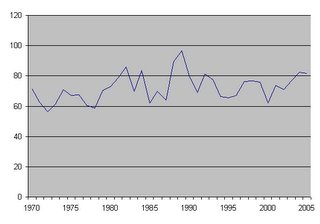 Despite all the problems, somehow the sugarcane industry, post-CARP, is still doing well. That means the new landowners are probably enjoying a higher standard of living than without the program – they receive the profits from the land, rather than just wages. I am getting much of this information from my land markets study, a sub-component of a bigger study assessing the impact of agrarian reform in the Philippines. I can confirm that many of the new landowners do lease out their lands to big sugarcane planters, and end up earning wages from the leased out land. Despite the apparent irony of the situation, it is clear that they are better off than before the program, because they receive lease rental in addition to wage. Furthermore, most who practice this do not in fact lease out all their land, and seldom is this practiced on a permanent basis.
So are the sugarcane workers better off with than without the Program? I wouldn’t know the answer to that – yet. But I do know that a lot of distortions is poisoning the discussion about the future of land reform. The last thing this country needs is policymaking by hyperbole.
In 1988, the Philippines embarked on its last and most extensive program of land reform, the Comprehensive Agrarian Reform Program (CARP). The CARP implements a law imposing a five hectare limit to total agricultural landholdings, with the excess to be distributed - with compensation - to tenants and other qualified beneficiaries. Unlike previous programs, the CARP would cover everything - including the hitherto untouchable haciendas.
The modern feudal lords have battled the redistribution program. Negros Occidental, which has the country's largest potential area for land reform (over 280,000 ha), has the lowest redistribution accomplishment (about 55%). Yet land reform has gone farther than most had expected in the late 1980s, forever transforming the face of the Negros countryside.
Not always for the better. First, land reform prohibits the transfer of land from beneficiaries to other parties (except by inheritance), for ten years after award of the land. In the medium term this has taken land away from enterprises with access to working capital (the haciendas) to enterprises without such access (the beneficiaries' farms). Sugarcane yields have reportedly dropped, as ideal input intensity cannot be achieved in the beneficiaries' farms. Second, the miscellaneous consumption financing offered by traditional sugarcane landlords did serve a useful function - which is completely disabled by land redistribution. Post-feudal forms of finance (i.e. the commercial banking system) has so far failed to deliver adequate financing to the new class of landowners.
But has land reform been a complete catastrophe? Far from it. Sugarcane yields do not seem to have seriously suffered owing to land reform. Check out the following graph, which shows the average yield in tons of cane per ha per year in the Philippines.
 Despite all the problems, somehow the sugarcane industry, post-CARP, is still doing well. That means the new landowners are probably enjoying a higher standard of living than without the program – they receive the profits from the land, rather than just wages. I am getting much of this information from my land markets study, a sub-component of a bigger study assessing the impact of agrarian reform in the Philippines. I can confirm that many of the new landowners do lease out their lands to big sugarcane planters, and end up earning wages from the leased out land. Despite the apparent irony of the situation, it is clear that they are better off than before the program, because they receive lease rental in addition to wage. Furthermore, most who practice this do not in fact lease out all their land, and seldom is this practiced on a permanent basis.
So are the sugarcane workers better off with than without the Program? I wouldn’t know the answer to that – yet. But I do know that a lot of distortions is poisoning the discussion about the future of land reform. The last thing this country needs is policymaking by hyperbole.
Subscribe to:
Posts (Atom)