Last month I visited Negros island, in West-Central Philippines, the country's "sugar bowl". The west part especially (Negros Occidental) is covered with vast sugarcane areas, previously organized into
haciendas, large estates under one landowner. Here enormously rich
hacenderos accumulated enormous wealth, while poor resident workers lived on their vast estates. These workers grew to depend on the
hacendero for their daily needs, depending on the vale (cash advance) for medical emergencies and other consumption needs. Sometimes the workers formed communities (complete with church and school) right on the hacienda. Meanwhile the
hacendero class grew to wield great political power, entrenched itself at the forefront of the traditional elite of the country. It was a textbook example of modern-day feudalism, alive and kicking in the developing world.
In 1988, the Philippines embarked on its last and most extensive program of land reform, the Comprehensive Agrarian Reform Program (CARP). The CARP implements a law imposing a five hectare limit to total agricultural landholdings, with the excess to be distributed - with compensation - to tenants and other qualified beneficiaries. Unlike previous programs, the CARP would cover everything - including the hitherto untouchable
haciendas.
The modern feudal lords have battled the redistribution program. Negros Occidental, which has the country's largest potential area for land reform (over 280,000 ha), has the lowest redistribution accomplishment (about 55%). Yet land reform has gone farther than most had expected in the late 1980s, forever transforming the face of the Negros countryside.
Not always for the better. First, land reform prohibits the transfer of land from beneficiaries to other parties (except by inheritance), for ten years after award of the land. In the medium term this has taken land away from enterprises with access to working capital (the
haciendas) to enterprises without such access (the beneficiaries' farms). Sugarcane yields have reportedly dropped, as ideal input intensity cannot be achieved in the beneficiaries' farms. Second, the miscellaneous consumption financing offered by traditional sugarcane landlords did serve a useful function - which is completely disabled by land redistribution. Post-feudal forms of finance (i.e. the commercial banking system) has so far failed to deliver adequate financing to the new class of landowners.
But has land reform been a complete catastrophe? Far from it. Sugarcane yields do not seem to have seriously suffered owing to land reform. Check out the following graph, which shows the average yield in tons of cane per ha per year in the Philippines.
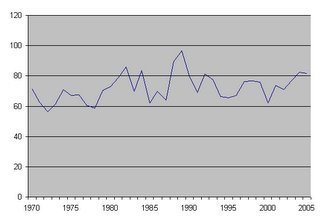
Despite all the problems, somehow the sugarcane industry, post-CARP, is still doing well. That means the new landowners are probably enjoying a higher standard of living than without the program – they receive the profits from the land, rather than just wages. I am getting much of this information from my land markets study, a sub-component of a bigger study assessing the impact of agrarian reform in the Philippines. I can confirm that many of the new landowners do lease out their lands to big sugarcane planters, and end up earning wages from the leased out land. Despite the apparent irony of the situation, it is clear that they are better off than before the program, because they receive lease rental in addition to wage. Furthermore, most who practice this do not in fact lease out all their land, and seldom is this practiced on a permanent basis.
So are the sugarcane workers better off with than without the Program? I wouldn’t know the answer to that – yet. But I do know that a lot of distortions is poisoning the discussion about the future of land reform. The last thing this country needs is policymaking by hyperbole.


