I don't read the Daily Tribune. It's a yawning abyss of poison news and views. However it's being published in a country which constitutionally protects freedom of speech. So short of direct incitement to violence, this poison is untouchable. If you hate it, just don't buy it.
In this earlier post I linked to Proclamation 1017 and the Philippine Constitution. The latter clearly vests the right for the government to take over a private business during a period of emergency - precisely the principle invoked in the Proclamation.
What the framers (and the people who voted for it) didn't anticipate is that this power could be used to contravene the free speech provision. And it has been so used, in the case of the Tribune. So now the case is under petition with the Supreme Court.
Thanks to President GMA, the latent contradiction is now exposed.
However legal it may be, suppressing the Tribune was a mistake. In cases of conflicting provisions, the government should have erred on the side of civil liberties. In any case it possesess the vast powers of the police - and the military - to suppress armed revolt. Applying it to the dissemination of ideas and opinions is wrong; it also sends the wrong signal about the fragility of democratic and private property institutions.
After all, it is not only military adventurists and insurgents (whether communist or secessionist) which threaten these institutions; the threat can also come from within.
The Constitutional provision authorizing takeover of private business during periods of emergency is problematic and prone to abuse. It should be stricken off. Let some future legislation - which is easier to discuss, debate, and change - take care of potential emergencies.
What should be non-negotiable is the fact that the Strong Republic must be a Republic of free speech.
Keep the marketplace for ideas free and competitive.
Tuesday, February 28, 2006


Monday, February 27, 2006
Experimental economics is going commercial
A mainstay empirical method in economics is "econometrics", which has been called a "nonexperimental" method of investigating causal relations. The usual argument is that the economic system is not subject to experimentation; nonexperimental data will have to be subject to different methods of analysis. (The contrast of course is with the natural sciences, where experimentation is standard.)
Increasingly though economics adopting experimental techniques. The latest Scientific American reports on the work of Kay-Yut Chen at Hewlett-Packard. The difference is that direct commercial applications are being explored:
Chen thinks he has solved the sandbagging problem: have each salesperson choose a personal balance of fixed and variable compensation. For example, the salesperson can choose a high commission percentage with no fixed salary or, at the other extreme, a modest fixed salary and no commission--or some combination in between. Each choice implicitly reveals how much the salesperson plans to sell, much as an insurance subscriber's choice of deductible and premium reveals how sick she is. Based on a truth-telling mechanism from game theory, this design works on paper. But as an experimental economist, Chen will keep testing it empirically, comparing the emerging design with other available models, such as the one he is testing today.
Chen has successfully used that approach to help HP managers design good contracts with retailers and resellers, and he is starting to tackle other thorny problems for his employer: figuring out how to protect HP's bottom line against international currency fluctuations and discovering ways for brick-and-mortar retailers and HP's online store to coexist happily.
Econometrics is nowhere near being supplanted by experimental economics, even in the long run. But I'd be glad to see experimentation becoming a fairly common research method in the field in the medium term.
Increasingly though economics adopting experimental techniques. The latest Scientific American reports on the work of Kay-Yut Chen at Hewlett-Packard. The difference is that direct commercial applications are being explored:
Chen thinks he has solved the sandbagging problem: have each salesperson choose a personal balance of fixed and variable compensation. For example, the salesperson can choose a high commission percentage with no fixed salary or, at the other extreme, a modest fixed salary and no commission--or some combination in between. Each choice implicitly reveals how much the salesperson plans to sell, much as an insurance subscriber's choice of deductible and premium reveals how sick she is. Based on a truth-telling mechanism from game theory, this design works on paper. But as an experimental economist, Chen will keep testing it empirically, comparing the emerging design with other available models, such as the one he is testing today.
Chen has successfully used that approach to help HP managers design good contracts with retailers and resellers, and he is starting to tackle other thorny problems for his employer: figuring out how to protect HP's bottom line against international currency fluctuations and discovering ways for brick-and-mortar retailers and HP's online store to coexist happily.
Econometrics is nowhere near being supplanted by experimental economics, even in the long run. But I'd be glad to see experimentation becoming a fairly common research method in the field in the medium term.
Saturday, February 25, 2006
Solita Monsod gives the other side on the Middle Forces
Economist Winnie Monsod has written a column that is an exact representation of my own analysis and sentiments on the current Philippine turmoil.
Freedom of assembly is indeed a sacred right. However it is the citizenry's responsibility not to abuse that right. I'm not saying that the government ought to enforce that responsibility on them. But one error does not offset another. It's like the Danish newspapers' decision to publish those cartoons - a very bad choice, even if it was one one they had a right to make.
Here, where the atmosphere is heavy with military adventurism and sedition at a hat-drop, a responsible (albeit free) citizenry should think twice about feeding the fire.
Failure of poverty reduction is directly traceable to failure of institutions crucial for a stable and thriving business climate. Institution-builders look ahead. Removal of the President is neither a necessary nor sufficient condition for institution-building. We are now reaping the harvest sown in Edsa 2. Shall we now sow an Edsa 4, some bizarre hybrid of Edsa 2 and 3? God help us.
Calling for Arroyo's "voluntary" resignation is not a membership requirement for the Middle Forces, is it?
----------------------------------------------------------
Get Real : Keeping the flame of Edsa alive
First posted 01:14am (Mla time) Feb 25, 2006
By Solita Collas-Monsod
Inquirer
Editor's Note: Published on Page A10 of the February 25, 2006 issue of the Philippine Daily Inquirer
COUNT ME OUT of the protest actions at the Edsa Shrine and Makati City disguised as a peaceful celebration of the 20th anniversary of the Edsa People Power Revolt. It is not because I don't want to celebrate it -- that event showed not only us, but an admiring world, the best of the Filipino spirit, and is therefore worthy of recall. But I refuse to celebrate it with people who are cynically using the occasion to further their own political or personal agendas by invoking "the greater good." Truly the last refuge of scoundrels.
By doing so, they are destroying all that the Edsa revolt stands for: the spirit of self-sacrifice for the motherland, with no thought of personal benefit. And what is more, they are encouraging military adventurism that may end up at first with a military/civilian junta, but will, if world experience is any indication, surely metamorphose into a military dictatorship, a la Myanmar with its 44-year-old military rule. That will truly be the height of irony:
They want to change Gloria Macapagal-Arroyo (with assertions of her "illegitimacy" that so far has not been substantiated), and will end up with a regime that they may not be able to change at all. Sow the wind, reap the whirlwind.
Those who are calling loudest for Ms Arroyo to make the "supreme sacrifice" and step down for the "good of the country," what kind of sacrifice are they willing to make, if at all? Take the leftists with the red flags who sat out Edsa People Power I and are trying to exploit the event to set up their own government without benefit of elections (to be held only after 1,000 days, if at all). Like the proposed governing council or junta, were they not expecting to be in that self-same governing council themselves?
Take those who resigned their Cabinet positions. Was that really a sacrifice, considering that they seemed to be maneuvering to be in the incoming government (what was that visit to Hong Kong all about, after all)? Or take those who supported them. Weren't they also expecting, and bargaining for plum positions in the successor government?
Take those supposed military "idealists" who want change. What were they doing playing footsies with the New People's Army, whose sworn objective is the violent overthrow of any government that is not theirs? Or people like Scout Ranger Brig. Gen. Danny Lim, who has been in I don't know how many coup attempts, pretended to have reformed and thus rose through the ranks, and now resurfaces as the head of a breakaway group.
Have these people bothered to ask themselves what benefit, or rather, damage, the country has incurred from their activities to supposedly save it?
What about all the hysterical reactions to the so-called "state of emergency," which does not add any powers to the President that she does not already have? It is like the "state of rebellion" declared during -- was it the Oakwood incident? -- that some people immediately described as undeclared martial law. The fact is that there is an emergency situation because there was an attempt by a faction of the military to withdraw support from the government and to solicit participation through the chain of command.
And it is likely that the attempt was made with the support, tacit or material, of others. And it is likely that a few (certainly not all) elements of those participating in the street celebration may want to exploit the situation for their own ends. Provided that the police act with maximum tolerance, what is wrong with taking the necessary precautions to make sure that the assemblies are indeed only peaceful celebrations of a glorious moment in our history?
After all, the spirit of Edsa People Power is not dead, as some people say, perhaps to excuse their inability to mobilize a critical mass in the streets. It is very much alive -- not in those with self-serving agendas or who think of it in the narrow sense of street protests -- but in the quiet heroes engaged in the noble task of nation-building, especially in their own communities, who exercise people power as an instrument to make a better life for themselves, like the parents who work with local officials to improve the education of their children (i.e., Synergeia, about which I have often written), or who make sure that their local officials are accountable for the internal revenue allotments, or who strive to make the justice system work in their "barangay" [villages or neighborhood districts], or who even resort to the recall of non-performing local officials, or who resist projects that endanger their environment.
There are other manifestations of people power at a broader level. Like the private initiative, Gawad Kalinga, that is so purely unselfish in spirit that it has drawn countless people to help build not only homes but thriving communities for the underprivileged. Like government officials both low and high (Gem Carague at the Commission on Audit, and Karina David at the Civil Service Commission) who are engaged in institution-building despite the distractions and politicking around them.
Take those who are disappointed with the impeachment proceedings but know that the ultimate sanction in the accountability process in a democracy lies in elections. Hence, they object to the "no-el" [no-election] scenario and advocate truly credible elections in 2007. A Congress with a different composition can pursue the "closure" of the issue of national leadership.
There are thousands more like them around the country. This year I am celebrating Edsa People Power with them, because of them, for keeping the flame of Edsa People Power alive for all of us.
Freedom of assembly is indeed a sacred right. However it is the citizenry's responsibility not to abuse that right. I'm not saying that the government ought to enforce that responsibility on them. But one error does not offset another. It's like the Danish newspapers' decision to publish those cartoons - a very bad choice, even if it was one one they had a right to make.
Here, where the atmosphere is heavy with military adventurism and sedition at a hat-drop, a responsible (albeit free) citizenry should think twice about feeding the fire.
Failure of poverty reduction is directly traceable to failure of institutions crucial for a stable and thriving business climate. Institution-builders look ahead. Removal of the President is neither a necessary nor sufficient condition for institution-building. We are now reaping the harvest sown in Edsa 2. Shall we now sow an Edsa 4, some bizarre hybrid of Edsa 2 and 3? God help us.
Calling for Arroyo's "voluntary" resignation is not a membership requirement for the Middle Forces, is it?
----------------------------------------------------------
Get Real : Keeping the flame of Edsa alive
First posted 01:14am (Mla time) Feb 25, 2006
By Solita Collas-Monsod
Inquirer
Editor's Note: Published on Page A10 of the February 25, 2006 issue of the Philippine Daily Inquirer
COUNT ME OUT of the protest actions at the Edsa Shrine and Makati City disguised as a peaceful celebration of the 20th anniversary of the Edsa People Power Revolt. It is not because I don't want to celebrate it -- that event showed not only us, but an admiring world, the best of the Filipino spirit, and is therefore worthy of recall. But I refuse to celebrate it with people who are cynically using the occasion to further their own political or personal agendas by invoking "the greater good." Truly the last refuge of scoundrels.
By doing so, they are destroying all that the Edsa revolt stands for: the spirit of self-sacrifice for the motherland, with no thought of personal benefit. And what is more, they are encouraging military adventurism that may end up at first with a military/civilian junta, but will, if world experience is any indication, surely metamorphose into a military dictatorship, a la Myanmar with its 44-year-old military rule. That will truly be the height of irony:
They want to change Gloria Macapagal-Arroyo (with assertions of her "illegitimacy" that so far has not been substantiated), and will end up with a regime that they may not be able to change at all. Sow the wind, reap the whirlwind.
Those who are calling loudest for Ms Arroyo to make the "supreme sacrifice" and step down for the "good of the country," what kind of sacrifice are they willing to make, if at all? Take the leftists with the red flags who sat out Edsa People Power I and are trying to exploit the event to set up their own government without benefit of elections (to be held only after 1,000 days, if at all). Like the proposed governing council or junta, were they not expecting to be in that self-same governing council themselves?
Take those who resigned their Cabinet positions. Was that really a sacrifice, considering that they seemed to be maneuvering to be in the incoming government (what was that visit to Hong Kong all about, after all)? Or take those who supported them. Weren't they also expecting, and bargaining for plum positions in the successor government?
Take those supposed military "idealists" who want change. What were they doing playing footsies with the New People's Army, whose sworn objective is the violent overthrow of any government that is not theirs? Or people like Scout Ranger Brig. Gen. Danny Lim, who has been in I don't know how many coup attempts, pretended to have reformed and thus rose through the ranks, and now resurfaces as the head of a breakaway group.
Have these people bothered to ask themselves what benefit, or rather, damage, the country has incurred from their activities to supposedly save it?
What about all the hysterical reactions to the so-called "state of emergency," which does not add any powers to the President that she does not already have? It is like the "state of rebellion" declared during -- was it the Oakwood incident? -- that some people immediately described as undeclared martial law. The fact is that there is an emergency situation because there was an attempt by a faction of the military to withdraw support from the government and to solicit participation through the chain of command.
And it is likely that the attempt was made with the support, tacit or material, of others. And it is likely that a few (certainly not all) elements of those participating in the street celebration may want to exploit the situation for their own ends. Provided that the police act with maximum tolerance, what is wrong with taking the necessary precautions to make sure that the assemblies are indeed only peaceful celebrations of a glorious moment in our history?
After all, the spirit of Edsa People Power is not dead, as some people say, perhaps to excuse their inability to mobilize a critical mass in the streets. It is very much alive -- not in those with self-serving agendas or who think of it in the narrow sense of street protests -- but in the quiet heroes engaged in the noble task of nation-building, especially in their own communities, who exercise people power as an instrument to make a better life for themselves, like the parents who work with local officials to improve the education of their children (i.e., Synergeia, about which I have often written), or who make sure that their local officials are accountable for the internal revenue allotments, or who strive to make the justice system work in their "barangay" [villages or neighborhood districts], or who even resort to the recall of non-performing local officials, or who resist projects that endanger their environment.
There are other manifestations of people power at a broader level. Like the private initiative, Gawad Kalinga, that is so purely unselfish in spirit that it has drawn countless people to help build not only homes but thriving communities for the underprivileged. Like government officials both low and high (Gem Carague at the Commission on Audit, and Karina David at the Civil Service Commission) who are engaged in institution-building despite the distractions and politicking around them.
Take those who are disappointed with the impeachment proceedings but know that the ultimate sanction in the accountability process in a democracy lies in elections. Hence, they object to the "no-el" [no-election] scenario and advocate truly credible elections in 2007. A Congress with a different composition can pursue the "closure" of the issue of national leadership.
There are thousands more like them around the country. This year I am celebrating Edsa People Power with them, because of them, for keeping the flame of Edsa People Power alive for all of us.
Friday, February 24, 2006
"State of emergency" in the Philippines
You can read the state of emergency proclamation (pdf) (hat tip: sassy lawyer). Back in May 2001 the President declared a "state of rebellion" when the pro-Estrada demonstrators got rowdy and marched on the Presidential palace. She got a lot of flak for that one, so this time it's called a "state of emergency."
I'll leave it to the lawyers to sort out the legalities. Two provision of the Constitution have been invoked:
1. Article 18 Section 7 - suppression of rebellion; ("state of rebellion", now studiously avoided);
2. Article 12 Section 17 - from which the term "emergency" actually came.
The latter provision states: "In times of national emergency, when the public interest so requires, the State may, during the emergency and under reasonable terms prescribed by it, temporarily take over or direct the operation of any privately owned public utility or business affected with public interest."
What does this have to do with preventing public demonstrations? What privately owned public utility or business could the administration be thinking of taking over? Broadcast media? Sea and air transport? Beats me.
Because of this kind of possible intervention, the atmosphere for business just got hazier. What can blacken it is bloodshed and a persistent clampdown on peaceful assembly.
The pressing need of the country is a return to normalcy. The sooner, the better.
I'll leave it to the lawyers to sort out the legalities. Two provision of the Constitution have been invoked:
1. Article 18 Section 7 - suppression of rebellion; ("state of rebellion", now studiously avoided);
2. Article 12 Section 17 - from which the term "emergency" actually came.
The latter provision states: "In times of national emergency, when the public interest so requires, the State may, during the emergency and under reasonable terms prescribed by it, temporarily take over or direct the operation of any privately owned public utility or business affected with public interest."
What does this have to do with preventing public demonstrations? What privately owned public utility or business could the administration be thinking of taking over? Broadcast media? Sea and air transport? Beats me.
Because of this kind of possible intervention, the atmosphere for business just got hazier. What can blacken it is bloodshed and a persistent clampdown on peaceful assembly.
The pressing need of the country is a return to normalcy. The sooner, the better.
Wednesday, February 22, 2006
Dilbert and Dogbert talk about forecasting and oil
This has been making rounds among econobloggers. Didn't know that Dogbert was the economist in this strip.
But then his parody of making bad business assumptions here, here, and here are hilarious. Terrific reminder for making business plans, and in general any kind of forecasting.
ASIDE on the oil thing, Dilbert could have argued thus with Dogbert -
Dilbert: "But if enough of us buy fuel-efficient cars then that might overall help reduce the price of oil, which could ultimately squeezes oil revenues for whichever states that sponsor terrorism."
Dogbert:"If, might, could, and whichever."
But then his parody of making bad business assumptions here, here, and here are hilarious. Terrific reminder for making business plans, and in general any kind of forecasting.
ASIDE on the oil thing, Dilbert could have argued thus with Dogbert -
Dilbert: "But if enough of us buy fuel-efficient cars then that might overall help reduce the price of oil, which could ultimately squeezes oil revenues for whichever states that sponsor terrorism."
Dogbert:"If, might, could, and whichever."
Tuesday, February 21, 2006
Disasters
Aside from faulty institutions, the country's economic growth continues to suffer from natural disasters. The recent landslide in Leyte - with massive loss of life and property - is the latest tragedy to command national and global attention.
In 2000 the Centre for Research and Epidemiology of Disasters named the Philippines as the world's most disaster prone country. A major contestant for this dubious disinction is Bangladesh, according to the UNDP (PDF).
There are some interesting statistics on economic loss from disasters (PDF file: bottom of page 1). The most destructive in these terms are the hurricanes hitting the US (Katrina and Rita) just last year, valued at 131 billion. Interestingly but unsurprisingly, economic loss is highest for the developed countries. However loss of life is certainly far greater in developing nations, which aside from having higher populations, tend to maintain population centers in disaster-prone areas, for which mitigating measures are scanty at best. When was the last time a typhoon passed in the country, however minor, without at least one death? These are typically households in makeshift shelters along riverbanks or coasts, who are ill-equipped to fend off floodwaters and heavy winds.
So once more poverty rears its ugly head. While economic growth can by no means prevent disasters, in the long run it can shift the cost from human lives to human commodities. However costly in numerical terms, this would be a very welcome development indeed.
In 2000 the Centre for Research and Epidemiology of Disasters named the Philippines as the world's most disaster prone country. A major contestant for this dubious disinction is Bangladesh, according to the UNDP (PDF).
There are some interesting statistics on economic loss from disasters (PDF file: bottom of page 1). The most destructive in these terms are the hurricanes hitting the US (Katrina and Rita) just last year, valued at 131 billion. Interestingly but unsurprisingly, economic loss is highest for the developed countries. However loss of life is certainly far greater in developing nations, which aside from having higher populations, tend to maintain population centers in disaster-prone areas, for which mitigating measures are scanty at best. When was the last time a typhoon passed in the country, however minor, without at least one death? These are typically households in makeshift shelters along riverbanks or coasts, who are ill-equipped to fend off floodwaters and heavy winds.
So once more poverty rears its ugly head. While economic growth can by no means prevent disasters, in the long run it can shift the cost from human lives to human commodities. However costly in numerical terms, this would be a very welcome development indeed.
Friday, February 17, 2006
Defending the dollar
Some University of Asia and Pacific economists want to boost the value of the US dollar:
UA & P Economist says the government must stop boosting peso
THE Arroyo government should take steps to prevent a bigger trade deficit this year by weakening the local currency through more dollar reserves, according to the economists of the University of Asia and the Pacific (UA&P). "The trade deficit will be much larger this year because of the (strong) peso," said Dr. Victor Abola, strategic economics program director of the University of Asia and the Pacific (UA&P), at Wednesday's press briefing. He described the impact of the Bangko Sentral's move in allowing the peso to gather more strength as a "double whammy." He added: "What the BSP (Bangko Sentral ng Pilipinas) is doing is making the OFWs finance the trade gap and at the same time, make industries uncompetitive," Abola said. "Oil prices are going down. You can't allow the peso to strengthen more." To allow the country to withstand the negative effects of the erratic flow of portfolio investments, Abola said the government should intervene by buying dollars to mop up the excess in the financial market.Dr. Emilio Antonio, Abola's UA&P colleague, said that to erase a substantial portion of the deficit this year, the peso should be allowed to go down to as low as P75 to a dollar. However, if the foreign exchange is maintained on the average at P55 to a dollar, the imbalance is likely to reach $8.5 billion. Abola also dismissed fears of perceived government intervention on the foreign exchange, saying, "There is no such thing as a freely floating exchange rate." ... Both urged the government to increase its GIR equivalent to six to 12 months instead of following the conventional standard of three months, which has become obsolete because of the speed of financial transactions.
Well first of all the title is wrong - the government is not "boosting the peso." It is simply doing nothing - allowing the value of the dollar to slide, in peso terms. (Oh for a more perceptive economics journalism in this country!)
I am entirely sympathetic to Vic Abola's argument. It provides a sobering counterweight to syncophant "analysis" on the government side claiming that a strengthening peso is entirely good news. There is some appeal to targeting a weaker peso.
However in principle I skeptical about any kind of policy towards targeting exchange rates. And the fact that India and China are doing it, does not mean it is the right policy. It is indeed possible to minimize intervention in foreign exchange markets. Just because a landlord must monitor the care of his property, does not entitle him to snoop and sneak at whim into the tenant's residence and forbid all manner of use.
There is some legitimacy to the argument of stockpiling a surplus in order to battle speculation. The problem though is whether anyone really knows what "speculation" is. No, "big" trade deficits are not necessarily a sign of speculation. A trade deficit simply means that foreigners are willing to sell more goods to the Philippines (in peso terms) than they are willing to buy from the Philippines. This is an intertemporal (comparison of time periods) decision. Their excess pesos are kept in some form - perhaps in cash, or peso-denominated assets. Think of it as a household with a credit card. The household sells labor services to the outside world. It purchases goods from the outside world. By means of the credit card, the household can buy more goods than it sells in any given month. The outside world is willing to hold onto the excess in return for an interest charge. Maintaining a zero deficit is something like cleaning up your monthly bill everytime - it sounds responsible, but there is a hidden cost somewhere, say the household may be holding off purchasing a new car or constructing a house.
It may well be that big trade deficits now are needed, say to purchase durable equipment. In that case a strong peso would be quite helpful indeed.
My advice to the BSP would be: stick to the basics, which is a low and stable inflation rate. Anything besides that is a distraction at best and a fount of instability at worst.
UA & P Economist says the government must stop boosting peso
THE Arroyo government should take steps to prevent a bigger trade deficit this year by weakening the local currency through more dollar reserves, according to the economists of the University of Asia and the Pacific (UA&P). "The trade deficit will be much larger this year because of the (strong) peso," said Dr. Victor Abola, strategic economics program director of the University of Asia and the Pacific (UA&P), at Wednesday's press briefing. He described the impact of the Bangko Sentral's move in allowing the peso to gather more strength as a "double whammy." He added: "What the BSP (Bangko Sentral ng Pilipinas) is doing is making the OFWs finance the trade gap and at the same time, make industries uncompetitive," Abola said. "Oil prices are going down. You can't allow the peso to strengthen more." To allow the country to withstand the negative effects of the erratic flow of portfolio investments, Abola said the government should intervene by buying dollars to mop up the excess in the financial market.Dr. Emilio Antonio, Abola's UA&P colleague, said that to erase a substantial portion of the deficit this year, the peso should be allowed to go down to as low as P75 to a dollar. However, if the foreign exchange is maintained on the average at P55 to a dollar, the imbalance is likely to reach $8.5 billion. Abola also dismissed fears of perceived government intervention on the foreign exchange, saying, "There is no such thing as a freely floating exchange rate." ... Both urged the government to increase its GIR equivalent to six to 12 months instead of following the conventional standard of three months, which has become obsolete because of the speed of financial transactions.
Well first of all the title is wrong - the government is not "boosting the peso." It is simply doing nothing - allowing the value of the dollar to slide, in peso terms. (Oh for a more perceptive economics journalism in this country!)
I am entirely sympathetic to Vic Abola's argument. It provides a sobering counterweight to syncophant "analysis" on the government side claiming that a strengthening peso is entirely good news. There is some appeal to targeting a weaker peso.
However in principle I skeptical about any kind of policy towards targeting exchange rates. And the fact that India and China are doing it, does not mean it is the right policy. It is indeed possible to minimize intervention in foreign exchange markets. Just because a landlord must monitor the care of his property, does not entitle him to snoop and sneak at whim into the tenant's residence and forbid all manner of use.
There is some legitimacy to the argument of stockpiling a surplus in order to battle speculation. The problem though is whether anyone really knows what "speculation" is. No, "big" trade deficits are not necessarily a sign of speculation. A trade deficit simply means that foreigners are willing to sell more goods to the Philippines (in peso terms) than they are willing to buy from the Philippines. This is an intertemporal (comparison of time periods) decision. Their excess pesos are kept in some form - perhaps in cash, or peso-denominated assets. Think of it as a household with a credit card. The household sells labor services to the outside world. It purchases goods from the outside world. By means of the credit card, the household can buy more goods than it sells in any given month. The outside world is willing to hold onto the excess in return for an interest charge. Maintaining a zero deficit is something like cleaning up your monthly bill everytime - it sounds responsible, but there is a hidden cost somewhere, say the household may be holding off purchasing a new car or constructing a house.
It may well be that big trade deficits now are needed, say to purchase durable equipment. In that case a strong peso would be quite helpful indeed.
My advice to the BSP would be: stick to the basics, which is a low and stable inflation rate. Anything besides that is a distraction at best and a fount of instability at worst.
Wednesday, February 15, 2006
GDP growth in 2006
The Ateneo Center for Economic Research and Development (ACERD) forecasts a GDP growth for the Philippines of 4.9% for 2006. This is much lower than the government forecast of 5.7% - 6.3%.
A reader has pointed out that my work as forecaster does not seem to square with this earlier post.
Let me qualify: I do not outright proscribe forecasting. I would however treat forecasts with great caution. They are very useful, but they are always accompanied by some range of uncertainty. The forecaster often doesn't even know how much uncertainty is associated with the forecast. The best a forecaster can do is to provide a sound basis for making choices. Sometimes making a choice requires certain scenarios about the future - how much average income will grow in a country, for example. Based on this scenario a choice can be made - to push through with an expansion project; to enact an annual budget. Forecasting can be a great help to making the scenario.
Furthermore, I would hesitate to make a short term forecast about asset or commodity prices. Such forecasts are prone to the arbitrage objection: if based on public information (that is, past trends), then any systematic pattern that could yield a profit opportunity would have already been exploited. This implies that asset prices move in an unsystematic pattern (more precisely, a "martingale" Hat tip: Amadeo). Long term forecasts though, based on fundamentals of supply and demand, are fine. So is a forecast about a vast aggregate that would be useful for planning but of little value to an arbitrageur - for example, GDP growth. But the exchange rate by end of 2006? Forget it!
Personally I feel that 5.0% or so is a safe conservative forecast. It will all depend on how investment improves this 2006 - and investment by far is the most volatile component of GDP, so volatile in fact that Keynes attributes its swings to "animal spirits". If the recent investment downtrend can be reversed (and the reversal can come very sharply), then the economy may conceivably overshoot even the government's sanguine estimate.
A reader has pointed out that my work as forecaster does not seem to square with this earlier post.
Let me qualify: I do not outright proscribe forecasting. I would however treat forecasts with great caution. They are very useful, but they are always accompanied by some range of uncertainty. The forecaster often doesn't even know how much uncertainty is associated with the forecast. The best a forecaster can do is to provide a sound basis for making choices. Sometimes making a choice requires certain scenarios about the future - how much average income will grow in a country, for example. Based on this scenario a choice can be made - to push through with an expansion project; to enact an annual budget. Forecasting can be a great help to making the scenario.
Furthermore, I would hesitate to make a short term forecast about asset or commodity prices. Such forecasts are prone to the arbitrage objection: if based on public information (that is, past trends), then any systematic pattern that could yield a profit opportunity would have already been exploited. This implies that asset prices move in an unsystematic pattern (more precisely, a "martingale" Hat tip: Amadeo). Long term forecasts though, based on fundamentals of supply and demand, are fine. So is a forecast about a vast aggregate that would be useful for planning but of little value to an arbitrageur - for example, GDP growth. But the exchange rate by end of 2006? Forget it!
Personally I feel that 5.0% or so is a safe conservative forecast. It will all depend on how investment improves this 2006 - and investment by far is the most volatile component of GDP, so volatile in fact that Keynes attributes its swings to "animal spirits". If the recent investment downtrend can be reversed (and the reversal can come very sharply), then the economy may conceivably overshoot even the government's sanguine estimate.
Monday, February 13, 2006
Physician, heal thyself
The Asian Development Bank, based in Manila, has had to swallow a dose of its own medicine.
The World Bank has also been overtly active in the fight against internal corruption.
What about the bilaterals - JAICA, USAID, AusAid, DANIDA, DFID...? Clue me in if you know.
Perhaps we also need a survey of development clients and practioners, rating the various bilateral and multi-lateral donors for transparency, accountability, and performance. How about it, Transparency International?
The World Bank has also been overtly active in the fight against internal corruption.
What about the bilaterals - JAICA, USAID, AusAid, DANIDA, DFID...? Clue me in if you know.
Perhaps we also need a survey of development clients and practioners, rating the various bilateral and multi-lateral donors for transparency, accountability, and performance. How about it, Transparency International?
Wednesday, February 08, 2006
Addendum on "rolling stores" as a poverty alleviation tool
Just a brief follow-up on an earlier post I had about those "rolling stores". The Provincial Welfare Officer in Eastern Samar mentioned that such a method fails to reach the poorest of the poor. Why? Because rolling stores will travel only up to villages where roads are passable with their big trailers. But the poorest dwell in remote villages where road access is difficult or absent. Oo nga naman. (Policy and program evaluation is 99.9% common sense, and 0.01% technical analysis.)
But note that even for these areas there are local stores which sell food patronized by the poor. By whatever means they are able to bring their wares (by mule or horse if necessary). A food stamp system would, unlike the rolling store, be able to reach the hinterland villagers through these intrepid entrepreneurs. There is indeed a better way.
But note that even for these areas there are local stores which sell food patronized by the poor. By whatever means they are able to bring their wares (by mule or horse if necessary). A food stamp system would, unlike the rolling store, be able to reach the hinterland villagers through these intrepid entrepreneurs. There is indeed a better way.
Scientific assessment of the mining issue
"WILL those hotshot economists and environmental scientists from the country's top schools please conduct a credible cost-benefit analysis of the mining industry in the Philippines?" asks Business Mirror in an editorial.
Feeling -ehem- alluded to in part (I'm not an environmental scientist by the way), let me dish out a reality check: There is no way you can conduct a benefit-cost analysis on mining per se. It simply does not work that way.
What you do is you point to a specific mining activity, over a particular location and time period, and then you can do retrospective benefit-cost analysis of the net benefits of that activity. Or you can identify a specific planned mining project to do prospective benefit-cost analysis. Then you can make a conclusion of "go" or "no-go" over such projects. Never for an industry as a whole.
Of course if you want to be academic about it then you can do some kind of rough-and-dirty, broad-stroke analysis covering a whole industry. However nothing beats an honest-to-goodness, empirical study. And for that one must go site-specific. And be ready to shoulder the cost of doing such studies. (As a percentage of mining revenues, such studies are not that expensive.)
As I understand it some kind of benefit-cost analysis is already de rigeur in the environmental impact assessment phase of mining project. The quality of this analysis is of course another issue. As with anything else - you need to call a professional.
Feeling -ehem- alluded to in part (I'm not an environmental scientist by the way), let me dish out a reality check: There is no way you can conduct a benefit-cost analysis on mining per se. It simply does not work that way.
What you do is you point to a specific mining activity, over a particular location and time period, and then you can do retrospective benefit-cost analysis of the net benefits of that activity. Or you can identify a specific planned mining project to do prospective benefit-cost analysis. Then you can make a conclusion of "go" or "no-go" over such projects. Never for an industry as a whole.
Of course if you want to be academic about it then you can do some kind of rough-and-dirty, broad-stroke analysis covering a whole industry. However nothing beats an honest-to-goodness, empirical study. And for that one must go site-specific. And be ready to shoulder the cost of doing such studies. (As a percentage of mining revenues, such studies are not that expensive.)
As I understand it some kind of benefit-cost analysis is already de rigeur in the environmental impact assessment phase of mining project. The quality of this analysis is of course another issue. As with anything else - you need to call a professional.
Monday, February 06, 2006
An Invitation to Eagle Watch
From the Ateneo website - An Invitation to Eagle Watch: An Economic and Political Briefing:
Do the rosy headline statistics that highlight the financial bullishness reflect the true state of the economy? Is there a basis for the much-touted claim of an economic take-off? Do recent political developments arrest questions on the legitimacy of the present leadership?
The strong peso and the surging stock prices are meaningless if they do not positively affect the lives of the majority.Yet, government claims that an economic takeoff is imminent. And that the strong peso and surging stock prices are initial signs that we are headed towards that direction.
On the political front, the political stalemate among the political parties, the continuing question on the legitimacy of the present government, the major recommendations of the Concom are but some of the issues that also need to be understood.
These are the crucial questions and considerations that need answers and ample understanding if we are to make sound decisions economically and politically.
Thus, the Ateneo de Manila University, together with the Ateneo Center for Economic Research and Development (ACERD), Departments of Economics, Political Science, and the School of Government, brings Eagle Watch, an economic and political briefing this time on “The political impasse and the real-financial economy gap: Understanding the disconnect” on 8 February 2006, 8:30 a.m. -12 noon, at the Veritas Hall, 4th Floor Ateneo Professional Schools, Rockwell Center, Makati City.
Among the speakers who will help shed light on the aforementioned issues are Dr. Cielito F. Habito, professor at the Ateneo Economics Department and director of ACERD, who will speak on “Bullish markets, empty pockets: Challenges to the real economy;”
Fr. Jose Cecilio Magadia, S.J., associate professor at the Ateneo Political Science Department, with his talk “Completing the picture of chacha;” and Maritess Vitug, editor in chief of Newsbreak Magazine, who will give the talk “Armed and apolitical? A perspective of the Philippine military”.
The participation fee is PhP 2,500 per person, inclusive of lunch and briefing materials.
To register, please email rneri@ateneo.edu or call Sai Sandoval at 4265661 or Guia Janson at 9297970. Please make checks payable to ATENEO DE MANILA UNIVERSITY (TIN 000-707-229).
Do the rosy headline statistics that highlight the financial bullishness reflect the true state of the economy? Is there a basis for the much-touted claim of an economic take-off? Do recent political developments arrest questions on the legitimacy of the present leadership?
The strong peso and the surging stock prices are meaningless if they do not positively affect the lives of the majority.Yet, government claims that an economic takeoff is imminent. And that the strong peso and surging stock prices are initial signs that we are headed towards that direction.
On the political front, the political stalemate among the political parties, the continuing question on the legitimacy of the present government, the major recommendations of the Concom are but some of the issues that also need to be understood.
These are the crucial questions and considerations that need answers and ample understanding if we are to make sound decisions economically and politically.
Thus, the Ateneo de Manila University, together with the Ateneo Center for Economic Research and Development (ACERD), Departments of Economics, Political Science, and the School of Government, brings Eagle Watch, an economic and political briefing this time on “The political impasse and the real-financial economy gap: Understanding the disconnect” on 8 February 2006, 8:30 a.m. -12 noon, at the Veritas Hall, 4th Floor Ateneo Professional Schools, Rockwell Center, Makati City.
Among the speakers who will help shed light on the aforementioned issues are Dr. Cielito F. Habito, professor at the Ateneo Economics Department and director of ACERD, who will speak on “Bullish markets, empty pockets: Challenges to the real economy;”
Fr. Jose Cecilio Magadia, S.J., associate professor at the Ateneo Political Science Department, with his talk “Completing the picture of chacha;” and Maritess Vitug, editor in chief of Newsbreak Magazine, who will give the talk “Armed and apolitical? A perspective of the Philippine military”.
The participation fee is PhP 2,500 per person, inclusive of lunch and briefing materials.
To register, please email rneri@ateneo.edu or call Sai Sandoval at 4265661 or Guia Janson at 9297970. Please make checks payable to ATENEO DE MANILA UNIVERSITY (TIN 000-707-229).
Blaming poverty
The recent crowd disaster at the Philsport (aka the ULTRA) in Pasig City, Metro Manila was tragic. My condolences to the families of the victims.
Some of the usual suspects have blamed the disaster on poverty. Given that they were poor, sure, the prizes up for grabs attracted a big crowd of them. In this shallow sense, the attribution is correct. However there were many other necessary conditions for such a disaster to materialize. Remove one, and it all passes by as just another show at the ULTRA.
The most glaring necessary condition was the absence of adequate crowd control measures. Hence, the responsibility falls squarely on the shoulders of those tasked to enforce crowd control, and those who are in the authority over them.
Poverty is an age-old problem in the country and will continue to be so in the foreseeable future. Everybody knows this, for heaven's sake. One cannot eliminate poverty just like that. But one can put adequate crowd control measures, just like that.
The reality folks is that nobody is to blame for "poverty". Yes, someone is to blame for specific acts that abuse the poor. But nobody is responsible for poverty in toto, anymore than anyone is responsible for GDP growth. Blaming poverty is a useless exercise. But focusing on adequate crowd control is useful, meaningful, and necessary, because crowds will emerge under any circumstance, in countries rich, poor, or middling. We should not exploit this disaster to gain publicity, or worse, flaunt our own political agenda.
Some of the usual suspects have blamed the disaster on poverty. Given that they were poor, sure, the prizes up for grabs attracted a big crowd of them. In this shallow sense, the attribution is correct. However there were many other necessary conditions for such a disaster to materialize. Remove one, and it all passes by as just another show at the ULTRA.
The most glaring necessary condition was the absence of adequate crowd control measures. Hence, the responsibility falls squarely on the shoulders of those tasked to enforce crowd control, and those who are in the authority over them.
Poverty is an age-old problem in the country and will continue to be so in the foreseeable future. Everybody knows this, for heaven's sake. One cannot eliminate poverty just like that. But one can put adequate crowd control measures, just like that.
The reality folks is that nobody is to blame for "poverty". Yes, someone is to blame for specific acts that abuse the poor. But nobody is responsible for poverty in toto, anymore than anyone is responsible for GDP growth. Blaming poverty is a useless exercise. But focusing on adequate crowd control is useful, meaningful, and necessary, because crowds will emerge under any circumstance, in countries rich, poor, or middling. We should not exploit this disaster to gain publicity, or worse, flaunt our own political agenda.
Saturday, February 04, 2006
Killing to save lives?
Last month Philip Yam of the Scientific American blog also had something on science and the death penalty. Yam estimates that execution error (i.e. executing an innocent person) to lie between 1/30 to 1/12 - and this in the United States! He asks: Would you be in favor of the death penalty if one innocent person were executed for every 10 guilty ones? How about 1 in 100?
Hmmm. One way to answer this is: does the death penalty save lives? (Of course this works through deterring homicide). Gary Becker, guru of the economics of crime and the family, is rather sanguine about the deterrent effects of capital punishment. This is based on a priori analysis (using the common sense observation that the typical individual dislikes death more than life imprisonment), combined with some early empirical studies (e.g. by Isaac Ehrlich).
The empirical evidence is reviewed by a recent NBER paper. (Hat tip: Ben Muse.) According to this paper, the link between capital punishment and deterrence is inconclusive; earlier studies that appear to have established some connection suffer from serious flaws.
So, should we be killing to save lives? Clearly the criterion of deterrence and net reduction of the death rate provides no sound justification (as of yet) for capital punishment. Every polity that does institute capital punishment would have to justify it using other ethical imperatives, rather than a practical, measurable impact on public safety.
Hmmm. One way to answer this is: does the death penalty save lives? (Of course this works through deterring homicide). Gary Becker, guru of the economics of crime and the family, is rather sanguine about the deterrent effects of capital punishment. This is based on a priori analysis (using the common sense observation that the typical individual dislikes death more than life imprisonment), combined with some early empirical studies (e.g. by Isaac Ehrlich).
The empirical evidence is reviewed by a recent NBER paper. (Hat tip: Ben Muse.) According to this paper, the link between capital punishment and deterrence is inconclusive; earlier studies that appear to have established some connection suffer from serious flaws.
So, should we be killing to save lives? Clearly the criterion of deterrence and net reduction of the death rate provides no sound justification (as of yet) for capital punishment. Every polity that does institute capital punishment would have to justify it using other ethical imperatives, rather than a practical, measurable impact on public safety.
Tuesday, January 31, 2006
The model got it right after all
Last year I had this post: What the Eagle Saw. The Ateneo Macroeconomic Forecasting Model (AMFM) generated a forecast of 5.3% growth for the Philippines in 2005. This set the upper bound for the forecasting range; the lower bound (4.5%) was from an alternative model, plus adjustment for a pessimistic scenario due to political uncertainty.
Well the model was more or less on track: actual growth was 5.1%. The economy bucked political concerns to outperform most other forecasts (i.e. the competition!)
As the modeler I can't deny the ego boost. To be fair though, one needs to examine AMFM forecasting performance over several periods. One hit does not a reliable model make. On a consultancy basis I'm working on the AMFM to improve its forecasting performance.
Getting to the point: Ateneo will be holding another Eagle Watch economic briefing this coming Wednesday, February 8. Forecasts for this year will be unveiled. Hopefully we can repeat our forecasting performance for 2006.
Off for another trip, this time to Samar in central Philippines (Visayas). No, not related at all to macroeconomic forecasting! Next post at the end of the week.
Well the model was more or less on track: actual growth was 5.1%. The economy bucked political concerns to outperform most other forecasts (i.e. the competition!)
As the modeler I can't deny the ego boost. To be fair though, one needs to examine AMFM forecasting performance over several periods. One hit does not a reliable model make. On a consultancy basis I'm working on the AMFM to improve its forecasting performance.
Getting to the point: Ateneo will be holding another Eagle Watch economic briefing this coming Wednesday, February 8. Forecasts for this year will be unveiled. Hopefully we can repeat our forecasting performance for 2006.
Off for another trip, this time to Samar in central Philippines (Visayas). No, not related at all to macroeconomic forecasting! Next post at the end of the week.
Monday, January 30, 2006
The market promotes cooperation
Occassionally I come across a brilliant essay by the Austrian economists. This one is from Gary Gales at the Mises Economics Blog. Read the whole essay. I find the following most insightful:
In reality, however, a competitive market economy is characterized by more extensive and effective cooperation, because of the form that competition takes, than an economy controlled by the state, which is the means of achieving supposed "cooperation" by way of coercion. The reason that market competition enhances social cooperation is that it is the process by which we establish who can best cooperate with us. That is why commerce has reduced conflict-especially armed conflict-- throughout mankind's history, with greater beneficial effects, the smaller the extent that it has been hamstrung by governments. Markets reward competency, consistent, honest dealing and good faith, which are also virtues that improve the quality of every aspect of social cooperation.
And:
. But competitive markets excel at promoting cooperation, because success in the marketplace requires extensive cooperative skills among many individuals in widely varied activities. Further, the stronger the competition for consumer patronage and in the labor market, the more cooperation develops within organizations. Just as sports teams and orchestras illustrate how fierce competition can produce outstanding cooperation, the employees of firms must cooperate to produce high quality, low cost results, or risk being outperformed by rivals. Another way to put it is that competition in the marketplace is rivalry in which the best cooperators-who cooperate more effectively with more other people--earn greater rewards.
And:
A further problem with viewing competition and cooperation as alternative ways of organizing society is that in "cooperative" societies, there will be competition to control the supposed cooperation. No societal organization can eliminate scarcity or self-interest, and thereby none can eliminate competition. In the "cooperative" public sector, however, it takes the form of competition for control of those laws and rules which are to be imposed for their advantages over others--to extract all that is possible from others through the coercive powers of the state. So despite the imagery that all agree, allegedly cooperative benefits in fact go to some at others' expense, and the competition for that control is just the cooperation of some to win special favors by controlling the government apparatus that will enforce "cooperation" on those who are not otherwise (i.e., not really) willing. And that competition can be unbelievably ugly, as the socialist regimes of the 20th century proved.
Now, application: The Catholic Bishop's Conference of the Philippines wants to stop foreign investment in mining:
Arroyo has vigorously encouraged foreign mining corporations to invest in the country to bolster the ailing economy and create jobs in a politically difficult time... "Allowing the interest of the big mining corporations to prevail over people's right to these sources amounts to violating their right to life," the CBCP said in a two-page pastoral statement.
In the statement read by Sorsogon Bishop Arturo Bastes, the CBCP expressed alarm over the deletion of the nationalist provisions in the Constitution being pushed by the Macalanang-formed consultative commission.
If it succeeds, the move could "pave the way [for] the wholesale plunder of our national patrimony and undermine our sovereignty," the bishops warned.
"We believe that the Mining Act destroys life," the CBCP said. "The right to life of people is inseparable from their right to sources of food and livelihood."
"Furthermore, mining threatens people's health and environmental safety through the wanton dumping of waste and tailings in rivers and seas," the CBCP said.
So the CBCP wants to limit the exploitation of mineral resources - all owned by the State - to nationals. That is, the State (representing all Filipinos) cannot cooperate with the best possible cooperator; it can only cooperate with its own citizens, possibly excluding the best cooperator.
As for those wanton dumping, etc., why there are a host of regulations and controls and charges - applicable to citizen or foreigner alike - to address these.
Livelihood? Again, in the end some cooperator will have to start digging up the ground. Otherwise there will be no livelihood, just minerals lying beneath people's feet, rich and poor alike. The best livelihood will probably be generated by those who are most efficient at digging up those minerals. Again, by allowing foreigners to compete, the State is able to select the most efficient cooperator.
Do the good bishops realize this? But then their expertise is theology, isn't it?
In reality, however, a competitive market economy is characterized by more extensive and effective cooperation, because of the form that competition takes, than an economy controlled by the state, which is the means of achieving supposed "cooperation" by way of coercion. The reason that market competition enhances social cooperation is that it is the process by which we establish who can best cooperate with us. That is why commerce has reduced conflict-especially armed conflict-- throughout mankind's history, with greater beneficial effects, the smaller the extent that it has been hamstrung by governments. Markets reward competency, consistent, honest dealing and good faith, which are also virtues that improve the quality of every aspect of social cooperation.
And:
. But competitive markets excel at promoting cooperation, because success in the marketplace requires extensive cooperative skills among many individuals in widely varied activities. Further, the stronger the competition for consumer patronage and in the labor market, the more cooperation develops within organizations. Just as sports teams and orchestras illustrate how fierce competition can produce outstanding cooperation, the employees of firms must cooperate to produce high quality, low cost results, or risk being outperformed by rivals. Another way to put it is that competition in the marketplace is rivalry in which the best cooperators-who cooperate more effectively with more other people--earn greater rewards.
And:
A further problem with viewing competition and cooperation as alternative ways of organizing society is that in "cooperative" societies, there will be competition to control the supposed cooperation. No societal organization can eliminate scarcity or self-interest, and thereby none can eliminate competition. In the "cooperative" public sector, however, it takes the form of competition for control of those laws and rules which are to be imposed for their advantages over others--to extract all that is possible from others through the coercive powers of the state. So despite the imagery that all agree, allegedly cooperative benefits in fact go to some at others' expense, and the competition for that control is just the cooperation of some to win special favors by controlling the government apparatus that will enforce "cooperation" on those who are not otherwise (i.e., not really) willing. And that competition can be unbelievably ugly, as the socialist regimes of the 20th century proved.
Now, application: The Catholic Bishop's Conference of the Philippines wants to stop foreign investment in mining:
Arroyo has vigorously encouraged foreign mining corporations to invest in the country to bolster the ailing economy and create jobs in a politically difficult time... "Allowing the interest of the big mining corporations to prevail over people's right to these sources amounts to violating their right to life," the CBCP said in a two-page pastoral statement.
In the statement read by Sorsogon Bishop Arturo Bastes, the CBCP expressed alarm over the deletion of the nationalist provisions in the Constitution being pushed by the Macalanang-formed consultative commission.
If it succeeds, the move could "pave the way [for] the wholesale plunder of our national patrimony and undermine our sovereignty," the bishops warned.
"We believe that the Mining Act destroys life," the CBCP said. "The right to life of people is inseparable from their right to sources of food and livelihood."
"Furthermore, mining threatens people's health and environmental safety through the wanton dumping of waste and tailings in rivers and seas," the CBCP said.
So the CBCP wants to limit the exploitation of mineral resources - all owned by the State - to nationals. That is, the State (representing all Filipinos) cannot cooperate with the best possible cooperator; it can only cooperate with its own citizens, possibly excluding the best cooperator.
As for those wanton dumping, etc., why there are a host of regulations and controls and charges - applicable to citizen or foreigner alike - to address these.
Livelihood? Again, in the end some cooperator will have to start digging up the ground. Otherwise there will be no livelihood, just minerals lying beneath people's feet, rich and poor alike. The best livelihood will probably be generated by those who are most efficient at digging up those minerals. Again, by allowing foreigners to compete, the State is able to select the most efficient cooperator.
Do the good bishops realize this? But then their expertise is theology, isn't it?
Friday, January 27, 2006
Why booty capitalism thrives
Mel Ditangco tells about his father's experience in running a business in the Philippines:
My dad has been operating his business in the province of Tarlac for some decades now. I would say that he has achieved some degree of success. So much so he decided to expand his base of operations in the neighboring province of Pangasinan in Urdaneta city. However, he seems to be encountering institutional harassment from the police force over there. According to these law enforcers, my dad’s operations have violated certain laws as such will be shut down. As such, my dad would perform the necessary upgrades to his plant in Urdaneta.
However, recently the powers at be have run out of excuses for his plant to get cited for anything as my dad have spent millions of pesos in complying with all existing regulations. In the last raid by the authorities, they had no reason to find exception, but did so anyway and shut down the plant.
Competitors are controlling the NBI and local police force. It’s sad but it is reality. Is this the free market economy we enjoy today? Where a powerful family or company can shoot down its competition through influence. It is not the best companies that survive the Philippine market, rather the most treacherous survive, no matter how poor their services or products are.
Anecdotal, yes, but it drives home an obvious point: the more rules, the greater the cost of doing business, the wider the opportunity for vested interests to restrict competition. With limited competition, goods and services tend to be shoddier, and prices higher. The public at large is shafted; ironically because of the rules ostensibly imposed for the "public good". The reverse is true: the fewer rules, the more competitive the market; in general quality improves and prices are lower.
Is it really that simple? I do need to qualify that with ifs and buts. But booty capitalism in the country is so bad, such oversimplification is good.
My dad has been operating his business in the province of Tarlac for some decades now. I would say that he has achieved some degree of success. So much so he decided to expand his base of operations in the neighboring province of Pangasinan in Urdaneta city. However, he seems to be encountering institutional harassment from the police force over there. According to these law enforcers, my dad’s operations have violated certain laws as such will be shut down. As such, my dad would perform the necessary upgrades to his plant in Urdaneta.
However, recently the powers at be have run out of excuses for his plant to get cited for anything as my dad have spent millions of pesos in complying with all existing regulations. In the last raid by the authorities, they had no reason to find exception, but did so anyway and shut down the plant.
Competitors are controlling the NBI and local police force. It’s sad but it is reality. Is this the free market economy we enjoy today? Where a powerful family or company can shoot down its competition through influence. It is not the best companies that survive the Philippine market, rather the most treacherous survive, no matter how poor their services or products are.
Anecdotal, yes, but it drives home an obvious point: the more rules, the greater the cost of doing business, the wider the opportunity for vested interests to restrict competition. With limited competition, goods and services tend to be shoddier, and prices higher. The public at large is shafted; ironically because of the rules ostensibly imposed for the "public good". The reverse is true: the fewer rules, the more competitive the market; in general quality improves and prices are lower.
Is it really that simple? I do need to qualify that with ifs and buts. But booty capitalism in the country is so bad, such oversimplification is good.
Wednesday, January 25, 2006
The ASEAN economy
The most significant economic initiative in Southeast Asia is the ASEAN Free Trade Area (AFTA). Currently the main implementation arrangement is the Common Effective Preferential Tariff, where members charge uniform and low tariffs to imports from other members. According to this brief (PDF), average tariff within the ASEAN is below 4%. Most products have a tariff of 5%. (Certain sensitive products, comprising about 1% of the total number of products, are permanently excluded from CEPT and free trade). Ultimately the goal is elimination of all customs duties by 2010.
Following the establishment of the AFTA, "trade among ASEAN countries has grown from US $ 44.2 billion in 1993 to US $ 95.2 billion in 2000, representing an average annual increase of 11.6 percent. As of the year 2000, intra-regional exports made up about 23.3 percent of total ASEAN exports. Before the financial and economic crisis struck in mid-1997, intra-ASEAN exports had been increasing by 29.6 percent. This is significantly higher than the rate of increase of total ASEAN exports, which grew at 18.8 percent during the same period." Currently intra-ASEAN exports account for 22% of all ASEAN exports.
Lots more need to be done for full economic integration. Some heavily regulated products require mutual recognition of standards before being freely imported. A perfect example is pharmaceuticals. I would love to see recognition of safety and efficacy standards in the rest of Southeast Asia, where medicines tend to be much cheaper, by 40 to 70 percent, than in the Philippines. This is anti-poor, anti-rational, an outrage. Importation, even just within ASEAN, should be deregulated starting now . Expect lies, damn lies, and statistics to be dished out by the powerful pharmaceutical lobby to oppose this, the way they opposed the Generics Drug Law back in 1988.
Another problem is the movement of persons. While short-term visits are visa-free, there remain quite stringent barriers to intra-regional employment. There are working groups within ASEAN actively looking into promoting labor market integration.
Once these obstacles have been hurdled, what next? Following the EU example, ASEAN may adopt a common currency. Aside from reducing transaction costs within the region, a common currency would make monetary policy uniform, perhaps improving the investment climate; it would also force fiscal discipline on the member states. This is decades from now, but hey the EU was 40 years in the making.
The ASEAN economy is simply the way to go.
Following the establishment of the AFTA, "trade among ASEAN countries has grown from US $ 44.2 billion in 1993 to US $ 95.2 billion in 2000, representing an average annual increase of 11.6 percent. As of the year 2000, intra-regional exports made up about 23.3 percent of total ASEAN exports. Before the financial and economic crisis struck in mid-1997, intra-ASEAN exports had been increasing by 29.6 percent. This is significantly higher than the rate of increase of total ASEAN exports, which grew at 18.8 percent during the same period." Currently intra-ASEAN exports account for 22% of all ASEAN exports.
Lots more need to be done for full economic integration. Some heavily regulated products require mutual recognition of standards before being freely imported. A perfect example is pharmaceuticals. I would love to see recognition of safety and efficacy standards in the rest of Southeast Asia, where medicines tend to be much cheaper, by 40 to 70 percent, than in the Philippines. This is anti-poor, anti-rational, an outrage. Importation, even just within ASEAN, should be deregulated starting now . Expect lies, damn lies, and statistics to be dished out by the powerful pharmaceutical lobby to oppose this, the way they opposed the Generics Drug Law back in 1988.
Another problem is the movement of persons. While short-term visits are visa-free, there remain quite stringent barriers to intra-regional employment. There are working groups within ASEAN actively looking into promoting labor market integration.
Once these obstacles have been hurdled, what next? Following the EU example, ASEAN may adopt a common currency. Aside from reducing transaction costs within the region, a common currency would make monetary policy uniform, perhaps improving the investment climate; it would also force fiscal discipline on the member states. This is decades from now, but hey the EU was 40 years in the making.
The ASEAN economy is simply the way to go.
Monday, January 23, 2006
Irritants to economic integration in the ASEAN
The ASEAN (Association of Southeast Asian Nations) was set up in 1967. According to their website (www.aseansec.org), it "has a population of about 500 million, a total area of 4.5 million square kilometers, a combined gross domestic product of US$737 billion, and a total trade of US$ 720 billion." Nothing to sneeze at, for sure. The rationale for economic integration is mainly geographical (just look at the map), as well as historical (we are able to exploit centuries of cultural and economic ties).
There are a few political irritants to economic integration. Consider the absurd Philippine claim over Sabah. I am not familiar with the historical background, and all that, but I do know that possession is nine-tenths of the law, and that is most indisputably in favor of the Malaysians. I am all for laying these legal sheenanigans to rest and profit from existing geopolitical realities. (Read the Malaysian justification for its inclusion of Sabah. Speaking objectively as a Filipino, there ain't no basis for our claim. Zero. Zilch. Some politicians in Mulsim Mindanao are apparently lobbying Manila to keep the claim alive by supporting the claims of the heirs of the Sultan of Sulu. Perhaps getting some generous settlement from Malaysia is a great motivation for this kind of support.)
Domestic laws and policies are also errecting barriers to ASEAN investment. Remember the Manila Hotel fiasco back in 1997? Let me recount: a Malaysian group had given the winning bid for the Manila Hotel. The Filipino runner-up (headed by the owner of Manila Bulletin) lodged a complaint against the deal with the Supreme Court. The Supreme Court relies on the national patrimony provision of the Philippine Constitution to reverse the decision and let the Pinoy investor win. (A clear example why national patrimony provisions may mean by settling for the inferior deal just because the offer is from a Filipino). Apparently this forestalled an outpouring of Malaysian investment in Mindanao - just at the height of the euphoria from the 1996 peace agreeement with the Moro National Liberation Front. Wasted opportunities indeed. Given problems in deregulating foreign investments in general for each ASEAN country, it is time to start examining preferential treatment for ASEAN investors under parity terms.
There is however considerable progress made on other fronts. We'll take that up on my next post.
There are a few political irritants to economic integration. Consider the absurd Philippine claim over Sabah. I am not familiar with the historical background, and all that, but I do know that possession is nine-tenths of the law, and that is most indisputably in favor of the Malaysians. I am all for laying these legal sheenanigans to rest and profit from existing geopolitical realities. (Read the Malaysian justification for its inclusion of Sabah. Speaking objectively as a Filipino, there ain't no basis for our claim. Zero. Zilch. Some politicians in Mulsim Mindanao are apparently lobbying Manila to keep the claim alive by supporting the claims of the heirs of the Sultan of Sulu. Perhaps getting some generous settlement from Malaysia is a great motivation for this kind of support.)
Domestic laws and policies are also errecting barriers to ASEAN investment. Remember the Manila Hotel fiasco back in 1997? Let me recount: a Malaysian group had given the winning bid for the Manila Hotel. The Filipino runner-up (headed by the owner of Manila Bulletin) lodged a complaint against the deal with the Supreme Court. The Supreme Court relies on the national patrimony provision of the Philippine Constitution to reverse the decision and let the Pinoy investor win. (A clear example why national patrimony provisions may mean by settling for the inferior deal just because the offer is from a Filipino). Apparently this forestalled an outpouring of Malaysian investment in Mindanao - just at the height of the euphoria from the 1996 peace agreeement with the Moro National Liberation Front. Wasted opportunities indeed. Given problems in deregulating foreign investments in general for each ASEAN country, it is time to start examining preferential treatment for ASEAN investors under parity terms.
There is however considerable progress made on other fronts. We'll take that up on my next post.
Saturday, January 21, 2006
Developing the fringes: Tawi-Tawi as a freeport zone
Tawi-Tawi sits at the southernmost tip of the Philippines, just a few hours away by fastcraft from Malaysia. Its Human Development Index is only 0.364, making it third lowest in the country. To give you an idea, that's below Malawi, Zambia, Congo, Mozambique, Burundi, and Ethiopia (but just ahead of Chad). To get there I had to fly from Manila to Zamboanga City, then take a jetprop to the province. The jetprop alone costs 3,200 pesos (about US$ 62.00) one-way. (Otherwise you need an overnight trip by fastcraft).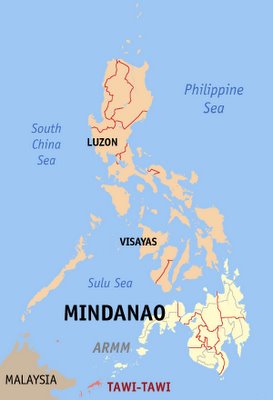 (Photo source.)
Surely this remoteness has contributed to its lack of development. The province has many woes: electricity (delivered by desiel-fueled power barges) is said to be the most expensive in the country. Its fragmented landmass needs to be linked by a system of bridges. Water sources are few and hard to pump; given its island structure, saltwater intrusion can hardly be avoided.
However it has several things going for it. First, its remoteness from mainland Southern Philippines also means proximity to Borneo. If you walk through the typical Tawi-Tawi marketplace you will see plenty of Malaysian and Indonesian products. Tawi-Tawi was a traditional center of trade between Borneo and Southern Philippines. Before it was conducted on a barter basis (so was the common impression), but these days the transactions are regularly for currency. To a large extent this cross-border trade is happening informally.
Second is its security. Contrary to popular belief, Tawi-Tawi is not a dangerous place. Locals tell me perhaps that insecurity is true for nearby Sulu (which lies in-between Tawi-Tawi and the mainland) but not for Tawi-Tawi. A lot of it has to do with culture, apparently - not warlike, but peace-loving. They are more apt to trust the local military and police, and more suspicious of potential insurgents, or terrorists, or plain criminals, which have made Mindanao undeservedly notorious. (So perhaps there is a cultural basis for social capital?)
Third, its island structure is both a blessing and curse. I saw lots of beautiful sandy beaches (unfortunately I had no time to take a dip). Seaweed culture, as well as fishing, are major industries.
I spoke to some members of the local chamber of commerce. All of them complained against the high cost of doing business in the province. This is partly due to the unecessary bureaucracy, plus fees and paperwork, introduced by the national government and by the autonomous region of muslim mindanao (ARMM). For instance, the national government slaps a 1,620 pesos travel tax (about US$ 31.00) for every legal visit to Malaysia.
To a man and woman - lots of female entrepreneurship in this Muslim-dominated province - they all spoke of Tawi-Tawi's strategic location and wonderful economic potential. I broached the idea of a Tawi-Tawi freeport zone. Turns out, they had been proposing that for a long time. But the remote center (i.e. Manila - now I'm beginning to feel the long arms of Imperial Manila) has been cool to it.
For a special economic zone to work, a lot of infrastructure investments have to be put in place. But I think it makes a lot of sense - the idea certainly merits serious benefit-cost analysis. And government has to strike a deal with the local traders - we'll give you duty-free priveleges, and all the infrastructure to becoming a regional center of trade, but everything has got to be formalized, and all the requisite taxes on sales and income (minus absurd fees and charges such as the travel tax) will have to be collected. I don't see a reason for local entrepreneurs to object.
A thriving economic zone anchored on the freeport. Then sit back and enjoy watching this blessed province rocket ahead in the human development rankings.
 (Photo source.)
Surely this remoteness has contributed to its lack of development. The province has many woes: electricity (delivered by desiel-fueled power barges) is said to be the most expensive in the country. Its fragmented landmass needs to be linked by a system of bridges. Water sources are few and hard to pump; given its island structure, saltwater intrusion can hardly be avoided.
However it has several things going for it. First, its remoteness from mainland Southern Philippines also means proximity to Borneo. If you walk through the typical Tawi-Tawi marketplace you will see plenty of Malaysian and Indonesian products. Tawi-Tawi was a traditional center of trade between Borneo and Southern Philippines. Before it was conducted on a barter basis (so was the common impression), but these days the transactions are regularly for currency. To a large extent this cross-border trade is happening informally.
Second is its security. Contrary to popular belief, Tawi-Tawi is not a dangerous place. Locals tell me perhaps that insecurity is true for nearby Sulu (which lies in-between Tawi-Tawi and the mainland) but not for Tawi-Tawi. A lot of it has to do with culture, apparently - not warlike, but peace-loving. They are more apt to trust the local military and police, and more suspicious of potential insurgents, or terrorists, or plain criminals, which have made Mindanao undeservedly notorious. (So perhaps there is a cultural basis for social capital?)
Third, its island structure is both a blessing and curse. I saw lots of beautiful sandy beaches (unfortunately I had no time to take a dip). Seaweed culture, as well as fishing, are major industries.
I spoke to some members of the local chamber of commerce. All of them complained against the high cost of doing business in the province. This is partly due to the unecessary bureaucracy, plus fees and paperwork, introduced by the national government and by the autonomous region of muslim mindanao (ARMM). For instance, the national government slaps a 1,620 pesos travel tax (about US$ 31.00) for every legal visit to Malaysia.
To a man and woman - lots of female entrepreneurship in this Muslim-dominated province - they all spoke of Tawi-Tawi's strategic location and wonderful economic potential. I broached the idea of a Tawi-Tawi freeport zone. Turns out, they had been proposing that for a long time. But the remote center (i.e. Manila - now I'm beginning to feel the long arms of Imperial Manila) has been cool to it.
For a special economic zone to work, a lot of infrastructure investments have to be put in place. But I think it makes a lot of sense - the idea certainly merits serious benefit-cost analysis. And government has to strike a deal with the local traders - we'll give you duty-free priveleges, and all the infrastructure to becoming a regional center of trade, but everything has got to be formalized, and all the requisite taxes on sales and income (minus absurd fees and charges such as the travel tax) will have to be collected. I don't see a reason for local entrepreneurs to object.
A thriving economic zone anchored on the freeport. Then sit back and enjoy watching this blessed province rocket ahead in the human development rankings.
Subscribe to:
Posts (Atom)