I was waiting for the Economist to put in its obligatory piece on the latest Nobel Memorial Prize in Economics. (The qualifier "Memorial" is there to pay tribute to the hardcore sciences of physiology, chemistry, and physics, which are the original Nobel Prizes.) At last I have something to free-ride on.
In my line of work "incentive compatibility" crops up frequently - it means that we should expect an agent to behave consistent with her incentives. Incentive compatibility is one of the keystones of mechanism design. It may sound trivial, but responses to incentives are naively ignored, say, in government policy. If for instance government is so distressed by rampant smuggling, perhaps in ought to wonder whether all those import restrictions actually spawned incentives for evasion (i.e. by creating a premium of the domestic price over the world price). Or that tax exemptions on dependents is not going to help curb the fertility rate. Examples can be multiplied. And don't get me started over the pardon of former President Estrada.
Saturday, October 27, 2007


Saturday, October 20, 2007
Trauma
Many in Manila consider Glorietta one of their favorite haunts. Years pass without incident, and soon, like our own home, such places acquire an aura of impenetrability. That is gone now. Horror has pierced clean through. You go down an escalator, ponder over the items you've seen on sale, match the colors and parties in your mind, blink, and the blast changes everything. On one end your life is taken - and so it was for nine people. On the other, you flee for your life at the crumbling debris. In between is a spectrum of injury. Some of you will need only stitches. Others will lose an arm, a leg, an eye, a face.
But whoever you are, you are a victim - unless you played a part in this, you lowlife piece of shit. For the rest of us there is only sadness, rage at evil men who did this, and fear. Fear that comes with the violation of sanctuaries, and with the swift deadliness of strangers.
The only cure is ordinary life. Malls that bustle, trains that run, crowds that mill; even an economy that continues to gallop with nary a pause, as I expect it would. Our routines are the most fitting rite of remembrance for this day of infamy.
But whoever you are, you are a victim - unless you played a part in this, you lowlife piece of shit. For the rest of us there is only sadness, rage at evil men who did this, and fear. Fear that comes with the violation of sanctuaries, and with the swift deadliness of strangers.
The only cure is ordinary life. Malls that bustle, trains that run, crowds that mill; even an economy that continues to gallop with nary a pause, as I expect it would. Our routines are the most fitting rite of remembrance for this day of infamy.
Thursday, October 11, 2007
In praise of the cheap peso
The peso is getting more and more expensive relative to the dollar. Since about this day in 2005 to the present, the peso's value in dollar terms has risen by about 27% (from P56 to P46.23 per $).
This is to a big extent due to the overall weakness of the dollar, causing it to become cheaper against all currencies. Aside from this though is specific high demand for Philippine pesos from dollar-denominated funds, basically from foreign remittances and portfolio investment. The timing though is beyond explanation - for all we know this is the result of forces set into motion months or even years back.
The era of the cheap peso arrived after the Asian crisis, as hot money blew cold on emerging markets, and the Central Bank shifted more credibly away from exchange rate targeting to inflation targeting. Filipinos have since gone global, working overseas in droves, seeking foreign customers (both inside and outside the country) to earn suddenly valuable foreign currency.
So is the dearer peso a market-driven correction? Partly. I don't believe in a return to a P56 per dollar regime. But the current trend is disturbing, to say the least. At least one prominent economist is taking up the cudgels for a cheap peso, and a major businesss daily (Business Mirror) is backing him up.
Bringing back the cheap peso makes eminent sense. (Coming from Professor Fabella, we can expect no less.) No, capital controls and exchange rate caps are nowhere near the table. The target is policy choices that may be artificially propping up the peso. Government should now shift towards dollar-denominated options (borrowing, investment, debt pre-payments), in line with the cheaper dollar. (But no bilateral deals in the dark, please.)
But if I may be too malice-minded, perhaps our policymakers are relucant to return to the cheap peso. Their rhetoric of a strong peso being the sign of good macrofundamentals is particularly off-putting. Let's hope they keep an open mind about the concerns of our dollar-earners.
This is to a big extent due to the overall weakness of the dollar, causing it to become cheaper against all currencies. Aside from this though is specific high demand for Philippine pesos from dollar-denominated funds, basically from foreign remittances and portfolio investment. The timing though is beyond explanation - for all we know this is the result of forces set into motion months or even years back.
The era of the cheap peso arrived after the Asian crisis, as hot money blew cold on emerging markets, and the Central Bank shifted more credibly away from exchange rate targeting to inflation targeting. Filipinos have since gone global, working overseas in droves, seeking foreign customers (both inside and outside the country) to earn suddenly valuable foreign currency.
So is the dearer peso a market-driven correction? Partly. I don't believe in a return to a P56 per dollar regime. But the current trend is disturbing, to say the least. At least one prominent economist is taking up the cudgels for a cheap peso, and a major businesss daily (Business Mirror) is backing him up.
Bringing back the cheap peso makes eminent sense. (Coming from Professor Fabella, we can expect no less.) No, capital controls and exchange rate caps are nowhere near the table. The target is policy choices that may be artificially propping up the peso. Government should now shift towards dollar-denominated options (borrowing, investment, debt pre-payments), in line with the cheaper dollar. (But no bilateral deals in the dark, please.)
But if I may be too malice-minded, perhaps our policymakers are relucant to return to the cheap peso. Their rhetoric of a strong peso being the sign of good macrofundamentals is particularly off-putting. Let's hope they keep an open mind about the concerns of our dollar-earners.
Thursday, June 28, 2007
More evidence for a downward sloping demand curve
When I was teaching I often heard the canard, "Gas is so essential it doesn't have downward sloping demand."
Here is evidence to the contrary. Not in any way rigorous, but fairly convincing to a college sophomore!
Here is evidence to the contrary. Not in any way rigorous, but fairly convincing to a college sophomore!
Tuesday, June 19, 2007
The breast of intentions
Another controversy with strong implications for economic freedom: the breast milk advertising controversy. (See this news item.) The Philippine government wants to fully implement the National Milk Code (full text
here.)
The Code is well-intentioned. Yes, breast milk is really best for babies. As with tobacco products, I agree that mandatory labeling can help balance the subtle cues inherent in product advertising.
But extremists advocate an outright advertising ban. That is going too far.
I have a better approach: tax it. The analogy with tobacco (and alcohol) is very precise. And don't call it "sin" tax or some such pejorative term: call it a "health tax". Set it at an ad valorem rate say equal to or even double the VAT (now at 12%). Watch the money roll in and the breastfeeding rates go up! Earmark the money for maternal and child health services of the LGUs (Local Government Units). LGUs would be happy. Maybe they'd even pressure the Congress to approve of it.
here.)
The Code is well-intentioned. Yes, breast milk is really best for babies. As with tobacco products, I agree that mandatory labeling can help balance the subtle cues inherent in product advertising.
But extremists advocate an outright advertising ban. That is going too far.
I have a better approach: tax it. The analogy with tobacco (and alcohol) is very precise. And don't call it "sin" tax or some such pejorative term: call it a "health tax". Set it at an ad valorem rate say equal to or even double the VAT (now at 12%). Watch the money roll in and the breastfeeding rates go up! Earmark the money for maternal and child health services of the LGUs (Local Government Units). LGUs would be happy. Maybe they'd even pressure the Congress to approve of it.
Wednesday, June 06, 2007
The egghead disconnect
The Philippines and Japan are in the process of ratifying a bilateral free trade agreement. In principle I am no fan of bilateral agreements - broad multilateral is more of my thing. But (as usual) I am bothered by the remarks of a Philippine Senator calling for"safety nets", because "Thousands of Filipino workers in factories making garments and electric appliances, and assembling automobiles stand to lose their jobs."
Now where did that figure (vague though it is) come from? The analysis is thought-provoking:
The chair of the Senate committee on economic affairs said his studies showed that 20 percent of Philippine products covered by the JPEPA would be adversely affected because the deal would reduce duties on Japanese exports to the Philippines to zero from between 10 percent and 30 percent.
“The domestic industries that would be affected are in garments, electronics such as toasters, washing machines and cooking ranges, and automobiles and spare parts,” said Roxas.
He noted that the three sectors were the country’s top dollar exports.
Now let's get this straight: these sectors are competitive enough to be able to export. But somehow they are threatened by the fact that we are repealing our tariffs? It boggles.
What's really happening? Well it's this cross-hauling thing: while we export a lot of these industrial products, in the same aggregated categories we are importing. So in some finer categories we are competitive, in some we are not. The latter is threatened by Japan's exports.
Well at least the good Senator didn't call for abrogating the agreement! Just putting safety nets. But then demanding these safety nets could be a ruse to put an end to the whole thing. In any case, such "safety nets" would use public funds, putting them in real danger of being wasted or worse, stolen.
(For an informative discussion about the bilateral trade agreement - which I mistakenly characterized as "free" - read here.)
Now where did that figure (vague though it is) come from? The analysis is thought-provoking:
The chair of the Senate committee on economic affairs said his studies showed that 20 percent of Philippine products covered by the JPEPA would be adversely affected because the deal would reduce duties on Japanese exports to the Philippines to zero from between 10 percent and 30 percent.
“The domestic industries that would be affected are in garments, electronics such as toasters, washing machines and cooking ranges, and automobiles and spare parts,” said Roxas.
He noted that the three sectors were the country’s top dollar exports.
Now let's get this straight: these sectors are competitive enough to be able to export. But somehow they are threatened by the fact that we are repealing our tariffs? It boggles.
What's really happening? Well it's this cross-hauling thing: while we export a lot of these industrial products, in the same aggregated categories we are importing. So in some finer categories we are competitive, in some we are not. The latter is threatened by Japan's exports.
So how big is the threat and what to do about it? As a matter of fact the first part of the question has been answered, "not much." A bunch of eggheads have already done that study. See here. In short: Gains on the Philippine side mostly arise from lower prices and higher imports. Increased export is minimal (except services exports) because our main exports are already charged low to zero tariffs on Japan's side. Output adjustment on the Philippine side ranges from 0 to a whopping -0.04%. (Yeah, that's right, it's already in percent.)
By some awesome display of nonchalance, this research is ignored.Well at least the good Senator didn't call for abrogating the agreement! Just putting safety nets. But then demanding these safety nets could be a ruse to put an end to the whole thing. In any case, such "safety nets" would use public funds, putting them in real danger of being wasted or worse, stolen.
(For an informative discussion about the bilateral trade agreement - which I mistakenly characterized as "free" - read here.)
Friday, June 01, 2007
English or Filipino?
English as a medium of instruction is a hot topic again these days. Philippine Commentary has posted several times, this being the most recent.
As with many other issues, the market-oriented approach seems best. (Which allows me to get away with using my comment as a post in this here economics blog):
It's time to depart from the rhetoric of cultural imperialism and legalism, and shift towards a pragmatic approach to this issue. I was intrigued by Tan's claim that students learn faster with the mother tongue. Not being an education language expert, I did a little googling and found that, voila (Pranses iyan, uy), there is good evidence that mother tongue teaching is associated with better education outcomes, compared to second (or third) language teaching. However there is by no means a consensus - mainly because the "all other factors constant" condition is difficult to meet.
The best paper I've read about the subject is found here. Paper No. 9 argues for a "market-oriented" approach. Rather than a dogmatic, one-size-fits-all approach, why not devolve the language issue to the schools? (And that's not the only choice that needs to be devolved. I happen to think the entire public school system should be privatized and education support extended through school vouchers. But that's another debate). Public resources can indeed be devoted to production of mother tongue learning materials. But there should be no ridiculous language quota one way or another. And note that I am not talking about Tagalog. All the studies have been about the "mother tongue" - which for most Filipinos, is certainly NOT Tagalog (which is my mother tongue).
As with many other issues, the market-oriented approach seems best. (Which allows me to get away with using my comment as a post in this here economics blog):
It's time to depart from the rhetoric of cultural imperialism and legalism, and shift towards a pragmatic approach to this issue. I was intrigued by Tan's claim that students learn faster with the mother tongue. Not being an education language expert, I did a little googling and found that, voila (Pranses iyan, uy), there is good evidence that mother tongue teaching is associated with better education outcomes, compared to second (or third) language teaching. However there is by no means a consensus - mainly because the "all other factors constant" condition is difficult to meet.
The best paper I've read about the subject is found here. Paper No. 9 argues for a "market-oriented" approach. Rather than a dogmatic, one-size-fits-all approach, why not devolve the language issue to the schools? (And that's not the only choice that needs to be devolved. I happen to think the entire public school system should be privatized and education support extended through school vouchers. But that's another debate). Public resources can indeed be devoted to production of mother tongue learning materials. But there should be no ridiculous language quota one way or another. And note that I am not talking about Tagalog. All the studies have been about the "mother tongue" - which for most Filipinos, is certainly NOT Tagalog (which is my mother tongue).
Saturday, May 26, 2007
Why are Filipinos most skeptical of globalization
According to the Social Weather Stations, most people surveyed in 18 countries believe that globalization is mostly good for most people. This is quite an eye-opener - all along I thought most people were, at the very least, wary of globalization.
The highest "approval ratings", as it were, for globalization are found - unshockingly - in China and South Korea. Export-dependent countries both. (Goes to show you the legendary antiglobalist Korean hotheads demonstrating in every possible ocassion, are not quite representative of their countrymen.)
Interestingly, the lowest approval rating is in the Philippines. Perhaps it's the level of education - after all, it's the Philippines and India who are least approving of globalization.
However the result for the Philippines, despite low educational level of the population, should still be surprising. After all, 1 in 5 Filipino workers is employed overseas. Does the export of labor turn the remaining citizenry off of globalization, unlike the export of goods? I conjecture, "yes." The export of labor is attended with great ambivalence, from which the export of goods is spared. The latter separates the worker from the labor (which is then embodied in the product) - the product then undergoes the slings and arrows of xenophobia, while the worker takes off at five o'clock and goes - home.
Of course I'd be the last to oppose free market choices to migrate. But I'd be the first to admit - yes, my ambivalence.
Bayan ko, nahan ka
Ako ngayo'y nag-iiisa
Nais kong magbalik
Sa iyo, bayan ko
Patawarin mo ako
Kung ako'y nagkamali
Sa landas na aking
Tinahak
(My country, where are you?
I am now alone.
I wish to return to you, my country.
Forgive me,
If I have erred
In the way
I have taken. )
The highest "approval ratings", as it were, for globalization are found - unshockingly - in China and South Korea. Export-dependent countries both. (Goes to show you the legendary antiglobalist Korean hotheads demonstrating in every possible ocassion, are not quite representative of their countrymen.)
Interestingly, the lowest approval rating is in the Philippines. Perhaps it's the level of education - after all, it's the Philippines and India who are least approving of globalization.
However the result for the Philippines, despite low educational level of the population, should still be surprising. After all, 1 in 5 Filipino workers is employed overseas. Does the export of labor turn the remaining citizenry off of globalization, unlike the export of goods? I conjecture, "yes." The export of labor is attended with great ambivalence, from which the export of goods is spared. The latter separates the worker from the labor (which is then embodied in the product) - the product then undergoes the slings and arrows of xenophobia, while the worker takes off at five o'clock and goes - home.
Of course I'd be the last to oppose free market choices to migrate. But I'd be the first to admit - yes, my ambivalence.
Bayan ko, nahan ka
Ako ngayo'y nag-iiisa
Nais kong magbalik
Sa iyo, bayan ko
Patawarin mo ako
Kung ako'y nagkamali
Sa landas na aking
Tinahak
(My country, where are you?
I am now alone.
I wish to return to you, my country.
Forgive me,
If I have erred
In the way
I have taken. )
Friday, May 25, 2007
Game theorists speak
Pointing you to a new book about Game Theory. Unlike other references, which present specific game theory models, this is really about the theory, its key areas, progress, empirical application, and future prospects. It is based on interviews with top scholars in the field. I have only the online excerpts to go on, but it is already mostly fascinating. The most interesting of these are of Ken Binmore, Tom Schelling, and Bob Sugden, which are all about the real world applications of game theory. Let's hear from Nobel Laureate Sugden:
Conventional game theory presupposes that each player’s motivations can be represented by numerical payoffs, assigned to the outcomes of strategy profiles, and that the combined behaviour of the players of a game can be explained by using solution concepts that use these payoffs as data. But what entitles game theory to claim that this strategy of explanation will work? It is not a self-evident truth that players are motivated by individual payoffs, or that standard solution principles, such as dominance, hold when defined relative to such payoffs.16 To know if this strategy works, we need to be shown that there is a method of assigning payoffs to real-world games such that, when it is used, the solution concepts of game theory lead to successful predictions. If this strategy doesn’t work, game theory is at fault and needs to be changed. If progress is to be possible, the first essential is that game theorists recognise that it is their job to make their theories fit the world. That is what science is all about.
Friday, May 11, 2007
The good, the bad, and the ugly
The Philippines is holding its local and legilative elections this May 14. Which of the senatorial candidates exhibit the most libertarian leanings? Let's consider their answers to a question on the importation of low cost medicines (Philippine Daily Inquirer, May 6, 2007). I've divided their answers into three categories.
The categories cut randomly across partly lines. Unlike the recent runoffs in France, where the drama was resolved in favor of the more libertarian party, there is practically no ideological distinction between the contending elements in Philippine politics. Both favor good governance and unity; each claims itself as authentic. Product differentiation descends to the level of personalities, rather than philosophies. Perhaps, in the Philippine context, this is a good thing - when products are unstandardized, there is hardly a point to reading the label.
Of the three categories, of course I favor the first; in that category I have awarded the Man-With-No-Name award for the first two. Most of the other answers are blah-blah-blah-blah, blah-blah, blah-blah-blah-blah-blah-blah-blah, blah-blah-blah, blah.
In the final category are answers I have included for your enjoyment.
***************************************************************
PRO:
Vicente Magsaysay, administration: I am for importation of low-cost medicines.
Antonio Trillanes, opposition: I support the importation of low-priced medicines.
Benigno Aquino, opposition: Im in favor of legislative initiatives seeking to amend the Intellectual Property Code to allow parallel importation of medicines as the first step toward broader access to quality health care.
Manuel Villar, administration: Under my watch as Senate President, the Senate approved the bill lowering the prices of medicines by amending our Patents Law to allow the importation and early development of patented medicines to greatly alleviate the health care needs of our people.
PRO BUT PROLIX:
Edgardo Angara, administration: Caring for ones health is a personal responsibility for most people but for me, it is my public duty. I have helped institutionalize a National Health Insurance Program thru PhilHealth, pushed for the creation of the National Institutes of Health to promote health R & D, and rallied behind the Generics Act. Ill push for the increase in the elderlys discount privileges for medicine to 34 percent by proposing amendments to the Senior Citizens Act. Ill support measures that will make available health support to an even bigger public even if it means importing quality low-priced medicines.Alan Cayetano, opposition: The Arroyo administration has neglected the health needs of the people. The cost of medicine is now beyond the reach of most Filipinos. I support the bills in Congress that call for importation of cheap drugs and for the institution of price control on certain drugs. Government purchases of drugs are also mired in corruption. This can be addressed by allowing patients to purchase medicine directly from private drugstores by issuing vouchers instead of the usual bidding that is practiced today.
Panfilo Lacson, opposition: Health is a priority in my advocacy as I have delineated in my HOPE legislative agenda. I, therefore, squarely support the policy allowing importation of low-priced medicines to enable Filipinos to have easier and fuller access to more medicines. Government, however, must ensure that unscrupulous parties that import low-priced but fake or substandard medicine are quickly punished.Luis Singson, administration: I am totally in favor of the parallel importation of low-priced medicines as it redounds to the benefit of the great majority of our countrymen. However, I also believe that we must resolutely pursue a comprehensive health program that includes allocation of substantial research and development funds for alternative herbal-based medicines or drugs made from indigenous materials that abound in the Philippines. We must develop our local pharmaceutical industry to lessen our dependence on imported medicines.
Juan Zubiri, administration: The high cost of medicine affects the poor more than the rich. Thus, it is only right and in the interest of the Filipinos for the government to find ways to lower medicine prices. This could be done by buying low-priced medicines abroad, fostering the local generic medicine industry, eliminating the monopoly of big medicine manufacturers, and placing prices of essential and life-saving medicine under government control. Not only manufactured medicine can be imported. Technologies in the manufacture of medicines with expired patents can also be adopted in the country by drug companies, so we can make cheaper medicines.
Francisco Pangilinan, independent: Because its economically beneficial for the country and people, importing low-priced medicines is a boon. If it poses a challenge to the local pharmaceutical industry, it should be taken as a chance for the industry to be more competitive. The benefit of having cheap but quality medicines for our people should prevail. These are thereasons the Senate passed the patents bill on the third reading before we ended session in February. The House of Representatives should give immediate attention to this bill when we resume session in July.
EVASIVE
Anna Dominique Coseteng, opposition: While I am not against the importation of low-priced medicines, we must ensure that these are of the same high standard of safety and potency as medicines from established drug firms. One way to lower medicine prices is to require manufacturers to put in big enough text, the manufacturers suggested retail price on the package so that consumers will know how much a drug outlet is making, over the manufacturers cost of production.Mike Defensor, administration: One of the priority programs of the government is to bring quality but affordable medicine to the public. Notwithstanding, the implementation of the generics law, we have not been successful in reducing the price of medicines. We are implementing the Botika ng Bayan and the Botika ng Barangay in coordination with theDepartment of Health and the PITC. I agree to the importation of medicine if this will benefit the public.
Francis Escudero, opposition: I am in favor of such a move if indeed it will redound to the benefit of our people. Safety nets would have to be provided, however, in connection with quality control and intellectual property rights.
Loren Legarda, opposition: The manufacture of pharmaceutical products in the Philippines is a virtual monopoly. This makes the price of medicines costly in our country, even if manufactured locally. India produces a lot of medicines comparable to those manufactured here. If importing medicine will bring down the cost of health care in the Philippines, then importation should be undertaken. Unrestricted importation, however, does not sound good. Only medicines which are genuine and which have not yet gone beyond their storage life should be imported.
Tessie Oreta, administration: The cost of medicine in the country is one of the highest in Asia. The high cost becomes a major stumbling block to improving the well-being of Filipinos. Importing low-priced medicines may be one option to address the problem. However, we must ensure that standards of quality are met. In addition, we need to strengthen the capacities of regulatory bodies such as the Bureau of Customs and Bureau of Food and Drugs in order to prevent the entry of fake and substandard medicines.
Prospero Pichay, administration: There should be a balance between the importation of low-priced medicines and the need to let the local drug industry continue to be viable. We need to import low-priced medicines to help our countrymen cope with the high drug prices but we dont also want to kill the local drug industry. So there should be a balance.
Vicento Sotto, administration: Importing low-priced medicines is a major step in addressing the problem of access to affordable and quality medicines. However, we must ensure that standards of quality are always met and are constantly kept updated. In the case of low-cost imported medicines, quality must be a priority. We also need to explore and develop more alternative and traditional medicines, which may be more affordable to the majority of our people. In addition, we need to strengthen the capability of regulatory bodies such as the Bureau of Food and Drugs in order to prevent the entry of fake and below-standard medicines.
HUH?
Sonia Roco, opposition: Are the multinationals providing reasonably priced medicines? Is the distribution of imported medicines democratized? Is the use of herbal and traditional medicine and methods sufficiently promoted and supported by the government? The 54-percent self-rated poor badly need cheap, unexpired medicines. Can they be bought at the Botika ng Bayan?
Ralph Recto, administration: Like the medicines we take, importation should be of the right dosage and kind. The challenge is not to import from India, but to copy India, which has been able to provide cheap medicines to its people by manufacturing essential drugs, to the extent of skirting patent limitations.
Cesar Montano, administration: Thats a good idea. But another option is to support locally made drugslike herbal medicines. In doing so, we are also providing jobs to our countrymen.
Richard Gomez, independent: All Filipinos should be given access to cheap medicines. Poverty is a major problem in our country. Thats why my priority is to raise the salaries of Filipinos.
Jamalul Kiram, administration: Expand the program and increase the budget allocation consistent with WHO standards and health services budget.
John Osmena, opposition: I am in favor of low-priced drugs.
Joker Arroyo, administration: No answer.
The categories cut randomly across partly lines. Unlike the recent runoffs in France, where the drama was resolved in favor of the more libertarian party, there is practically no ideological distinction between the contending elements in Philippine politics. Both favor good governance and unity; each claims itself as authentic. Product differentiation descends to the level of personalities, rather than philosophies. Perhaps, in the Philippine context, this is a good thing - when products are unstandardized, there is hardly a point to reading the label.
Of the three categories, of course I favor the first; in that category I have awarded the Man-With-No-Name award for the first two. Most of the other answers are blah-blah-blah-blah, blah-blah, blah-blah-blah-blah-blah-blah-blah, blah-blah-blah, blah.
In the final category are answers I have included for your enjoyment.
***************************************************************
PRO:
Vicente Magsaysay, administration: I am for importation of low-cost medicines.
Antonio Trillanes, opposition: I support the importation of low-priced medicines.
Benigno Aquino, opposition: Im in favor of legislative initiatives seeking to amend the Intellectual Property Code to allow parallel importation of medicines as the first step toward broader access to quality health care.
Manuel Villar, administration: Under my watch as Senate President, the Senate approved the bill lowering the prices of medicines by amending our Patents Law to allow the importation and early development of patented medicines to greatly alleviate the health care needs of our people.
PRO BUT PROLIX:
Edgardo Angara, administration: Caring for ones health is a personal responsibility for most people but for me, it is my public duty. I have helped institutionalize a National Health Insurance Program thru PhilHealth, pushed for the creation of the National Institutes of Health to promote health R & D, and rallied behind the Generics Act. Ill push for the increase in the elderlys discount privileges for medicine to 34 percent by proposing amendments to the Senior Citizens Act. Ill support measures that will make available health support to an even bigger public even if it means importing quality low-priced medicines.Alan Cayetano, opposition: The Arroyo administration has neglected the health needs of the people. The cost of medicine is now beyond the reach of most Filipinos. I support the bills in Congress that call for importation of cheap drugs and for the institution of price control on certain drugs. Government purchases of drugs are also mired in corruption. This can be addressed by allowing patients to purchase medicine directly from private drugstores by issuing vouchers instead of the usual bidding that is practiced today.
Panfilo Lacson, opposition: Health is a priority in my advocacy as I have delineated in my HOPE legislative agenda. I, therefore, squarely support the policy allowing importation of low-priced medicines to enable Filipinos to have easier and fuller access to more medicines. Government, however, must ensure that unscrupulous parties that import low-priced but fake or substandard medicine are quickly punished.Luis Singson, administration: I am totally in favor of the parallel importation of low-priced medicines as it redounds to the benefit of the great majority of our countrymen. However, I also believe that we must resolutely pursue a comprehensive health program that includes allocation of substantial research and development funds for alternative herbal-based medicines or drugs made from indigenous materials that abound in the Philippines. We must develop our local pharmaceutical industry to lessen our dependence on imported medicines.
Juan Zubiri, administration: The high cost of medicine affects the poor more than the rich. Thus, it is only right and in the interest of the Filipinos for the government to find ways to lower medicine prices. This could be done by buying low-priced medicines abroad, fostering the local generic medicine industry, eliminating the monopoly of big medicine manufacturers, and placing prices of essential and life-saving medicine under government control. Not only manufactured medicine can be imported. Technologies in the manufacture of medicines with expired patents can also be adopted in the country by drug companies, so we can make cheaper medicines.
Francisco Pangilinan, independent: Because its economically beneficial for the country and people, importing low-priced medicines is a boon. If it poses a challenge to the local pharmaceutical industry, it should be taken as a chance for the industry to be more competitive. The benefit of having cheap but quality medicines for our people should prevail. These are thereasons the Senate passed the patents bill on the third reading before we ended session in February. The House of Representatives should give immediate attention to this bill when we resume session in July.
EVASIVE
Anna Dominique Coseteng, opposition: While I am not against the importation of low-priced medicines, we must ensure that these are of the same high standard of safety and potency as medicines from established drug firms. One way to lower medicine prices is to require manufacturers to put in big enough text, the manufacturers suggested retail price on the package so that consumers will know how much a drug outlet is making, over the manufacturers cost of production.Mike Defensor, administration: One of the priority programs of the government is to bring quality but affordable medicine to the public. Notwithstanding, the implementation of the generics law, we have not been successful in reducing the price of medicines. We are implementing the Botika ng Bayan and the Botika ng Barangay in coordination with theDepartment of Health and the PITC. I agree to the importation of medicine if this will benefit the public.
Francis Escudero, opposition: I am in favor of such a move if indeed it will redound to the benefit of our people. Safety nets would have to be provided, however, in connection with quality control and intellectual property rights.
Loren Legarda, opposition: The manufacture of pharmaceutical products in the Philippines is a virtual monopoly. This makes the price of medicines costly in our country, even if manufactured locally. India produces a lot of medicines comparable to those manufactured here. If importing medicine will bring down the cost of health care in the Philippines, then importation should be undertaken. Unrestricted importation, however, does not sound good. Only medicines which are genuine and which have not yet gone beyond their storage life should be imported.
Tessie Oreta, administration: The cost of medicine in the country is one of the highest in Asia. The high cost becomes a major stumbling block to improving the well-being of Filipinos. Importing low-priced medicines may be one option to address the problem. However, we must ensure that standards of quality are met. In addition, we need to strengthen the capacities of regulatory bodies such as the Bureau of Customs and Bureau of Food and Drugs in order to prevent the entry of fake and substandard medicines.
Prospero Pichay, administration: There should be a balance between the importation of low-priced medicines and the need to let the local drug industry continue to be viable. We need to import low-priced medicines to help our countrymen cope with the high drug prices but we dont also want to kill the local drug industry. So there should be a balance.
Vicento Sotto, administration: Importing low-priced medicines is a major step in addressing the problem of access to affordable and quality medicines. However, we must ensure that standards of quality are always met and are constantly kept updated. In the case of low-cost imported medicines, quality must be a priority. We also need to explore and develop more alternative and traditional medicines, which may be more affordable to the majority of our people. In addition, we need to strengthen the capability of regulatory bodies such as the Bureau of Food and Drugs in order to prevent the entry of fake and below-standard medicines.
HUH?
Sonia Roco, opposition: Are the multinationals providing reasonably priced medicines? Is the distribution of imported medicines democratized? Is the use of herbal and traditional medicine and methods sufficiently promoted and supported by the government? The 54-percent self-rated poor badly need cheap, unexpired medicines. Can they be bought at the Botika ng Bayan?
Ralph Recto, administration: Like the medicines we take, importation should be of the right dosage and kind. The challenge is not to import from India, but to copy India, which has been able to provide cheap medicines to its people by manufacturing essential drugs, to the extent of skirting patent limitations.
Cesar Montano, administration: Thats a good idea. But another option is to support locally made drugslike herbal medicines. In doing so, we are also providing jobs to our countrymen.
Richard Gomez, independent: All Filipinos should be given access to cheap medicines. Poverty is a major problem in our country. Thats why my priority is to raise the salaries of Filipinos.
Jamalul Kiram, administration: Expand the program and increase the budget allocation consistent with WHO standards and health services budget.
John Osmena, opposition: I am in favor of low-priced drugs.
Joker Arroyo, administration: No answer.
Wednesday, May 02, 2007
Trivial economics of time allocation as applied to blogging
Why do I blog? Blogging is a matter of self-expression, mostly, along with the hope that some reader may be entertained or informed (in that order of difficulty). This is consistent with a model in which the number of posts in my blog appears as an argument in my utility function, alongside consumption of rice, housing services, transport services....
As Becker argued, utility is actually a production process involving commodities purchased in the market, as well as time. Time however is also a factor in producing the income to purchase the market goods. So the choice of time allocation and choice of goods is a compromise between competing ways of generating utility. For example, in deciding to buy a DVD, the biggest factor is time (for the dollar-per-disk variety, cost is rather trivial.)
And similarly for posting in the weblog. It is relatively easy to trace a life history of my schedule over the past couple of years. In general during months where the frequency of posting would be higher, the value of my time for income-generation was rather low (deadlines farther away).
Now is as fairly convoluted an explanation as you can get for a posting hiatus.
As Becker argued, utility is actually a production process involving commodities purchased in the market, as well as time. Time however is also a factor in producing the income to purchase the market goods. So the choice of time allocation and choice of goods is a compromise between competing ways of generating utility. For example, in deciding to buy a DVD, the biggest factor is time (for the dollar-per-disk variety, cost is rather trivial.)
And similarly for posting in the weblog. It is relatively easy to trace a life history of my schedule over the past couple of years. In general during months where the frequency of posting would be higher, the value of my time for income-generation was rather low (deadlines farther away).
Now is as fairly convoluted an explanation as you can get for a posting hiatus.
The new institutional economics (2)
As discussed earlier, early development economics tended to ascribe irrational and inefficient behaviors to the traditional agrarian economy as a reason for its underdevelopment. But analysis by economicsts such as Ted Schultz and Steve Chung began a quest for elaborating the hidden rationality underlying traditional agrarian structures and behavior. For example, the new theory of share tenancy notes that when insurance markets are imperfect or missing altogether, the tenancy contract acts as a partial insurance device. Under sharecropping, any loss is shared by both owner and tenant.
In general, according to Otsuka and associates, there is no evidence that share tenancy keeps employment of labor or other resources less productive than warranted. Agrarian contracts are found to adapt to real world enforcement problems; hence, share tenancy is more frequently observed in cases where monitoring is less costly, i.e. in closely-knit communities and families.
The need to provide work incentives and closely monitor labor to prevent shirking reveals an important advantage of the family farm as a production unit. Because of this, it is now commonly argued that economies of scale in agriculture are largely non-existent. However we do observe considerable land consolidation; such patterns may be due to market failure. Under imperfect credit markets, tenants face constraints in raising working capital from commercial sources. Banks may be more willing to lend to affluent landowners – who have collateral and a credit history – rather than to cultivators with no assets and no credit history in the formal sector. From a dynamic viewpoint, land serves as a store of wealth to smooth expenditures during income or consumption shocks. Because of these failures, the price of land remains artificially high . Furthermore land transfers are frequently motivated by “distress sales” rather than reallocation of land to more productive uses, leading to cumulative asset inequality.
To some extent, land rental markets offer an important means for improving asset inequality, as landless workers are able to climb the “agricultural ladder” of share tenancy, leasehold, and ultimately ownership.
From this perspective, land reform may have both positive and negative impacts. Conferment of ownership to cultivators may accelerate capital accumulation among the poor towards a more egalitarian and efficient distribution of assets. However redistributive land reform may incur high administrative cost; moreover, incentives to invest may be crippled during the interim period during ownership rights is yet to be transferred. Finally, controls on the rental market, including proscription of share tenancy, may deprive cultivators an important means to for sharing risk as well as foreclosing opportunities to the landless to climb the “agricultural ladder”.
In general, according to Otsuka and associates, there is no evidence that share tenancy keeps employment of labor or other resources less productive than warranted. Agrarian contracts are found to adapt to real world enforcement problems; hence, share tenancy is more frequently observed in cases where monitoring is less costly, i.e. in closely-knit communities and families.
The need to provide work incentives and closely monitor labor to prevent shirking reveals an important advantage of the family farm as a production unit. Because of this, it is now commonly argued that economies of scale in agriculture are largely non-existent. However we do observe considerable land consolidation; such patterns may be due to market failure. Under imperfect credit markets, tenants face constraints in raising working capital from commercial sources. Banks may be more willing to lend to affluent landowners – who have collateral and a credit history – rather than to cultivators with no assets and no credit history in the formal sector. From a dynamic viewpoint, land serves as a store of wealth to smooth expenditures during income or consumption shocks. Because of these failures, the price of land remains artificially high . Furthermore land transfers are frequently motivated by “distress sales” rather than reallocation of land to more productive uses, leading to cumulative asset inequality.
To some extent, land rental markets offer an important means for improving asset inequality, as landless workers are able to climb the “agricultural ladder” of share tenancy, leasehold, and ultimately ownership.
From this perspective, land reform may have both positive and negative impacts. Conferment of ownership to cultivators may accelerate capital accumulation among the poor towards a more egalitarian and efficient distribution of assets. However redistributive land reform may incur high administrative cost; moreover, incentives to invest may be crippled during the interim period during ownership rights is yet to be transferred. Finally, controls on the rental market, including proscription of share tenancy, may deprive cultivators an important means to for sharing risk as well as foreclosing opportunities to the landless to climb the “agricultural ladder”.
Monday, February 05, 2007
Land reform: the new institutional economics
Neoclassical economics has the advantage of strong theoretical foundations, in terms of individual constrained maximization and market equilibrium. However it suffers from a narrow representation of economic institutions. On the other hand, institutional economics addresses a wide variety of agrarian structures, but without deeper theoretical underpinnings. The new institutional economics or NIE seeks to ground the analysis of a wide variety of economic institutions on neoclassical foundations. This is done by broadening the types of constraints and costs, and relaxing competitive market assumptions. Key considerations in NIE are transaction costs, risk, imperfect contract enforcement, and asymmetric information.
Oliver Williamson distinguishes between first-order, second-order, and third-order economizing. First – order economizing covers the institutional environment that determines the “rules of the game”, in the areas of property rights, polity, judiciary, and bureaucracy. Second – order economizing involves governance structures and contract design. Third – order economizing is straightforward resource allocation subject to marginalist efficiency conditions, which is the traditional subject matter of neoclassical economics. Hence, while neoclassical theory specializes in third-order economizing, NIE specializes in the first two.
(To be continued)
Oliver Williamson distinguishes between first-order, second-order, and third-order economizing. First – order economizing covers the institutional environment that determines the “rules of the game”, in the areas of property rights, polity, judiciary, and bureaucracy. Second – order economizing involves governance structures and contract design. Third – order economizing is straightforward resource allocation subject to marginalist efficiency conditions, which is the traditional subject matter of neoclassical economics. Hence, while neoclassical theory specializes in third-order economizing, NIE specializes in the first two.
(To be continued)
Tuesday, January 30, 2007
Land reform - institutional economics
Neoclassical theory may be seen as a highly idealized representation of markets. A more realistic perspective, inspired by institutional economics, departs radically from this idealization. Institutional economists treat markets as one of numerous social constructs or institutions within a historical process. “Private property”, which is taken as a given in neoclassical theory, is merely one of possible configurations of property rights observed throughout history.
The task of applying institutional economics to developing country agriculture was taken up by early development economics. One important dichotomy in this literature is between traditional and modern institutions and cultural values. The classic paper of Johnston and Mellor (1961) describes possible impediments to agricultural modernization in terms of the traditional group constraints, attitudes towards change; perceptions of personal gain from the adoption of modern technologies, availability of market exchange outlets, and so on. Tenurial reform is identified as “the most essential requirement” to modernization, as traditional tenancy is the main obstacle to the formation of market – based agriculture.
Traditional tenancy is characterized by patron – client relationships and sharecropping, which are seen as institutional impediments to commercialization. Under the patronage system, the landowner offers an output share to the tenant in exchange for cultivation rights. The landowner also provides consumption loans, with effectively a transfer during times of emergency; this effectively guarantees a minimum subsistence to the tenant. The patronage system meanwhile obligates tenants in various ways, such as in rendering miscellaneous services as well as political support. These institutions characterized the manorial or feudal system in medieval Europe as well as agriculture in Southeast Asia.
The persistence of traditional structures is a serious obstacle when more commercialized transactions are superior ways to organize production. For instance, under share tenancy labor is paid below its marginal product, hence we expect a below optimum level of effort – the “Marshall critique”. A move towards either a straight wage contract or a fixed lease contract would pay factors their marginal product and improve allocative efficiency.
Between these two - neoclassical economics and institutional economics - who has a better approximation of reality? Or is it something in between?
The task of applying institutional economics to developing country agriculture was taken up by early development economics. One important dichotomy in this literature is between traditional and modern institutions and cultural values. The classic paper of Johnston and Mellor (1961) describes possible impediments to agricultural modernization in terms of the traditional group constraints, attitudes towards change; perceptions of personal gain from the adoption of modern technologies, availability of market exchange outlets, and so on. Tenurial reform is identified as “the most essential requirement” to modernization, as traditional tenancy is the main obstacle to the formation of market – based agriculture.
Traditional tenancy is characterized by patron – client relationships and sharecropping, which are seen as institutional impediments to commercialization. Under the patronage system, the landowner offers an output share to the tenant in exchange for cultivation rights. The landowner also provides consumption loans, with effectively a transfer during times of emergency; this effectively guarantees a minimum subsistence to the tenant. The patronage system meanwhile obligates tenants in various ways, such as in rendering miscellaneous services as well as political support. These institutions characterized the manorial or feudal system in medieval Europe as well as agriculture in Southeast Asia.
The persistence of traditional structures is a serious obstacle when more commercialized transactions are superior ways to organize production. For instance, under share tenancy labor is paid below its marginal product, hence we expect a below optimum level of effort – the “Marshall critique”. A move towards either a straight wage contract or a fixed lease contract would pay factors their marginal product and improve allocative efficiency.
Between these two - neoclassical economics and institutional economics - who has a better approximation of reality? Or is it something in between?
Monday, January 22, 2007
Impact of land reform: neoclassical perspective
To understand the impact of land reform, you have to view it from a theoretical perspective. The neoclassical perspective is one most familiar to economists. The neoclassical school treats land like any factor of production. The entrepreneur – an individual decision-maker - combines land, labor, capital, and material inputs, to produce output. The services of the factors of production must be purchased from other individuals who possess private property rights over the factors (unless the entrepreneur herself is the owner). The entrepreneur receives the proceeds from the sale of the output. The difference between revenue and cost (payments for all factors of production) is profit. The relationship between factors and outputs is represented by a production function, which expresses a particular state of technology. Entrepreneurial decisions are motivated by maximization of profit.
Markets are assumed to be perfectly competitive. Now suppose we define an "efficienct" allocation as follows: an allocation is efficient if any reallocation would inflict at least as much harm to losers as benefit to gainers. Neoclassical theory concludes that the way the market allocates resources, such as land, is efficient.
This all sounds very abstract. What are some practical predictions of the theory?
1. A government-administered reallocation of land from landowners to cultivators would likely reduce agricultural output.
2. Rent ceilings and transfer restrictions on agricultural land will reduce investments in land improvement, and encourage conversion to non-agricultural land.
The first opposes the claim that land reform would lead to a more efficient allocation of land. The second hypothesizes that agricultural land productivity and supply of agricultural land would decline under land reform.
Obviously the blokes who thought about land reform were not reasoning from a neoclassical perspective. What was the theoretical underpinning of land reform? Next week.
Markets are assumed to be perfectly competitive. Now suppose we define an "efficienct" allocation as follows: an allocation is efficient if any reallocation would inflict at least as much harm to losers as benefit to gainers. Neoclassical theory concludes that the way the market allocates resources, such as land, is efficient.
This all sounds very abstract. What are some practical predictions of the theory?
1. A government-administered reallocation of land from landowners to cultivators would likely reduce agricultural output.
2. Rent ceilings and transfer restrictions on agricultural land will reduce investments in land improvement, and encourage conversion to non-agricultural land.
The first opposes the claim that land reform would lead to a more efficient allocation of land. The second hypothesizes that agricultural land productivity and supply of agricultural land would decline under land reform.
Obviously the blokes who thought about land reform were not reasoning from a neoclassical perspective. What was the theoretical underpinning of land reform? Next week.
Sunday, January 14, 2007
University of the philistines
The raging issue in my alma mater is the increase in tuition fees. Long held at 300 pesos per unit (a little over US$ 6), in real terms this is now a little less than a third of its value when it was first set years ago. The proposal therefore is to raise it to about P1,000 (in the largest campuses) and thereby recover lost value. (Please check out this page and links to learn more about this issue.)
Of course, I should not expect the buyers (students) to take this lightly. It is an opportunity to rehash tired old bromides as the following:
Mr. Alfonso, has been quoted as saying that it is wrong to use students as a “source of income” for the university. “They tell us that it’s not the government’s role to subsidize tertiary education, but we believe otherwise.” (PDI, 24 November). During the congress of student councils held in Davao, which I personally attended, Mr. Alfonso declared that the difference between the students’ position and that of the UP administration was “philosophical.” In other words, their position is that tertiary education should be entirely subsidized.
Me too! It is my position that economists be entirely subsidized. Heck, it is my position that people who blog should be subsidized, as well as people with a fondness for Booksale pocketbooks. Furthermore, I demand as my unique inborn right to be subsidized because I am, er, in my mid-thirties. Yes, I demand to be subsidized because I take the MRT and I don't have a pet! That's my philosophy. Now if I can just round up a posse to lynch opponents of my sacred subsidies, I would demonstrate the depth of the values inculcated into me by my alma mater. So let us sing our school song:
UP naming mura, pamantasang hirap.
Ang bariya namin,
Sana'y iyong tiisin.
Malayong lupain,
Hasikan man ng lagim
'Di rin magbagago ang palamunin (2x)
Luntian at pula
Sakim kami kailanman
Ipagdiwang natin
Bulwagan ng hangal.
Humayo't ipagkait
Ginto at katapatan
Mabuhay ang pagpapakasasa sa pondo ng bayan (2x)
Of course, I should not expect the buyers (students) to take this lightly. It is an opportunity to rehash tired old bromides as the following:
Mr. Alfonso, has been quoted as saying that it is wrong to use students as a “source of income” for the university. “They tell us that it’s not the government’s role to subsidize tertiary education, but we believe otherwise.” (PDI, 24 November). During the congress of student councils held in Davao, which I personally attended, Mr. Alfonso declared that the difference between the students’ position and that of the UP administration was “philosophical.” In other words, their position is that tertiary education should be entirely subsidized.
Me too! It is my position that economists be entirely subsidized. Heck, it is my position that people who blog should be subsidized, as well as people with a fondness for Booksale pocketbooks. Furthermore, I demand as my unique inborn right to be subsidized because I am, er, in my mid-thirties. Yes, I demand to be subsidized because I take the MRT and I don't have a pet! That's my philosophy. Now if I can just round up a posse to lynch opponents of my sacred subsidies, I would demonstrate the depth of the values inculcated into me by my alma mater. So let us sing our school song:
UP naming mura, pamantasang hirap.
Ang bariya namin,
Sana'y iyong tiisin.
Malayong lupain,
Hasikan man ng lagim
'Di rin magbagago ang palamunin (2x)
Luntian at pula
Sakim kami kailanman
Ipagdiwang natin
Bulwagan ng hangal.
Humayo't ipagkait
Ginto at katapatan
Mabuhay ang pagpapakasasa sa pondo ng bayan (2x)
Monday, January 08, 2007
Doctors, nurses, economists, and fools
An old story (dating back to 2004) has been picked up and updated in the major US news services (example). It's about the medical exam topnotcher, Elmer Jacinto, who is now working as a nurse in New York.
The article draws attention to a major Filipino daily, who called Elmer a "sellout," and a columnist who condemns his "deplorable ambition". (Parallel Universes excerpt from these reactions.)
Such condemnation is foolish, ignorant, and stupid. Elmer is simply exercising his right to make a living, wherever and however he sees fit, without exercising fraud or violence. To say that he is "depriving" the Philippines of his medical skills, presumes that Filipinos have the right to demand Elmer to supply his services to them. There is no such pre-determined right. The right to demand Elmer his services belongs solely to his buyers, because of his standing promise to exchange services for fees.
It does however appear odd that a very bright medical doctor is spending his time dressing wounds and sticking needles into buttocks. Elmer is very likely to be more capable than many of the doctors ordering him about. Are markets stupid? No - government intervention is. The modern professional licensing system, firmly entrenched everywhere (including the United States), is preventing Elmer from being deployed in the job where the value of his service is highest. That's all there is to it. Contrary to popular belief, the United States is not an apostle of free markets, but rather a major heretic.
I am very thankful I belong to a profession that does not have licensing requirements. On the downside, a lot of fake "economists" though are getting away with pretty idiotic public pronouncements. Still, we seem to be doing pretty well even without the market distorting props of professional licensure.
We economists like to practice what we preach.
The article draws attention to a major Filipino daily, who called Elmer a "sellout," and a columnist who condemns his "deplorable ambition". (Parallel Universes excerpt from these reactions.)
Such condemnation is foolish, ignorant, and stupid. Elmer is simply exercising his right to make a living, wherever and however he sees fit, without exercising fraud or violence. To say that he is "depriving" the Philippines of his medical skills, presumes that Filipinos have the right to demand Elmer to supply his services to them. There is no such pre-determined right. The right to demand Elmer his services belongs solely to his buyers, because of his standing promise to exchange services for fees.
It does however appear odd that a very bright medical doctor is spending his time dressing wounds and sticking needles into buttocks. Elmer is very likely to be more capable than many of the doctors ordering him about. Are markets stupid? No - government intervention is. The modern professional licensing system, firmly entrenched everywhere (including the United States), is preventing Elmer from being deployed in the job where the value of his service is highest. That's all there is to it. Contrary to popular belief, the United States is not an apostle of free markets, but rather a major heretic.
I am very thankful I belong to a profession that does not have licensing requirements. On the downside, a lot of fake "economists" though are getting away with pretty idiotic public pronouncements. Still, we seem to be doing pretty well even without the market distorting props of professional licensure.
We economists like to practice what we preach.
Monday, January 01, 2007
The transformation of Negros
Last month I visited Negros island, in West-Central Philippines, the country's "sugar bowl". The west part especially (Negros Occidental) is covered with vast sugarcane areas, previously organized into haciendas, large estates under one landowner. Here enormously rich hacenderos accumulated enormous wealth, while poor resident workers lived on their vast estates. These workers grew to depend on the hacendero for their daily needs, depending on the vale (cash advance) for medical emergencies and other consumption needs. Sometimes the workers formed communities (complete with church and school) right on the hacienda. Meanwhile the hacendero class grew to wield great political power, entrenched itself at the forefront of the traditional elite of the country. It was a textbook example of modern-day feudalism, alive and kicking in the developing world.
In 1988, the Philippines embarked on its last and most extensive program of land reform, the Comprehensive Agrarian Reform Program (CARP). The CARP implements a law imposing a five hectare limit to total agricultural landholdings, with the excess to be distributed - with compensation - to tenants and other qualified beneficiaries. Unlike previous programs, the CARP would cover everything - including the hitherto untouchable haciendas.
The modern feudal lords have battled the redistribution program. Negros Occidental, which has the country's largest potential area for land reform (over 280,000 ha), has the lowest redistribution accomplishment (about 55%). Yet land reform has gone farther than most had expected in the late 1980s, forever transforming the face of the Negros countryside.
Not always for the better. First, land reform prohibits the transfer of land from beneficiaries to other parties (except by inheritance), for ten years after award of the land. In the medium term this has taken land away from enterprises with access to working capital (the haciendas) to enterprises without such access (the beneficiaries' farms). Sugarcane yields have reportedly dropped, as ideal input intensity cannot be achieved in the beneficiaries' farms. Second, the miscellaneous consumption financing offered by traditional sugarcane landlords did serve a useful function - which is completely disabled by land redistribution. Post-feudal forms of finance (i.e. the commercial banking system) has so far failed to deliver adequate financing to the new class of landowners.
But has land reform been a complete catastrophe? Far from it. Sugarcane yields do not seem to have seriously suffered owing to land reform. Check out the following graph, which shows the average yield in tons of cane per ha per year in the Philippines.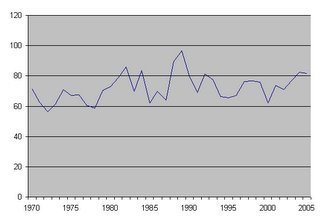 Despite all the problems, somehow the sugarcane industry, post-CARP, is still doing well. That means the new landowners are probably enjoying a higher standard of living than without the program – they receive the profits from the land, rather than just wages. I am getting much of this information from my land markets study, a sub-component of a bigger study assessing the impact of agrarian reform in the Philippines. I can confirm that many of the new landowners do lease out their lands to big sugarcane planters, and end up earning wages from the leased out land. Despite the apparent irony of the situation, it is clear that they are better off than before the program, because they receive lease rental in addition to wage. Furthermore, most who practice this do not in fact lease out all their land, and seldom is this practiced on a permanent basis.
So are the sugarcane workers better off with than without the Program? I wouldn’t know the answer to that – yet. But I do know that a lot of distortions is poisoning the discussion about the future of land reform. The last thing this country needs is policymaking by hyperbole.
In 1988, the Philippines embarked on its last and most extensive program of land reform, the Comprehensive Agrarian Reform Program (CARP). The CARP implements a law imposing a five hectare limit to total agricultural landholdings, with the excess to be distributed - with compensation - to tenants and other qualified beneficiaries. Unlike previous programs, the CARP would cover everything - including the hitherto untouchable haciendas.
The modern feudal lords have battled the redistribution program. Negros Occidental, which has the country's largest potential area for land reform (over 280,000 ha), has the lowest redistribution accomplishment (about 55%). Yet land reform has gone farther than most had expected in the late 1980s, forever transforming the face of the Negros countryside.
Not always for the better. First, land reform prohibits the transfer of land from beneficiaries to other parties (except by inheritance), for ten years after award of the land. In the medium term this has taken land away from enterprises with access to working capital (the haciendas) to enterprises without such access (the beneficiaries' farms). Sugarcane yields have reportedly dropped, as ideal input intensity cannot be achieved in the beneficiaries' farms. Second, the miscellaneous consumption financing offered by traditional sugarcane landlords did serve a useful function - which is completely disabled by land redistribution. Post-feudal forms of finance (i.e. the commercial banking system) has so far failed to deliver adequate financing to the new class of landowners.
But has land reform been a complete catastrophe? Far from it. Sugarcane yields do not seem to have seriously suffered owing to land reform. Check out the following graph, which shows the average yield in tons of cane per ha per year in the Philippines.
 Despite all the problems, somehow the sugarcane industry, post-CARP, is still doing well. That means the new landowners are probably enjoying a higher standard of living than without the program – they receive the profits from the land, rather than just wages. I am getting much of this information from my land markets study, a sub-component of a bigger study assessing the impact of agrarian reform in the Philippines. I can confirm that many of the new landowners do lease out their lands to big sugarcane planters, and end up earning wages from the leased out land. Despite the apparent irony of the situation, it is clear that they are better off than before the program, because they receive lease rental in addition to wage. Furthermore, most who practice this do not in fact lease out all their land, and seldom is this practiced on a permanent basis.
 So are the sugarcane workers better off with than without the Program? I wouldn’t know the answer to that – yet. But I do know that a lot of distortions is poisoning the discussion about the future of land reform. The last thing this country needs is policymaking by hyperbole.
Monday, December 25, 2006
Monday, October 09, 2006
Edmund Phelps: Bank of Sweden Winner for 2006
No honor in economics is more prestigious than the Bank of Sweden Prize, a.k.a. the "Nobel" prize in economics.
Winner for 2006 is Edmund Phelps (one of the rare single winners).
Frankly I just dimly recall Phelps from the "Friedman-Phelps" expectations-augmented Phillips curve. Then after reading the press release, I remember his name associated with the "golden rule" of growth theory. To summarize: he won for examining long-run trade-offs, between inflation and unemployment, and between consumption and investment.
For the inflation-unemployment trade-off he said: no such thing in the long run. Rather unemployment is held at the "natural rate" (later defined by Friedman as the unemployment rate "ground out by Walrasian equilibrium"P.
For the consumption-investment trade-off he said: if you don't believe in intergenerational discounting, you can adopt the "golden rule" in which equalized per capita consumption is maximized forever. Neat. This was a direct inspiration of the "sustainable development" idea of current consumption that does not sacrifice future consumption.
Just one problem: Phelps' prize is way overdue, and therefore dated. He could have won with Friedman, or Lucas, or some other monetarist-RBC type; or like Hayek and Myrdal, share it with Taylor or Modigliani (except he shared it with Miller already) or some other Keynesian-type.
The Committee should have been more forward-looking and rewarded recent work. Bhagwati, Krugman (trade), Fama (finance), Roemer (growth), Williamson, Baumol (industrial orgn.) I guess they tired of that already with the past 3 or 4 years of Bank of Sweden prizes.
Nevertheless my warmest congratulations.
Winner for 2006 is Edmund Phelps (one of the rare single winners).
Frankly I just dimly recall Phelps from the "Friedman-Phelps" expectations-augmented Phillips curve. Then after reading the press release, I remember his name associated with the "golden rule" of growth theory. To summarize: he won for examining long-run trade-offs, between inflation and unemployment, and between consumption and investment.
For the inflation-unemployment trade-off he said: no such thing in the long run. Rather unemployment is held at the "natural rate" (later defined by Friedman as the unemployment rate "ground out by Walrasian equilibrium"P.
For the consumption-investment trade-off he said: if you don't believe in intergenerational discounting, you can adopt the "golden rule" in which equalized per capita consumption is maximized forever. Neat. This was a direct inspiration of the "sustainable development" idea of current consumption that does not sacrifice future consumption.
Just one problem: Phelps' prize is way overdue, and therefore dated. He could have won with Friedman, or Lucas, or some other monetarist-RBC type; or like Hayek and Myrdal, share it with Taylor or Modigliani (except he shared it with Miller already) or some other Keynesian-type.
The Committee should have been more forward-looking and rewarded recent work. Bhagwati, Krugman (trade), Fama (finance), Roemer (growth), Williamson, Baumol (industrial orgn.) I guess they tired of that already with the past 3 or 4 years of Bank of Sweden prizes.
Nevertheless my warmest congratulations.
Subscribe to:
Posts (Atom)