Occassionally I come across a brilliant essay by the Austrian economists. This one is from Gary Gales at the Mises Economics Blog. Read the whole essay. I find the following most insightful:
In reality, however, a competitive market economy is characterized by more extensive and effective cooperation, because of the form that competition takes, than an economy controlled by the state, which is the means of achieving supposed "cooperation" by way of coercion. The reason that market competition enhances social cooperation is that it is the process by which we establish who can best cooperate with us. That is why commerce has reduced conflict-especially armed conflict-- throughout mankind's history, with greater beneficial effects, the smaller the extent that it has been hamstrung by governments. Markets reward competency, consistent, honest dealing and good faith, which are also virtues that improve the quality of every aspect of social cooperation.
And:
. But competitive markets excel at promoting cooperation, because success in the marketplace requires extensive cooperative skills among many individuals in widely varied activities. Further, the stronger the competition for consumer patronage and in the labor market, the more cooperation develops within organizations. Just as sports teams and orchestras illustrate how fierce competition can produce outstanding cooperation, the employees of firms must cooperate to produce high quality, low cost results, or risk being outperformed by rivals. Another way to put it is that competition in the marketplace is rivalry in which the best cooperators-who cooperate more effectively with more other people--earn greater rewards.
And:
A further problem with viewing competition and cooperation as alternative ways of organizing society is that in "cooperative" societies, there will be competition to control the supposed cooperation. No societal organization can eliminate scarcity or self-interest, and thereby none can eliminate competition. In the "cooperative" public sector, however, it takes the form of competition for control of those laws and rules which are to be imposed for their advantages over others--to extract all that is possible from others through the coercive powers of the state. So despite the imagery that all agree, allegedly cooperative benefits in fact go to some at others' expense, and the competition for that control is just the cooperation of some to win special favors by controlling the government apparatus that will enforce "cooperation" on those who are not otherwise (i.e., not really) willing. And that competition can be unbelievably ugly, as the socialist regimes of the 20th century proved.
Now, application: The Catholic Bishop's Conference of the Philippines wants to stop foreign investment in mining:
Arroyo has vigorously encouraged foreign mining corporations to invest in the country to bolster the ailing economy and create jobs in a politically difficult time... "Allowing the interest of the big mining corporations to prevail over people's right to these sources amounts to violating their right to life," the CBCP said in a two-page pastoral statement.
In the statement read by Sorsogon Bishop Arturo Bastes, the CBCP expressed alarm over the deletion of the nationalist provisions in the Constitution being pushed by the Macalanang-formed consultative commission.
If it succeeds, the move could "pave the way [for] the wholesale plunder of our national patrimony and undermine our sovereignty," the bishops warned.
"We believe that the Mining Act destroys life," the CBCP said. "The right to life of people is inseparable from their right to sources of food and livelihood."
"Furthermore, mining threatens people's health and environmental safety through the wanton dumping of waste and tailings in rivers and seas," the CBCP said.
So the CBCP wants to limit the exploitation of mineral resources - all owned by the State - to nationals. That is, the State (representing all Filipinos) cannot cooperate with the best possible cooperator; it can only cooperate with its own citizens, possibly excluding the best cooperator.
As for those wanton dumping, etc., why there are a host of regulations and controls and charges - applicable to citizen or foreigner alike - to address these.
Livelihood? Again, in the end some cooperator will have to start digging up the ground. Otherwise there will be no livelihood, just minerals lying beneath people's feet, rich and poor alike. The best livelihood will probably be generated by those who are most efficient at digging up those minerals. Again, by allowing foreigners to compete, the State is able to select the most efficient cooperator.
Do the good bishops realize this? But then their expertise is theology, isn't it?
Monday, January 30, 2006


Friday, January 27, 2006
Why booty capitalism thrives
Mel Ditangco tells about his father's experience in running a business in the Philippines:
My dad has been operating his business in the province of Tarlac for some decades now. I would say that he has achieved some degree of success. So much so he decided to expand his base of operations in the neighboring province of Pangasinan in Urdaneta city. However, he seems to be encountering institutional harassment from the police force over there. According to these law enforcers, my dad’s operations have violated certain laws as such will be shut down. As such, my dad would perform the necessary upgrades to his plant in Urdaneta.
However, recently the powers at be have run out of excuses for his plant to get cited for anything as my dad have spent millions of pesos in complying with all existing regulations. In the last raid by the authorities, they had no reason to find exception, but did so anyway and shut down the plant.
Competitors are controlling the NBI and local police force. It’s sad but it is reality. Is this the free market economy we enjoy today? Where a powerful family or company can shoot down its competition through influence. It is not the best companies that survive the Philippine market, rather the most treacherous survive, no matter how poor their services or products are.
Anecdotal, yes, but it drives home an obvious point: the more rules, the greater the cost of doing business, the wider the opportunity for vested interests to restrict competition. With limited competition, goods and services tend to be shoddier, and prices higher. The public at large is shafted; ironically because of the rules ostensibly imposed for the "public good". The reverse is true: the fewer rules, the more competitive the market; in general quality improves and prices are lower.
Is it really that simple? I do need to qualify that with ifs and buts. But booty capitalism in the country is so bad, such oversimplification is good.
Wednesday, January 25, 2006
The ASEAN economy
The most significant economic initiative in Southeast Asia is the ASEAN Free Trade Area (AFTA). Currently the main implementation arrangement is the Common Effective Preferential Tariff, where members charge uniform and low tariffs to imports from other members. According to this brief (PDF), average tariff within the ASEAN is below 4%. Most products have a tariff of 5%. (Certain sensitive products, comprising about 1% of the total number of products, are permanently excluded from CEPT and free trade). Ultimately the goal is elimination of all customs duties by 2010.
Following the establishment of the AFTA, "trade among ASEAN countries has grown from US $ 44.2 billion in 1993 to US $ 95.2 billion in 2000, representing an average annual increase of 11.6 percent. As of the year 2000, intra-regional exports made up about 23.3 percent of total ASEAN exports. Before the financial and economic crisis struck in mid-1997, intra-ASEAN exports had been increasing by 29.6 percent. This is significantly higher than the rate of increase of total ASEAN exports, which grew at 18.8 percent during the same period." Currently intra-ASEAN exports account for 22% of all ASEAN exports.
Lots more need to be done for full economic integration. Some heavily regulated products require mutual recognition of standards before being freely imported. A perfect example is pharmaceuticals. I would love to see recognition of safety and efficacy standards in the rest of Southeast Asia, where medicines tend to be much cheaper, by 40 to 70 percent, than in the Philippines. This is anti-poor, anti-rational, an outrage. Importation, even just within ASEAN, should be deregulated starting now . Expect lies, damn lies, and statistics to be dished out by the powerful pharmaceutical lobby to oppose this, the way they opposed the Generics Drug Law back in 1988.
Another problem is the movement of persons. While short-term visits are visa-free, there remain quite stringent barriers to intra-regional employment. There are working groups within ASEAN actively looking into promoting labor market integration.
Once these obstacles have been hurdled, what next? Following the EU example, ASEAN may adopt a common currency. Aside from reducing transaction costs within the region, a common currency would make monetary policy uniform, perhaps improving the investment climate; it would also force fiscal discipline on the member states. This is decades from now, but hey the EU was 40 years in the making.
The ASEAN economy is simply the way to go.
Monday, January 23, 2006
Irritants to economic integration in the ASEAN
The ASEAN (Association of Southeast Asian Nations) was set up in 1967. According to their website (www.aseansec.org), it "has a population of about 500 million, a total area of 4.5 million square kilometers, a combined gross domestic product of US$737 billion, and a total trade of US$ 720 billion." Nothing to sneeze at, for sure. The rationale for economic integration is mainly geographical (just look at the map), as well as historical (we are able to exploit centuries of cultural and economic ties).
There are a few political irritants to economic integration. Consider the absurd Philippine claim over Sabah. I am not familiar with the historical background, and all that, but I do know that possession is nine-tenths of the law, and that is most indisputably in favor of the Malaysians. I am all for laying these legal sheenanigans to rest and profit from existing geopolitical realities. (Read the Malaysian justification for its inclusion of Sabah. Speaking objectively as a Filipino, there ain't no basis for our claim. Zero. Zilch. Some politicians in Mulsim Mindanao are apparently lobbying Manila to keep the claim alive by supporting the claims of the heirs of the Sultan of Sulu. Perhaps getting some generous settlement from Malaysia is a great motivation for this kind of support.)
Domestic laws and policies are also errecting barriers to ASEAN investment. Remember the Manila Hotel fiasco back in 1997? Let me recount: a Malaysian group had given the winning bid for the Manila Hotel. The Filipino runner-up (headed by the owner of Manila Bulletin) lodged a complaint against the deal with the Supreme Court. The Supreme Court relies on the national patrimony provision of the Philippine Constitution to reverse the decision and let the Pinoy investor win. (A clear example why national patrimony provisions may mean by settling for the inferior deal just because the offer is from a Filipino). Apparently this forestalled an outpouring of Malaysian investment in Mindanao - just at the height of the euphoria from the 1996 peace agreeement with the Moro National Liberation Front. Wasted opportunities indeed. Given problems in deregulating foreign investments in general for each ASEAN country, it is time to start examining preferential treatment for ASEAN investors under parity terms.
There is however considerable progress made on other fronts. We'll take that up on my next post.
Saturday, January 21, 2006
Developing the fringes: Tawi-Tawi as a freeport zone
Tawi-Tawi sits at the southernmost tip of the Philippines, just a few hours away by fastcraft from Malaysia. Its Human Development Index is only 0.364, making it third lowest in the country. To give you an idea, that's below Malawi, Zambia, Congo, Mozambique, Burundi, and Ethiopia (but just ahead of Chad). To get there I had to fly from Manila to Zamboanga City, then take a jetprop to the province. The jetprop alone costs 3,200 pesos (about US$ 62.00) one-way. (Otherwise you need an overnight trip by fastcraft).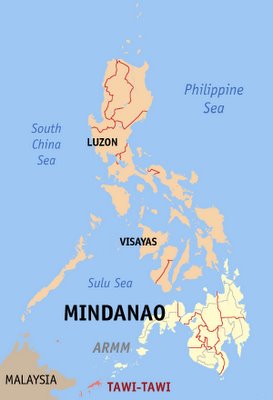 (Photo source.)
Surely this remoteness has contributed to its lack of development. The province has many woes: electricity (delivered by desiel-fueled power barges) is said to be the most expensive in the country. Its fragmented landmass needs to be linked by a system of bridges. Water sources are few and hard to pump; given its island structure, saltwater intrusion can hardly be avoided.
However it has several things going for it. First, its remoteness from mainland Southern Philippines also means proximity to Borneo. If you walk through the typical Tawi-Tawi marketplace you will see plenty of Malaysian and Indonesian products. Tawi-Tawi was a traditional center of trade between Borneo and Southern Philippines. Before it was conducted on a barter basis (so was the common impression), but these days the transactions are regularly for currency. To a large extent this cross-border trade is happening informally.
Second is its security. Contrary to popular belief, Tawi-Tawi is not a dangerous place. Locals tell me perhaps that insecurity is true for nearby Sulu (which lies in-between Tawi-Tawi and the mainland) but not for Tawi-Tawi. A lot of it has to do with culture, apparently - not warlike, but peace-loving. They are more apt to trust the local military and police, and more suspicious of potential insurgents, or terrorists, or plain criminals, which have made Mindanao undeservedly notorious. (So perhaps there is a cultural basis for social capital?)
Third, its island structure is both a blessing and curse. I saw lots of beautiful sandy beaches (unfortunately I had no time to take a dip). Seaweed culture, as well as fishing, are major industries.
I spoke to some members of the local chamber of commerce. All of them complained against the high cost of doing business in the province. This is partly due to the unecessary bureaucracy, plus fees and paperwork, introduced by the national government and by the autonomous region of muslim mindanao (ARMM). For instance, the national government slaps a 1,620 pesos travel tax (about US$ 31.00) for every legal visit to Malaysia.
To a man and woman - lots of female entrepreneurship in this Muslim-dominated province - they all spoke of Tawi-Tawi's strategic location and wonderful economic potential. I broached the idea of a Tawi-Tawi freeport zone. Turns out, they had been proposing that for a long time. But the remote center (i.e. Manila - now I'm beginning to feel the long arms of Imperial Manila) has been cool to it.
For a special economic zone to work, a lot of infrastructure investments have to be put in place. But I think it makes a lot of sense - the idea certainly merits serious benefit-cost analysis. And government has to strike a deal with the local traders - we'll give you duty-free priveleges, and all the infrastructure to becoming a regional center of trade, but everything has got to be formalized, and all the requisite taxes on sales and income (minus absurd fees and charges such as the travel tax) will have to be collected. I don't see a reason for local entrepreneurs to object.
A thriving economic zone anchored on the freeport. Then sit back and enjoy watching this blessed province rocket ahead in the human development rankings.
 (Photo source.)

Surely this remoteness has contributed to its lack of development. The province has many woes: electricity (delivered by desiel-fueled power barges) is said to be the most expensive in the country. Its fragmented landmass needs to be linked by a system of bridges. Water sources are few and hard to pump; given its island structure, saltwater intrusion can hardly be avoided.
However it has several things going for it. First, its remoteness from mainland Southern Philippines also means proximity to Borneo. If you walk through the typical Tawi-Tawi marketplace you will see plenty of Malaysian and Indonesian products. Tawi-Tawi was a traditional center of trade between Borneo and Southern Philippines. Before it was conducted on a barter basis (so was the common impression), but these days the transactions are regularly for currency. To a large extent this cross-border trade is happening informally.
Second is its security. Contrary to popular belief, Tawi-Tawi is not a dangerous place. Locals tell me perhaps that insecurity is true for nearby Sulu (which lies in-between Tawi-Tawi and the mainland) but not for Tawi-Tawi. A lot of it has to do with culture, apparently - not warlike, but peace-loving. They are more apt to trust the local military and police, and more suspicious of potential insurgents, or terrorists, or plain criminals, which have made Mindanao undeservedly notorious. (So perhaps there is a cultural basis for social capital?)
Third, its island structure is both a blessing and curse. I saw lots of beautiful sandy beaches (unfortunately I had no time to take a dip). Seaweed culture, as well as fishing, are major industries.
I spoke to some members of the local chamber of commerce. All of them complained against the high cost of doing business in the province. This is partly due to the unecessary bureaucracy, plus fees and paperwork, introduced by the national government and by the autonomous region of muslim mindanao (ARMM). For instance, the national government slaps a 1,620 pesos travel tax (about US$ 31.00) for every legal visit to Malaysia.
To a man and woman - lots of female entrepreneurship in this Muslim-dominated province - they all spoke of Tawi-Tawi's strategic location and wonderful economic potential. I broached the idea of a Tawi-Tawi freeport zone. Turns out, they had been proposing that for a long time. But the remote center (i.e. Manila - now I'm beginning to feel the long arms of Imperial Manila) has been cool to it.
For a special economic zone to work, a lot of infrastructure investments have to be put in place. But I think it makes a lot of sense - the idea certainly merits serious benefit-cost analysis. And government has to strike a deal with the local traders - we'll give you duty-free priveleges, and all the infrastructure to becoming a regional center of trade, but everything has got to be formalized, and all the requisite taxes on sales and income (minus absurd fees and charges such as the travel tax) will have to be collected. I don't see a reason for local entrepreneurs to object.
A thriving economic zone anchored on the freeport. Then sit back and enjoy watching this blessed province rocket ahead in the human development rankings.
Tuesday, January 17, 2006
Underground economy and flea markets
I'm due for a post tomorrow, but I'll be on travel again (to Tawi-Tawi, southernmost part of the Philippines, my first trip there!), so I'm posting early. A reader, Michelle Go, a student from UP Diliman, asks me the following questions:
1. What do you think does this tiangge (flea market) popularity says about the state of Philippine economy and consumer behavior?
Flea markets are a fixture in the Philippine (and many other) economies. As a matter of routine, they do not give receipts, hardly any sort of registration, and hence belong to the underground economy. The underground economy as a whole constitutes over forty percent of Philippine output. Fancy that.
What the undergroundization of the economy tells us (and flea markets is one sign of that) is that cost of going formal is high. According to the World Bank, the Philippines is ranked 113 out of 155 countries in terms of the ease of doing business. Incredible. Who are the best? New Zealand, Singapore, US, Canada, Norway, Hong Kong, in that order. We are 89th in terms of starting a business, 91st in terms of dealing with licenses, 82nd in terms of ease of hiring and firing workers, 92nd in terms of registering property, and a whopping 121st in terms of getting credit. Just to start a business, the average waiting time is 48 days, whereas in developed countries it is only 19.5 days; the cost of starting is up to one-fifth of per capita income, whereas in the latter it's below 7%. Now should we wonder why the informal economy is so large? And why the informal economy in New Zealand is less than 13% of its national output?
2. Does this rise in tiangges reflect a harder life for most Filipinos with buyers and sellers opting for cheaper (although sometimes lesser quality) goods and the informal economy?
Harder life? Hardly. I'm one of few people who think that social well being correlates roughly with per capita income, so since the latter has been going up, well... It's not a demand side thing. It's a supply side thing, as I argued above. Is the cost of going formal getting higher? Not really - the cost of not going formal is getting lower. The risks facing tax avoiders, the risk of getting caught without the right papers and licenses, is going down. I think this is a sheer case of deteriorating governance.
3. Does this rise in flea markets bode well or ill for the economy? (seeing that it provides jobs, income and brings cheap good s to those who can't afford expensive ones but also that a lot of the goods are cheap, imported Asian products and the BIR is claiming the government is losing millions in taxes)
It's not really what's wrong; it's a symptom of what's wrong. In general as the economy becomes more formalized, the better, subject to low cost of formalization. Of course we can get cheaper goods from the informal sector, but it's should not be because bureaucracy is artifically driving the price of formal goods up.
4. Do you think this rising trend will continue in the next years? Or will it all depend on the performance of the Philippine economy?
The BIR is cracking down on flea markets. Well and good; but government should realize it's not just a victim here, but also a perpetrator. In short, it will all depend on how government reduces the cost of formalization and raises the cost of informalization. We need government, but we do not need all of these procedures and fees and regulations from slow motion bureaucrats, who are apt to play favorites (or finagle the entrepreneur for grease money). I am not portraying business as the hero here; very often it is big business that lobbies for all these regulations to keep competition out. Why is it so hard to import identical drugs from India or other countries in ASEAN, like Malaysia and Vietnam, where drugs are much cheaper? No real medical reason - just good (or bad, depending on your viewpoint) old commercial interest. It sucks.
Monday, January 16, 2006
Lee Kwan Yew on India
Hat tip to Atanu Dey at Indiaeconomy. Lee Kwan Yew might as well be talking about the Philippines. It's a classic. Consider:
Like Nehru, I had been influenced by the ideas of the British Fabian society. But I soon realised that before distributing the pie I had first to bake it. So I departed from welfarism because it sapped a people’s self-reliance and their desire to excel and succeed. I also abandoned the model of industrialisation through import substitution. When most of the Third World was deeply suspicious of exploitation by western MNCs (multinational corporations), Singapore invited them in. They helped us grow, brought in technology and know-how, and raised productivity levels faster than any alternative strategy could.
Who says free market economics is all theory? This is economic theory in practice. Correct theory, that is.
The World Bank has also done its own study. It found that in India it can take a decade to close a business through insolvency proceedings. It also found, among other things, that official fees amount to almost 13 percent of a property transaction in India as against just over 3 percent in China.
Ever tried to get your property titled in the Philippines? Hah!
My secretaries asked Singapore businessmen with investments in India what, apart from infrastructure, they found as major constraints. To a man, they replied it was the bureaucracy. They believe it is a mindset problem. The average Indian civil servant still sees himself primarily as a regulator and not as a facilitator. The average Indian bureaucrat has not yet accepted that it is not a sin to make profits and become rich.
Regulator rather than facilitator. Spot on. Sin to get rich? Here it is more of a balato mentality - gimme a share or else!
The average Indian bureaucrat has little trust in India’s business community. They view Indian businessmen as money grabbing opportunists who do not have the welfare of the country at heart; and all the more so if they are foreign usinessmen. Deng Xiaoping said at the start of China’s open door policy, it was glorious to be rich. The sequel is reported in Forbes Asia, November 14 2005, where it listed over 300 China’s richest, 40 of them with thumbnail CVs in a centre -fold. All are new entrepreneurs creating jobs and spreading wealth. Now, after private enterprise and the free market have generated wealth in the coastal provinces, China’s leaders have concentrated on spreading growth to the inland provinces by building infrastructure and offering generous economic incentives for investments.
Listen folks: without ambitious and talented men and women dreaming of wealth and security and prosperity, pupulutin tayong lahat sa kangkungan (they'll be picking all of us up from the canal.) And see what China is doing: bake the cake first. You can start distribution when there's something to distribute. And in fact what you can distribute first are the tools and equipment - and skill - to bring the laggards up to par.
One Singapore businessman told me this story. He entertained a former senior Indian civil servant to lunch in Singapore. Some months later when he was in India, the former civil servant reciprocated by hosting a dinner at which severa l other guests were present. His host made this surprising comment that he was amazed to see that in Singapore, a business could be successful without being dishonest.
No comment necessary.
Please read Atanu Dey's commentary also. A good explanation of why politicos keep their blinkers on.
Friday, January 13, 2006
Spreading the good news of free trade
I had a conversation with my barber the other day. We were talking about me buying sandals. Topic shifts to the demise of the footwear industry in Marikina, Manila's shoetown up to the 80s. Then Jun (let's call him that) makes a comment: "If only all Filipinos were to patronize Filipino-made, our country would be rich!" He continues: "See how much the imported goods the rich are buying. All that money could have gone to Filipinos instead."
The free trader in me recoils, but remembers - this is probably the view of the common tao (person). Against this common sense analysis, what to say? I can't very well launch into an analysis of the 2x2 Ricardian example of comparative advantage. I couldn't even go into the long run balance of trade. Let's see, how would the quick-witted free trade evangelist handle this?
ME: Jun, it's really good to patronize your countryman's products. But it often happens, say for shoes, that a local product is more expensive than a very similar product imported from, say China. Which one would you buy?
JUN: Of course, if the difference is too big, I need to survive too, right? But if the difference is small enough I'd go for Filipino-made.
ME: But don't you think that, by buying the foreign shoe, you would be forcing the Filipino producer to match the foreigner's price? It might be that by buying Filipino you are spoiling the Filipino. He has to learn to compete.
JUN: But what if he can't compete. These foreigners have lots of capital. They have cornered the market. We consumers have to balance that.
ME: Why not? But I've seen too many greedy producers just lay back and jack up prices whenever government tries imports from freely competing against them. To me it looks so unfair.
JUN: Okay, suppose he enjoys a higher price. Wouldn't that let him expand his business? And employ more people? And pay higher wages? Isn't that good for our country? We won't get all that if we just import the shoe!
ME: Suppose you open a restaurant. You have a poor brother who is a small rice farmer. In the beginning you buy palay from him. Soon he is charging you a higher price than from the market. Actually you realize he's not good at farming. But he's your brother right, so you keep on helping him. You know that he's got a bachelor's degree in commerce. Soon you realize there's a better way: Ask him to sell his farm, and join your business. You enjoy higher profit from getting cheaper rice, he gets to use his bachelor's degree.
JUN: That's possible.
ME: Happens all the time. You don't need to get something from someone just because he's your relative, or friend, or what-not, when there's a better alternative, business-wise. You get higher profit, and you can use that to help your friend or relative, rather than let them do something they're not really good at.
JUN: Sounds good - but does it really work that way for the Philippines and the other countries?
ME: Yes, of course!
What really happened? Well, I thought this conversation up on my walk home. Actually I quietly changed the subject to politics, where abstract thought is not essentially to carry on an animated conversation. So much for spreading the good news of free trade. Oh well. Next time.
Wednesday, January 11, 2006
Poverty alleviation: a better way
Pump priming is a government intervention to boost economic activity and reduce unemployment. The background here is that, under Keynesian macroeconomic assumptions, weak aggregate demand depresses growth and employment, hence the need for an outside economic stimulus. Usually this takes the form of expansionary fiscal policy (e.g., hire an army of street sweepers who would otherwise be unemployed or underemployed), or expansionary monetary policy (e.g. the Central Bank purchases government Treasury bills using its reserves, thus reducing interest rates and stimulating investment).
Lately the term has been mixed up with poverty alleviation. Consider this:
THE debate continues: can a hastily put-together pump-priming program, kicked off with the distribution of P500 million in rice-noodles subsidies, translate "positive economic fundamentals" into sustained relief for most people?
Smarting from criticism of this strategy by a leading administration senator, the Palace said Sunday the controversial P35-billion "pump-priming fund" has been designed to let ordinary folk directly benefit from "the positive economic developments" in the country that the administration has been trumpeting since late last year.
It's a minor quibble, but I wish the government stuck to the "poverty alleviation" tag. Despite the growth slowdown, there is really no warrant for a stimulus package. The high unemployment and underemployment rate the country suffers from is due to structural factors, not a deficiency in aggregate demand. When there is a savings over the programmed deficit (the source of the 35 billion fund), a better signal to financial markets is to carry it over as reserve for the following year's budget. At least in doing so it goes through the mandated budgeting process.
Legal issues aside, suppose the government did package the fund as earmarked for "poverty alleviation." Is this money well-spent? I have nothing in principle with targeted transfers to the poor. One can justify, say the 500 million rice and noodle subsidy, as a form of targeted transfer. My problem is the amount and manner of targeting: as for amount, does 35 billion worth of subsidies make society better off, compared to say 35 billion worth of rural roads? Not quite sure, but at a modest 1 million pesos per kilometer, that's 35,000 km of barangay roads. Very tempting.
As for manner of targeting: the current strategy is a combination of commodity-targeting (rice and noodles) and geographic targeting (rolling stores). As for commodity targeting, a better choice is corn (i.e. corn grits), which is in the Philippines is consumed by the poorest of the rural poor, but shunned by the higher income groups. The problem with rice and noodles is that even the higher income groups buy it. This makes the system prone to cheating. Which brings us to the geographic targeting. An enterprising retailer can just follow the rolling store, buy the subsidized goods, and resell at the market price. (There are regulations against this, but how to prevent it in practice?) There is anecdotal evidence suggesting that such cheating is happening. A lot.
Am I saying the rice-noodle program is not helping the poor? Of course it helps. However I'm saying there's a better way, magis. President GMA, an alumnae and former teacher of Ateneo, surely knows this!
Monday, January 09, 2006
Dangerous ideas about the free market
Michael Shermer has a "dangerous idea" about free trade (hat tip: Cafe Hayek):
It appears CHICK-sent-me-high (official pronounciation) is voicing the vague unease of many regarding the market. Shermer's upbeat assessment ties in economic with political liberty - a connection forcefully argued by Milton Friedman. So Csikszentmihalyi's advocacy of _________? as an alternative to free markets, would probably end up constricting the very liberties that make, instrinsically or indirectly, for the high quality of life he advocates.
Where goods cross frontiers, armies won'tThe Edge feature on "dangerous ideas" also has this from Mihalyi Csikszentmihalyi (the man who popularized the creative "flow"):
Where goods cross frontiers, armies won't. Restated: where economic borders are porous between two nations, political borders become impervious to armies.
Data from the new sciences of evolutionary economics, behavioral economics, and neuroeconomics reveals that when people are free to cooperate and trade (such as in game theory protocols) they establish trust that is reinforced through neural pathways that release such bonding hormones as oxytocin. Thus, modern biology reveals that where people are free to cooperate and trade they are less likely to fight and kill those with whom they are cooperating and trading.
My dangerous idea is a solution to what I call the "really hard problem": how best should we live? My answer: A free society, defined as free-market economics and democratic politics — fiscal conservatism and social liberalism — which leads to the greatest liberty for the greatest number.
The free marketHow's that for contrast? Shermer is a well-known author and editor of Skeptic Magazine, and one of my favorite columnists (his column appears in Scientific American). I was pleasantly surprised to see him picking this as a dangerous idea.
Generally ideas are thought to be dangerous when they threaten an entrenched authority. Galileo was sued not because he claimed that the earth revolved around the sun — a "hypothesis" his chief prosecutor, Cardinal Bellarmine, apparently was quite willing to entertain in private — but because the Church could not afford a fact it claimed to know be reversed by another epistemology, in this case by the scientific method. Similar conflicts arose when Darwin's view of how humans first appeared on the planet challenged religious accounts of creation, or when Mendelian genetics applied to the growth of hardier strains of wheat challenged Leninist doctrine as interpreted by Lysenko.
One of the most dangerous ideas at large in the current culture is that the "free market" is the ultimate arbiter of political decisions, and that there is an "invisible hand" that will direct us to the most desirable future provided the free market is allowed to actualize itself. This mystical faith is based on some reasonable empirical foundations, but when embraced as a final solution to the ills of humankind, it risks destroying both the material resources, and the cultural achievements that our species has so painstakingly developed.
So the dangerous idea on which our culture is based is that the political economy has a silver bullet — the free market — that must take precedence over any other value, and thereby lead to peace and prosperity. It is dangerous because like all silver bullets it is an intellectual and political scam that might benefit some, but ultimately requires the majority to pay for the destruction it causes.
My dangerous idea is dangerous only to those who support the hegemony of the market. It consists in pointing out that the imperial free market wears no clothes — it does not exist in the first place, and what passes for it is dangerous to the future well being of our species. Scientist need to turn their attention to what the complex system that is human life, will require in the future.
It appears CHICK-sent-me-high (official pronounciation) is voicing the vague unease of many regarding the market. Shermer's upbeat assessment ties in economic with political liberty - a connection forcefully argued by Milton Friedman. So Csikszentmihalyi's advocacy of _________? as an alternative to free markets, would probably end up constricting the very liberties that make, instrinsically or indirectly, for the high quality of life he advocates.
Friday, January 06, 2006
The national patrimony and foreigners: the fear factor
The Philippines is undergoing a process of Charter change. A Constitutional Commission was convened and their proposed revisions have been submitted to the President. Many changes are suggested, including federalization, and a shift to a unicameral parliament. Here I will limit myself with the repeal of current Constitutional limits on foreign ownership of natural resources
Objectors claim that evil foreign corporations will exhaust the mineral and other resurces of the country for profit, and leave the country poorer than ever.
Let's think about this: Suppose a local company does the extraction for profit. Would it be any better? Profiteering is profiteering - you need government to make sure that the private company does not abuse its privilege, foreign or local.
But I suppose what the naysayers really object to is any private company exploiting our natural resources. Foreign companies are just better at it, ratcheting up the fear factor. So they would rather have government get all the minerals and stuff out. Better, isn't it, cause then that's all revenues for the public welfare?
Really, some people need to go down from their left-leaving ivory tower, and get dirty in the real world. Plenty of investments up front are needed to get to all that precious stuff. One can easily make a mistake and dig up a dud. All that investment - using taxpayers money, if the government were to do it. Experience has shown that government is very very good at spending taxpayer's money, but very very bad at getting good returns from it.
So you're back to the private company. Now remember - the private company does not have the initial right to the resource - the State does. So the State strikes a deal with the company - give me your exploitation expertise, and here's a share for you as a payment for your investment and risk-taking. The exact terms and conditions will depend on a particular negotiation. So whether it's a foreign or local company the government is bargaining with, if it ends up with a bad deal, it only has itself to blame.
Nice thing about allowing foreigners is that the locals will have plenty of competition. Locals who would only offer a 70-30 sharing may have to soften up if an efficient foreign company comes around and offers 60-40.
The repeal makes perfect sense, whatever our gut reaction to foreigners "owning" the "national patrimony." As with the show, overcoming our gut reaction is necessary to win the prize.
(Download the Concom Report from this site).
Wednesday, January 04, 2006
How to make a forecast
It's that time of year when people are cranking out their fearless forecasts for 2006. I have my own:
Speaking before members of the Pampanga Chamber of Commerce and Industry, Inc. (PamCham), Villegas, Senior Vice President of the University of Asia and the Pacific (UA&P), presented the strategic plan for Central Luzon, underscoring the need for the Philippines to familiarize itself of the "engines of growth" in the global community.
In his presentation, Villegas said the peso may end up at P55.6 to a dollar by the end of 2005. At the first quarter of the year, the local currency faired at about P55 to the US dollar, which presently shows up to be the strongest currency in the world.
In 2006, he said, a dollar would cost P56.5.
Yes, the same Bernie Villegas, famous "prophet of boom", who predicted a foreign market-powered growth in the 1970s, when the Philippines could still be called an "agricultural economy". However to be a reliable soothsayer, all your misses should be tracked, as well as all your hits. And if you bought dollars in '05, betting on Bernie's forecasts for '06, you're going to be weeping all the way to the bank.
List of good forecasting practices:
1. Don't. You can do this and still look smart. (It's an art.)
2. And if you can't (as often happens), qualify your forecast so that if someone acts on it, you get to cover your ass. (It's also an art, but requires greater skill.)
3. 'Fess up in style! See Brad Setser. Lots of people appreciate how frank he's been, in contrast to some soothsayers out there, whose sole concern is to crank out another set of wrong forecasts for the next year.
The peso:dollar exchange rate may be higher or lower by December '06 than it is today. The Philippines' GDP growth for '06 may be higher or lower than it was in '05.Really, that's the only way to get it right. Say something people can really act on, and you may end up regreting it. Consider the case of Bernie Villegas:
Speaking before members of the Pampanga Chamber of Commerce and Industry, Inc. (PamCham), Villegas, Senior Vice President of the University of Asia and the Pacific (UA&P), presented the strategic plan for Central Luzon, underscoring the need for the Philippines to familiarize itself of the "engines of growth" in the global community.
In his presentation, Villegas said the peso may end up at P55.6 to a dollar by the end of 2005. At the first quarter of the year, the local currency faired at about P55 to the US dollar, which presently shows up to be the strongest currency in the world.
In 2006, he said, a dollar would cost P56.5.
Yes, the same Bernie Villegas, famous "prophet of boom", who predicted a foreign market-powered growth in the 1970s, when the Philippines could still be called an "agricultural economy". However to be a reliable soothsayer, all your misses should be tracked, as well as all your hits. And if you bought dollars in '05, betting on Bernie's forecasts for '06, you're going to be weeping all the way to the bank.
List of good forecasting practices:
1. Don't. You can do this and still look smart. (It's an art.)
2. And if you can't (as often happens), qualify your forecast so that if someone acts on it, you get to cover your ass. (It's also an art, but requires greater skill.)
3. 'Fess up in style! See Brad Setser. Lots of people appreciate how frank he's been, in contrast to some soothsayers out there, whose sole concern is to crank out another set of wrong forecasts for the next year.
Monday, January 02, 2006
Religion and economic performance
One of the better commented-on posts I've was one of my last ones of 2005, that of culture and economics. One strand of that is the link between religion and economic performance. The Economist runs an article on the work of Jonathan Gruber, who conducts a statistical study of the impact of religiosity (measured by church attendance) on personal income. The effect is positive and significant. (Entire article reproduced below.)
Further study is needed on the actual causal links. The explanations given (which are speculative, by the way) all pertain to the effect of community on the churchgoer. Christian communities provide social capital and insurance, both financial and psychic (e.g. I, with my co-religionists, will give you moral support you when you are down, but later I may have to count on you!)
So what of the supposedly negative effects of religion on personal economic performance? The church-giving (which may reduce investment), the undermining of work ethic, the promotion of anti-modern attitudes (e.g. rejection of contraception technologies, evolutionary theory, old earth geology, etc.), the emphasis of egalitarian represssion of markets? All this seems to be swamped by the community effect. So the data suggests.
This is by no means the final word on the matter, but it sure points to a particular direction. I am not of course suggesting here that the function of religion is to boost wealth! But evidence continues to undermine criticisms about the retrograde implications of religion on economic growth.
************************************************
Wealth from worship
Dec 20th 2005
From The Economist print edition
An economist finds that going to church is more than its own reward
AT CHRISTMAS, many people do things they would never dream of the rest of the year, from giving presents to getting drunk. Some even go to church. Attendance soars, as millions of once-a-year worshippers fill the pews. In Britain, where most weeks fewer than one person in ten goes to church, attendance more than triples. Even in America, where two-fifths of the people say they go frequently, the share climbs in December.
Some of the occasional churchgoers must wonder whether they might benefit from turning up more often. If they did so, they could gain more than spiritual nourishment. Jonathan Gruber, an economist at the Massachusetts Institute of Technology, claims that regular religious participation leads to better education, higher income and a lower chance of divorce. His results* (based on data covering non-Hispanic white Americans of several Christian denominations, other faiths and none) imply that doubling church attendance raises someone's income by almost 10%.
The idea that religion can bring material advantages has a distinguished history. A century ago Max Weber argued that the Protestant work ethic lay behind Europe's prosperity. More recently Robert Barro, a professor at Harvard, has been examining the links between religion and economic growth (his work was reviewed here in November 2003). At the microeconomic level, several studies have concluded that religious participation is associated with lower rates of crime, drug use and so forth. Richard Freeman, another Harvard economist, found 20 years ago that churchgoing black youths were more likely to attend school and less likely to commit crimes or use drugs.
Until recently, however, there was little quantitative research on whether religion affects income directly and if so, by how much. A big obstacle is the difficulty of disentangling cause and effect. That frequent churchgoers have higher incomes than non-churchgoers does not prove that religion made them richer. It might be that richer people are likelier to go to church. Or unrelated traits, such as greater ambition or personal discipline, could lead people both to go to church and also to succeed in their work.
To distinguish cause from coincidence, Mr Gruber uses information on the ethnic mix of neighbourhoods and congregations. Sociologists have long argued that people are more likely to go to church if their neighbours share their faith. Thus Poles in Boston (which has lots of Italian and Irish Catholics) are more likely to attend mass than Poles in Minneapolis (which has more Scandinavian Protestants). Measuring the density of nationalities that share a religion in a particular city can therefore be a good predictor of church attendance.
But ethnic density is not wholly independent of income. Studies have found that people who live with lots of others of the same ethnic origin tend to be worse off than those who are not “ghettoised”. So Mr Gruber excludes an individual's own group from the measures, and instead calculates the density of “co-religionists”, the proportion of the population that shares your religion but not your race.
According to Mr Gruber's calculations, a 10% increase in the density of co-religionists leads to an 8.5% rise in churchgoing. Once he has controlled for other inter-city differences, Mr Gruber finds that a 10% increase in the density of co-religionists leads to a 0.9% rise in income. In other words, because there are lots of non-Polish Catholics in Boston and few in Minnesota, Poles in Boston both go to church more often and are materially better off relative to, say, Swedes in Boston than Poles in Minnesota relative to Swedes in Minnesota.
Mr Gruber finds little evidence that living near different ethnic groups of the same faith affects any other civic activity. Poles in Boston are no more likely to join secular organisations than Poles in Minnesota. Since general differences between cities are already controlled for, that leads him to conclude that it must be religious attendance that is driving the differences in income.
Looking for a cause
Other economists, though they think Mr Gruber's approach is clever, are not sure that he has established a causal link between religious attendance and wealth. So how might churchgoing make you richer? Mr Gruber offers several possibilities. One plausible idea is that going to church yields “social capital”, a web of relationships that fosters trust. Economists think such ties can be valuable, because they make business dealings smoother and transactions cheaper. Churchgoing may simply be an efficient way of creating them.
Another possibility is that a church's members enjoy mutual emotional and (maybe) financial insurance. That allows them to recover more quickly from setbacks, such as the loss of a job, than they would without the support of fellow parishioners. Or perhaps religion and wealth are linked through education. Mr Gruber's results suggest that higher church attendance leads to more years at school and less chance of dropping out of college. A vibrant church might also boost the number of religious schools, which in turn could raise academic achievement.
Finally, religious faith itself might be the channel through which churchgoers become richer. Perhaps, Mr Gruber muses, the faithful may be “less stressed out” about life's daily travails and thus better equipped for success. This may make religion more appealing to some of those who turn up only once a year. But given that Jesus warned his followers against storing up treasures on earth, you might think that this wasn't the motivation for going to church that he had in mind.
* “Religious Market Structure, Religious Participation and Outcomes: Is Religion Good for You?”, NBER Working Paper 11377, May 2005
Saturday, December 24, 2005
One Hundred
To all my readers, Merry Christmas and Happy New Year! This is my 100th post, on a blog rated as Multicellular Microorganism by TLB. Well, at least I'm Google PR 4 - for now. But I promise to keep on blogging, as long as my readership > 1, because I get to vent. And exercise my skills in writing for the nonspecialist. And change the planet for the better. And achieve global peace and prosperity. On top of that, getting the friggin' government out of the marketplace! (Santa, are you reading this?)
I've done my best to limit the weblog strictly to economics, and not turn it into a soapbox for each and every opinion of mine under the sun. This ain't easy to do, especially in the Philippines where the twists and turns of the political landscape are highly distracting. Aside from that restriction, I've been fairly wide-ranging in my interests. (But none of that arcane developed country macro and finance stuff. It bores me to tears.)
A few readers have informed me that my posts are in reasonably readable language. Whew, at least I'm doing something right, I think. I hope you've found my posts pleasantly amusing. Weblogs are another form of info-tainment in our recreation-obsessed world.
Speaking of recreation, I'm off traveling again, so light posting up to the New Year. Hey, before I leave the Old Year behind, I owed some of you a link to the papers from the SEARCA conference I reported on earlier.
Mabuhay kayong lahat!
Friday, December 23, 2005
Does culture matter in economic performance?
The common-sense view: Yes!
However we better be careful about this issue. For example, we can ask: does culture matter in Olympic performance? Are some cultures more determined or hard-working than others? Are some cultures simply more "sports-minded"? As you can see, the culture-performance debate is not that simple.
Exhibit A: The historian Rodney Stark claims that the origins of modern capitalism can be traced to Christianity. He stands the usual argument on its head, that medieval faith was the scourge of the "Dark Ages". His argument: on the one hand, Christian theology is fundamentally committed to reason, the improvement of material conditions, and the autonomy of economic and spiritul life from the political. On the other, Christian monastic orders became the vanguards of commerce, and eventually, of capitalism.
Exhibit B: The Indian Economy blog takes umbrage at remarks made by renowned management guru Kenichi Ohmae. Essentially Ohmae is attributing the failure of Indian manufacturing (relative to say the spectular rise of Chinese manufacturing) to a cultural factors: Indians are "too inquisitive", limiting their ability to excel in disciplined factory-style work. Nay say the economists: Indian manufacturing has been stifled by state regulation; remove the regulation, and manufacturing would respond to economic fundamentals, such as the great degree of labor abundance in the Indian economy. Please read the comments, the ensuing debate is fascinating.
About the Philippines: we often read plenty of self-criticism about our poor teamwork, proclivity for petty politicking, "talangka" (crab) mentality, fondness for backstabbing, lack of punctuality, cunning dishonesty ("mahilig magpalusot"), and the thousand-and-one elements of a "damaged culture". And this is why we are so poor, and the rest of the world is getting rich.
I don't buy it. These are failings, for sure, but if you read newspaper columnists in virtually any country, there will be lots of cultural self-criticism being dished out. And similar name-calling and blaming for economic failure. This is all silly. There is no way to measure the importance of these cultural factors - if the stereotypes have any empirical value at all - in the economic performance of any country. I think Philippine culture has constrained economic growth, to the same extent that Philippine culture has prevented Filipinos from bagging an Olympic gold. Namely, not at all.
How to win an Olympic gold? Spend, spend, spend. Sponsor lots of competition. Get the average health and fitness level of the population up, to widen the pool of improvable talent from which to develop superior athletes. Import lots of foreign expertise to bring our techniques and training to world standard. Offer big monetary incentives to gold medalists. Hey, we seem to have started doing some of this in the recent Southeast Asian Games.
That sounds suspiciously like a prescription for economic excellence as well. Hmm...
Wednesday, December 21, 2005
"Fair trade"
Fair trade is typically contrasted with free trade. I know what free trade is. Lots of people do. It's being able to transact without discriminatory regulations or fees against foreign trade as such. So it doesn't mean dropping all sorts of regulations - say, regulators can still coerce manufacturers to put seat belts in cars under free trade; however it will not implement one set of seat belt standards in foreign-made cars, and one in domestically-made cars.
What about fair trade, what is that all about? Beats me. Take a look at one of the more popular fair trade proponents, Oxfam: "Fair Trade is about paying poor producers a fair price, and helping them to gain the necessary skills and knowledge to develop their businesses and work their way out of poverty." The problems is defining "fair price". For centuries, writers from Aristotle down have been discussing the idea of a "just price", and tying themselves in metaphysical knots over the idea. Then came the smart scholars of Salamanca: a just price is just what is naturally established in the market. Modern economics would rephrase that in terms of competition, etc., but it was the Salamanca school that underscored the practical role of the market in discovering that just price.
The "fair trade" jargon is a thinly-veiled attempt to resurrect ye old "just price" debate. Of course they will wind up tying themselves, over and over, in metaphysical knots. What's that old saw again about ignoramuses who don't know their history?
Even value-laden economics, called "normative economics", has largely moved away from airy-fairy discussions about a just or fair price. The focus of the discussion is a just or fair distribution of wealth. That's where the action is. Debates about the fair price are stuck in the Middle Ages. Me, I'm moving on.
Monday, December 19, 2005
Hong Kong Ministerial Declaration (Rant warning!)
This is a verbatim quote from the HK Ministerial Declaration, under Agricultural Negotiations: "On domestic support, there will be three bands for reductions in Final Bound Total AMS and in the overall cut in trade-distorting domestic support, with higher linear cuts in higher bands. In both cases, the Member with the highest level of permitted support will be in the top band, the two Members with the second and third highest levels of support will be in the middle band and all other Members, including all developing country Members, will be in the bottom band. In addition, developed country Members in the lower bands with high relative levels of Final Bound Total AMS will make an additional effort in AMS reduction."
Econblogger: WTF? ROFLMAO - I think this was mistakenly written in Mandarin, not English. Help me out here, LOL. Anyway I'll take a SWAS at translating it:
"Let there be three classifications of aggregate market support. Highest, next-highest, rest of the world. The jerk in the highest band makes the biggest cut, followed by the two jerks in the next higher bands. Yeah, I'm talking to you, EU, US, Japan, fork-tongued pale-faces. And you other rich tightwads in the third band better think about making deep cuts too. How deep? What are you looking for a number? Jeez, didn't you hear Hong Kong was a slightly less big fat dud than Cancun and Seattle?"
IMNSHO, it is not that worthwhile passing thus through all this turgid text. I am still sick, and this soporific prose is turning me into a cynical bastard. (I'd like to think I haven't turned to that yet.)
I'll stick to the summaries made by healthy people, like here. Meanwhile, let me take amateurish revenge as follows:
"The basic model is set in a closed economy. There is a continuum of goods within the interval [0, 1], indexed by i. There is a representative consumer with symmetric Cobb-Douglas utility; hence, price elasticity of demand is –1 for every good. The quantity produced of good i is denoted by q(i); production uses only one factor of quantity l(i). The factor is perfectly mobile within the economy. The factor price is normalized at unity..." Wipe your faces in that, trade-neg dweebs.
If you can't dig that, PM me, or RTFM!!!!!
Saturday, December 17, 2005
Down but not out
You may have noticed this soapbox has been pretty silent this week. Econblogger has been indisposed by some nasty but curable throat infection. However I have some energy to react to some nasty but curable developments at the WTO.
The usual activist activity outside the Ministerial meeting in Hong Kong has escalated somewhat with direct clashes between riot police and protestors, especially from South Korea. Whew, those fellows from Korea have developed rallies and demonstrations to a martial art form. Forged over decades of confrontation with dictators, unfortunately this gets harnessed over the issue of protectionism. They do have a cause for concern, as the bulk of their rice farmers will not be able to compete at current world prices for rice. However as I have repeatedly argued, profits and losses are essential to the reallocation of resources towards more efficient uses. Very little can be accomplished by all this activitist activity, of course; but as publicity stunts they are unparalleled global news-getters. On a positive note, the level of violence appears to have toned down compared to Seattle and Cancun. Maybe this has to do with Hong Kong's excellent security measures?
The talks themselves are turning out according to expectation: an exercise in futility. I got a suggestion: give up getting any big agreements out of eliminating subsidies. As Anderson and Martin have argued, the bulk of the distortions in agriculture anyway emanate from tariffs. Many developing countries are net food importers (like the Philippines), and may likely lose anyway from removal of subsidies. Of course some sensitive crops, farmed by the poor in the developing world, may need a faster timetable of subsidy removal - cotton being a prime candidate.
Perhaps I am being too pessimistic: the Hong Kong Ministerial is laying groundwork for more talk, talk, talk, talk. Which is what you do when action is unpleasant. Not good, when a Ministerial Meeting is the decision-making organ of the WTO, and comes around every couple of years. Too bad, when the action is supposed to benefit the poor - the entire thrust of the Doha round of talks.
Oh well. The cause of trade liberalization is down for the count, but not out, not by a long shot. That's what I like to think. Now back to bed.
Sunday, December 11, 2005
On bilateral or regional free trade areas
Dean Jorge Bocobo has a couple of posts lamenting the USA's reluctance to pursue a free trade area with the Philippines. Now unless you are a rabid protectionist, there seems to be little that is objectionable about bilateral or regional free trade. After all reduces import costs by dropping barriers; moreover export access is widened.
Economists are less than enthusiastic. Reason? The arguments against "customs unions" made by Jacob Viner and others. By selectively dropping import barriers, a county may end up diverting imports to relatively high cost countries that happen to participate in the free trade area. As usual the Concise Encyclopaedia of Economics has a brief and informative treatment of the subject. The example given there is as follows:
Whether a bilateral or regional free trade area would end up improving a country's welfare is an empirical issue. I would endorse such agreements, but only as launching pad for multilateral approaches. Domestic political opposition may after all be softened by initial exposure to limited amounts of free trade. However it can go either way - as the example of the EU shows, resistance to dropping barriers outside the customs union may stiffen as a result of regionalized free trade. In the case of the Philippines though, I sense the ASEAN is functioning more as a stepping stone than a stumbling block. Agree or disagree? Discuss.
Economists are less than enthusiastic. Reason? The arguments against "customs unions" made by Jacob Viner and others. By selectively dropping import barriers, a county may end up diverting imports to relatively high cost countries that happen to participate in the free trade area. As usual the Concise Encyclopaedia of Economics has a brief and informative treatment of the subject. The example given there is as follows:
Suppose, for example, that Japan sells bicycles for $50, Mexico sells them for $60, and both face a $20 U.S. tariff. If tariffs are eliminated on Mexican goods, U.S. consumers will shift their purchases from Japanese to Mexican bicycles. The result is that Americans will purchase from a higher-cost source, and the U.S. government receives no tariff revenue. Consumers save $10 per bicycle, but the government loses $20. If a country enters such a "trade-diverting" customs union, economists have shown that the cost of this trade diversion may exceed the benefits of increased trade with the other members of the customs union. The net result is that the customs union could make the country worse off.
Whether a bilateral or regional free trade area would end up improving a country's welfare is an empirical issue. I would endorse such agreements, but only as launching pad for multilateral approaches. Domestic political opposition may after all be softened by initial exposure to limited amounts of free trade. However it can go either way - as the example of the EU shows, resistance to dropping barriers outside the customs union may stiffen as a result of regionalized free trade. In the case of the Philippines though, I sense the ASEAN is functioning more as a stepping stone than a stumbling block. Agree or disagree? Discuss.
Friday, December 09, 2005
Put your foot down in cheap imports!
Back in 1997-98, I interviewed over 100 shoe manufacturers in Marikina City (in Metro Manila, Philippines) for a survey connected to my dissertation. Marikina used to be a famous shoemaking town. Most of firms I interviewed were small scale, a few were medium to large. To a man (and woman), they all complained of the pernicious effects of liberalization, as cheap imports from Korea, Taiwan, and China eroded their market share and dragged prices down. None of them had a very favorable outlook for their industry. (This report from good ol' IBON gives us a update of their lot, from a very, shall we say, asymmetrical perspective.)
Of course business owners will complain about competition. We should however look at the upside: cheap shoes for consumers. The economic value lost by shoe producers should be compared with the economic value gained by consumers. Without going through the details, I can assure you the loss of the former does not exceed the gain of the latter.
But then some may complain, what if imports just come in and all our local producers are destroyed? With a little reflection, one can understand that this is impossible. We cannot buy something from abroad if we have nothing worthwhile to offer foreigners. To import, we must export. End of story.
Allow access to imports, resources move towards industries in which we are truly competitive in world markets, we earn foreign exchange to actually purchase the imports, consumers gain from lower prices. To re-allocate resources, labor and capital must be removed from uncompetitive sectors, and shifted into the competitive ones. The "must" here is not done by government fiat, but by price movements - inflicting losses in one sector and opening up profit opportunities in others.
Not theory. Reality.
Wednesday, December 07, 2005
Remittances - a new form of Dutch Disease?
"Dutch Disease" refers to the harmful effect imposed by export booms in one sector on other exporting sectors. The monicker was given for the Netherlands experience in the 1960s, following the surge in foreign exchange earnings from North Sea Oil. The resulting currency appreciation caused business contraction in the rest of the exporting sector, including manufacturing. Foreign exchange booms are typically associated with natural resource exports, such as oil (another example is Nigeria), though commodity exports (e.g. coffee in Colombia) have also been blamed. In this era of high oil prices, petrodollars are beginning to cause massive foreign currency effects on oil exporting economies.
While it is too early to make a diagnosis, early signs of a Dutch Disease may be suspected in the recent worker remittance boom. The peso has gained in value by 3.8% (relative to the US$) from October this year, while foreign exchange remittances are expected to hit an all time high of between 10 and 12 billion US$. Based on the latest Global Economic Prospects report of the World Bank, in 2004 the country was already the world's fourth biggest remittance earner. Among the top earners, the country had by far the largest share of remittances in GDP (13.5%).
What's the real problem with Dutch Disease? It's not all those dollars coming in - may as well complain about earning too much money! The problem is ensuring that the temporary wealth gains are not frittered away in investments in low returns - or not in investments at all. That happens when the policy environment is not conducive to such investment activities.
In short, the main problem is that an earnings boom may reinforce existing distortions and policy dithering. If the Central Bank is pursuing an inappropriate dirty float of the currency, the reserves accumulated from dollar earnings may encourage its anti-depreciation efforts. The dollar bonanza may also lull foreign lenders to throw more money down the abyss of public profligacy. That is, Dutch Disease is bad for economies prone to unsustainable exchange rate and fiscal policies. One guess as to which country I am describing.
Monday, December 05, 2005
Extraordinary claims require extraordinary scrutiny
Economist's Focus summarizes this recent paper (PDF) by two Federal Reserve economists refuting the controversial Freakonomics thesis: that abortion in the US in the 1970s caused a dramatic fall in the crime rate two decades later.
"Extraordinary claims require extraordinary evidence" is a phrase popularized by Carl Sagan - in turn derived from Hume's examination of miracles-claims. Now the original abortion-crime hypothesis is far from alleging a miracle. It is however extraordinary as it implies that causal mechanisms of crime originate from circumstances prevailing at the time of birth. Moreover, the claim that the behavior of eliminating live births is skewed against this causal mechanism (that is, abortion does not neutrally eliminate future crooks and law-abiders on a 50:50 ratio).
Now how do you actually produce extraordinary evidence? Only by extraordinary scrutiny. And that is not the responsibility only of the initial proponents. This highlights the social nature of science - even a soft science like economics. Peer review is essential. And it doesn't end when a paper is accepted for publication. The fact that it is published means its evidentiary claims are on the public domain. Hence data can be re-examined by others, or the method reapplied to another data set to check for robustness, and so on. Of course, such painstaking scrutiny entails plenty of resources, and cannot apply to all research. By a very economics-sounding principle, it will apply only to the most controversial claims.
Incredibly, Donahue and Levitt seem to have floundered on a couple of elementary gaffes: one of which is a computer code error. Wow. It's damn easy to go wrong with code, especially if you're doing it alone, and the reason you're doing it alone is that other programmers find it hard to follow what you're doing and therefore, spot your mistake. But others will spend that time if - that's right - you end up with a controversial result.
Lesson for the publication-challenged (me): keep it conventional and complicated, but not more complicated than you have to. That way you don't provoke extraordinary scrutiny, you pose enough obstacles against spotting obvious mistakes, but you don't look too opaque to your reviewer.
Oh yeah: it also helps to get it right.
-------------------------------------------------------------------
UPDATE and ERRATUM:
The Freakonomics blog replies to the Foote and Goetze paper here. Steve Sailer has got an interesting post plus links on this issue, here.
When I stated "50:50" ratio in my original post above, I was thinking of even odds for a person turning out crooked or law-abiding. If not, then for abortion to be selective, the percent of future crooks aborted in total abortions (adjusted for normal cohort mortality by age of "crimehood") should be more than the proportion of actual crooks in the population.
(Sheesh, that was a mouthful, 50:50 was such a better soundbite.)
There, admitting to a mistake isn't so hard. I've got nothin' to lose on this blog!
Friday, December 02, 2005
The anti-Walmarts: have I got an upward sloping demand curve for you
I offer this up as an example of upward sloping demand curve (see the discussion in Marginal Revolution.) Well, maybe just an upward sloping portion of some individual demand curves. According to this report, some consumers have stopped buying from Wal-Mart because they think its prices have dropped so low, they must be hiding some "unfair" business practices. (Is this Only In America? I wonder.) Most people shrug it off - see, their demand curves are downward sloping. (Why else is this a newsworthy report? Man bites dog, see.)
Wal-Mart critics rail against excessive "market power". Duh. Might as well condemn the consumer's "market power". Why does Wal-Mart drop its prices? Only to persuade consumers to buy more. In fact Wal-Mart is the silver bullet against another kind of market power - the anticompetitive practices of suppliers, other retailers, and organized labor. Maybe Wal-Mart should be up for a Trust-Buster award.
The price-tamping effect of Wal-Mart is confirmed by some recent research, cited in a Business Week article. I don't know about those upward-slopers, but give this normal consumer Wal-Mart-style pricing anytime.
Wednesday, November 30, 2005
Stonewalling on protection
The Philippines will not offer further tariff cuts in the WTO negotiations. According to the report, policymakers are claiming that:
1. "...the country needs to adjust from the headlong rush to liberalize."
2. "The Philippines has already unilaterally brought down its tariff rates much faster than in its ASEAN neighbors and through various early harvest schemes."
3. "On the agriculture issues, the Philippines is also against several of the provisions that would further open up the Philippine market to foreign agriculture imports."
For cryin' out loud. Point 1 is vague gibberish. Point 2 is true. However consider recent study by Rafaelita Aldaba of the PIDS (pdf file): Since the 1980s major tarrif reforms have been undertaken. Currently the average tariff rate is only 6.82%. However, tariff reform remains an important arena for policy debate: Recently the dispersion in tariff rates and effective protection rates have increased. Protection has risen in agriculture, with the rice and corn receiving some of the highest rates of protection. For specific manufacturing activities, effective protection remains high (such as for pesticides, insecticides, and motor vehicles). In 2004, the weighted average of effective protection rates for exporting industries is only 1.4%, whereas for importable industries the weighted average was 11.0%. This is an important source of distortion in the allocation of resources.
Aside: an obvious measure of the rate of protection is the percentage difference between domestic and world price. This is the "nominal" protection rate. The effective protection rate adjusts this further by computing protection extended only to the value-added; in other words, tariffs on imported inputs should reduce the amount of protection.
As for Point 3: Aldaba also points out that the high tariffs for agriculture resulted from the WTO negotiations. (Talk about perverse effects!) Apparently what happened was: ceiling tariffs were set very high. Tariffs were set at that ceiling. Tariffs were then reduced according to the agreed schedule. However the final tariffs continue to confer considerable protection on agriculture.
So yes, the average tariff and protection rate is low, but its uneven distribution continues to distort the allocation of resources. So yes there is further room for tariff reduction.
Perhaps the negotiators' statements are merely a ploy to help win concessions from other countries. In that case the rough analogy is: "I'm gonna shoot my own foot, as long as the bang is loud enough to make you all deaf! The only way to stop me is that if you stop shooting your own feet too!"
Come Hong Kong in December, guess what? BANG!!!!!!
Monday, November 28, 2005
The peso's recent surge
Recently the dollar/peso exchange rate has been rising. To buy one hundred pesos, two months back you needed about 1.8 USD; these days you need about 1.85 USD. Why?
Government spindoctors have been crowing over improving confidence in the economy as the reason - with the immediate trigger being approval of the EVAT. Really? I don't know. But there is a real spike of OFW remittances, over and above the seasonality associated with Christmas. This spike is probably the result of a deeper structural change, related to supply and demand of Filipino OFWs. That is unrelated to the EVAT approval. In short, coincidence. Other sources of dollar inflow may be more sensitive to domestic policy changes. However all this is speculative.
A recent article in the Economist is a good reminder of how little we know about exchange rate movements: The currency market routinely confounds economists. A classic 1983 study by Richard Meese and Kenneth Rogoff, then both at the Federal Reserve, concluded that macroeconomic models could not explain a currency's direction of travel, let alone how far it would go. One would do just as well to assume that next month's exchange rate will be the same as this month's. After another 20 years of interrogation, the macroeconomic data has confessed little more of value.
One version of the "efficients markets" hypothesis is that exchange rates follow a random walk. What's a random walk? One simple form: the change in exchange rate is random. Models based on random walk are not inferior in predicting power than sophisticated models, say macroeconomic models, that take into account structural factors, such as purchasing power parity, differential interest rates, inflation, and so forth.
The reason perhaps is that traders' collective wisdom already incorporates these structural factors in their buying/selling decisions. What they cannot incorporate is "news" - which is random. (If it were non-random it could be predicted, and therefore not news!) The unpredictable nature of news - say those unforeseen shifts in supply and demand for OFW workers - is what introduces the random walk. On hindsight, we can perhaps tie in this particular exchange rate movement with that particular news - after considerable econometric torture. But that's only a way to get published - not rich.
Friday, November 25, 2005
Hong Kong: from toy-makers to traders
I got a question from Blur re my previous post: hi. i'm not an economist but isn't hong kong (like singapore) not necessarily overflowing with natural resources? hence, the reason for not wanting to focus on producing or manufacturing but rather to act as "middlemen" for the region (or the world)?
Hong Kong, Singapore, Japan, are all resource-poor countries. However all went through a stage of rapid industrialization. Definitely not the type of macho, large-scale, steel-based industries the nationalists favor. The classic pattern is to start with labor-intensive industries (often consumer goods manufacturing, such as apparel and footwear), to take advantage of labor abundance. Yes, that's right, start with low wage cheap labor. The glass is half full after all - the "sweatshop" is but a the first room in the corridor towards the computerized office, or even the corporate boardroom.
Consider Hong Kong: Dodsworth and Mihaljek quote Smith (1997):
Well, now it is:
All that earlier Hong Kong manufacturing was domestic. Tao and Wong (PDF file) show that domestic exports in the 1970s accounted for over 80% of total exports; in recent years however re-exports (a large part of which goes to the mainland) now stands at about 70%. Within thirty years the low wage, labor -intensive manufacturing economy became a trade and financial hub.
One does not need exotic theory to explain this. One need only apply the most elementary economics. When labor is abundant relative to capital, the efficient use of resources, and one which the free market would promote, would be to specialize in labor-intensive industries. However with consistent savings, capital accumulates; labor slowly becomes scarce relative to capital, and wages start going up. Labor-intensive manufacturing disappears (the owners would go abroad for other countries in which labor remains abundant. In the Hong Kong case it was the mainland.) Either manufacturing diversifies towards capital-intensive, high technology activities, or disappears altogether, to be supplanted by services with high value-added. The former happened to Japan, and is happening in South Korea; the latter happened to Hong Kong and Singapore.
Most of the East Asian economies pursued industrial policies and export promotion; Hong Kong is unique, as it did none of this. Rather export promotion was "pursued" by engaging in free trade. Note that economy can only export (earn money from the rest of the world) by buying goods from the rest of the world (import), unless it is willing to lend indefinitely to the rest of the world. Hah, and my grandma is a TV set.
Why did Hong Kong pursue free trade? Historical reasons, apparently, according to this old Economic Times article Hong Kong used to be a duty-free port under the British. That historical heritage got embedded deep in the government psyche.
Unfortunately in other countries the psyche among policymakers and the general public (at least those with some idea about trade issues) is knee-jerk protection. Drat. At least I have the right to daydream. The Subic duty free zone, getting bigger and bigger, swallowing up Zambales, Pampanga, Tarlac, Metro Manila, Luzon, Visayas, Mindanao...
Hong Kong, Singapore, Japan, are all resource-poor countries. However all went through a stage of rapid industrialization. Definitely not the type of macho, large-scale, steel-based industries the nationalists favor. The classic pattern is to start with labor-intensive industries (often consumer goods manufacturing, such as apparel and footwear), to take advantage of labor abundance. Yes, that's right, start with low wage cheap labor. The glass is half full after all - the "sweatshop" is but a the first room in the corridor towards the computerized office, or even the corporate boardroom.
Consider Hong Kong: Dodsworth and Mihaljek quote Smith (1997):
When I arrived in the territory in 1970, Hong Kong’s reputation was as a low-cost manufacturer of cheap clothing, wigs, plastic goods and toys. Although the Hongkong and Shanghai Bank, Standard Chartered, and Citibank were present in Hong Kong with a group of relatively weak local banks, Hong Kong was in no sense a financial centre, let alone an international financial centre. If a trading company were to have asked its bankers for a price for U.S. dollars two weeks hence, it would most likely be told: "If you want dollars in two weeks’ time, come back then—I’m sure we will have some" (pp. 1–2).
Well, now it is:
the world’s seventh largest trading entity and seventh largest stock market; the world’s fifth largest banking center in terms of external financial transactions and fifth largest foreign exchange market in terms of average daily turnover; the world’s fourth leading source of foreign direct investment the world’s busiest container port, and one of the world’s most prosperous economies, with per capita GDP of US$24,500 comparable to all but the wealthiest industrial countries.
All that earlier Hong Kong manufacturing was domestic. Tao and Wong (PDF file) show that domestic exports in the 1970s accounted for over 80% of total exports; in recent years however re-exports (a large part of which goes to the mainland) now stands at about 70%. Within thirty years the low wage, labor -intensive manufacturing economy became a trade and financial hub.
One does not need exotic theory to explain this. One need only apply the most elementary economics. When labor is abundant relative to capital, the efficient use of resources, and one which the free market would promote, would be to specialize in labor-intensive industries. However with consistent savings, capital accumulates; labor slowly becomes scarce relative to capital, and wages start going up. Labor-intensive manufacturing disappears (the owners would go abroad for other countries in which labor remains abundant. In the Hong Kong case it was the mainland.) Either manufacturing diversifies towards capital-intensive, high technology activities, or disappears altogether, to be supplanted by services with high value-added. The former happened to Japan, and is happening in South Korea; the latter happened to Hong Kong and Singapore.
Most of the East Asian economies pursued industrial policies and export promotion; Hong Kong is unique, as it did none of this. Rather export promotion was "pursued" by engaging in free trade. Note that economy can only export (earn money from the rest of the world) by buying goods from the rest of the world (import), unless it is willing to lend indefinitely to the rest of the world. Hah, and my grandma is a TV set.
Why did Hong Kong pursue free trade? Historical reasons, apparently, according to this old Economic Times article Hong Kong used to be a duty-free port under the British. That historical heritage got embedded deep in the government psyche.
Unfortunately in other countries the psyche among policymakers and the general public (at least those with some idea about trade issues) is knee-jerk protection. Drat. At least I have the right to daydream. The Subic duty free zone, getting bigger and bigger, swallowing up Zambales, Pampanga, Tarlac, Metro Manila, Luzon, Visayas, Mindanao...
Wednesday, November 23, 2005
Hong Kong: a free trade country
I'm doing some research here in chilly Hong Kong. I was asking some government officials (who were very open and accommodating)about importation of fish into Hong Kong. They reminded me something I'd known but forgotten: Hong Kong is about the closest thing to a free trade economy in the world. Information on imports is collected from bills of lading; the declared values are probably accurate, because importation is duty-free, and the incentive to underdeclare (to avoid import taxes) is missing. Yep, the surest way to eliminate smuggling is to repeal tariffs and quotas.
Hong Kong has gotten prosperous without a development policy based on protecting domestic industry. It is living proof that rapid economic development is possible within a free trade regime. In fact, it is likely that free trade was one of the pillars of Hong Kong's economic boom. Perhaps its example may inspire some of our unimaginative policymakers that yes, a world without tariffs and quotas is possible, even dare I say, desirable?
Hong Kong has gotten prosperous without a development policy based on protecting domestic industry. It is living proof that rapid economic development is possible within a free trade regime. In fact, it is likely that free trade was one of the pillars of Hong Kong's economic boom. Perhaps its example may inspire some of our unimaginative policymakers that yes, a world without tariffs and quotas is possible, even dare I say, desirable?
Monday, November 21, 2005
Fiscal policy and supermarkets: a strange connection
Gordon and Li have a new paper explaining puzzles in the tax structure of developing countries. They note that many of the puzzles can be explained by the prevalence of the underground economy (compared to the alternative hypothesis that political economy constrains the tax authorities from exacting revenues.) The tax base consists of the formal enterprises which rely heavily on the financial sector (rather than cash transaction). It turns out that tariffs are one way of protecting the tax base (while itself a means of extracting tax revenues). Some unprincipled parties may use Gordon and Li's argument to promote tariff protection (I'm not saying Gordon and Li themselves do so). That argument (fiscal implications of tariff protection) in my mind suggests a serious practical point against tariff reform.
My thoughts then drift to an apparently unrelated topic - the rise of supermarkets. Tom Reardon has argued that the supermarket boom in developing Asia transformed agribusiness in these countries. I asked him whether there are strong fiscal implications as well. He replied, well in China one reason the small retailer lobby has not made much headway fighting the foreign retail juggernaut is that they hardly pay taxes anyway, and are viewed by the authorities as somewhat useless.
Further to Gordon and Li's point: supermarkets sell plenty of imported goods, so it is not clear whether there is a net protection effect from tariffs (it would depend on the tariff structure, I guess). Overall supermarkets represent a dramatic shift away from the underground economy. This would tend to undermine the fiscal protection argument against tariff reform. So - however wierd this sounds - optimum benefits from tariff reform may have to be accompanied by retail trade deregulation, which would expand the scope of the formal sector. If this sounds half-assed, lemme know.
Thursday, November 17, 2005
Biological models
I am very pleased to have been part of a conference-workshop of biologists and oceanographers centering around a biophysical ocean-fisheries model, called NEMURO. Somehow I got invited to it by virtue of my attendance last year in a conference on "Economics of Small Pelagics", where I presented a paper on the economic implications of climate change impacting on fisheries of small pelagics. ("Pelagics" are fish that dwell at upper levels of the water column, hence they tend to be mobile fish; their bottom-dwelling counterpart are the "demersals".) This was pretty hardcore stuff, based on the physics and chemistry of the ocean (currents, nutrient flows, etc.) as well as fish ecology (growth dynamics, food web interactions, etc.) Needless to say, I contributed trivially to that part of the discussion. I did learn something (as in, not nothing) in an osmotic sort of way - in the sense that, hearing "bioenergetics" would evoke in me some faint glimmer of recognition.
I knew enough though to see that in their model, fishing mortality (% of fish that die from being caught by humans) is constant - a black box, as it were. Of course it can be adjusted by the modeler to examine impact on the fish abundance and behavior, but it in itself it is left unexplained. I argued that a complete model needs to account for adjustments in fishing pressure, which is largely explained by economics. In short, the amount caught depends not only on the available fish (biophysical component), but also on the fishing effort (economic component). More to the point, the two affect each other - the fish catch depends partly on effort, and partly on the quantity of available fish, and vice-versa, the quantity of fish depends on fishing mortality. To be fair, economists in the market forecasting business likewise treat available fish populations as a black box, or at most adjusted by modeler's discretion. I presented a paper sketching a practical way in which a grand synthesis of economics and biology (and, in principle, oceanography) can be done, in practical terms.
I think they were definitely interested in such a disciplinary interface. As a modeler, I caught on their sentiment that incorporating added complexity (economics) was far past their immediate interest - which was combining biological and physical systems. It turns out that such biophysical models are on the research frontier. My value added I believe was my assurance that for now, economic behavior can be left well enough alone. (Knowing what not to do can sometimes be as important as knowing what to do!)
Modelers proceed by an accretion of complexity, rather than attacking all the important problems at the same time. So at least economics is on this group's radar screen, perhaps as a future agendum for collaboration. I do believe that interdisciplinary work is crucial; contrary to common belief however, scientists appreciate this. They are after all people whose job is to think, which they do very well - the group I was with is a fine exemplar of that. Cross-disciplinary work is however very difficult; even scientists in allied fields have a hard time collaborating, let alone specialists in entirely different fields. Scientist-bashers tend to be very critical, mainly because of their lack of appreciation of the constraints and complexities involved (charges of "comparmentalization!" "reductionism"! "Not holistic"! can get tiresome). Trust me, we're groping towards that interdisciplinary ideal.
Saturday, November 12, 2005
Bioeconomic supply-demand
The SEARCA conference ended yesterday. I caught one more paper presentation, Balisacan and Fuwa's literature survey on poverty and vulnerability. But I'm going back-to-back: I'm attending a workshop, this time on ""Global comparison of sardine, anchovy and other small pelagics ? building towards a multi-species model", in Tokyo. As the only economist in attendance, I feel like a fish out of water. (Unforgivable pun intended.) As I flounder about these arcane (to me) ecosystem models, I'll be presenting a paper that integrates simple ecological population dynamics into a standard economic supply-demand model. (When I have time I'll discuss the whys and the hows - in nonspecialist language - of this fascinating interdisciplinary synthesis. Don't ask me about its importance - I'm on the "pioneering breakthrough!!!" delusionary stage.)
Next week, I'm not sure I can keep up with regular blogging (Monday, Wednesday, and Friday, in case you haven't noticed) Try my best though.
Next week, I'm not sure I can keep up with regular blogging (Monday, Wednesday, and Friday, in case you haven't noticed) Try my best though.
Friday, November 11, 2005
Agricultural and rural development in Asia (2)
A few notes on the SEARCA conference:
Yujiro Hayami explores new ground with a theory of African underdevelopment. Taking off from a conjecture by co-author Platteau, he hypothesizes that property rights in African agriculture are undermined by a social norm of redistribution. These norms evolved under conditions of shifting cultivation, nomadic grazing, and land abundance, where redistribution had served as insurance against bad lack from a risky environment. However they fail to adjust to norms more respecting of property rights, once the resource condition altered to one of land scarcity. For example, a farmer who invests in improved livestock breeds, and receives higher-than-normal returns, is hounded by villagers to share the money or risk community censure, disapproval, and ostracism.
James Roumasset has a comprehensive retrospective and prospective on agricultural and rural development thinking. Obviously hard to summarize. Jock Anderson spoke on globalization and food security; he thinks that policy advice and development optimism should be tempered by real-world problems associated with risk, uncertainty, and uneven quality of governance in developing countries.
Keijiro Otsuka elaborated on the idea that population pressure leads to the development land rights (first argued by the late Ester Boserup). Based on case studies in Indonesia, Nepal, and Vietnam, he shows that land rights do evolve, in response to resource characteristics, population growth, and market conditions. Initially resources are degraded by poplation growth, but with the induced development of land rights, the resource stock recovers. Land rights need not always be private individualized ownership, though this emerges when the forest produces high-value timber and the cost of resource protection is low (i.e. accessible forest areas). Ian Coxhead also delivered a talk on poverty and the environment under globalization, but it was parallel with Kei Otsuka's so I unfortunately missed it.
How do the young say it these days? This is so not a waste of time.
Wednesday, November 09, 2005
Agricultural and rural development in Asia
What do Yujiro Hayami, Keijiro Otsuka, Randolph Barker, Jock Anderson, James Roumasset, Scott Rozelle, Gershon Feder, Dina Umali, Mark Rosegrant, Tom Reardon, Ian Coxhead, and Prabu Pingali have in common? They are all internationally prominent experts in agricultural economics and rural development. And they'll all be here to Manila tomorrow for a conference organized by SEARCA (Southeast Asian Regional Center for Graduate Study and Research in Agriculture.) The conference theme is "Agricultural Development: Policy Lessons from Major Ideas and Paradigms in the Past 30 Years." The field of agricultural and rural development has progressed rapidly since 1975, so the conference is a good chance to brush up on the what and the what for of these ideas.
The event is the brainchild of Arsenio Balisacan, indefatigable SEARCA Director and himself a renowned researcher on rural poverty. Joining them are well-known social scientists based in the Philippines, such as Tina David, Mahabub Hossain, Pandey Sushil, Ramon Clarete, and Gelia Castillo. It promises to be a high-quality assembly of the best minds in the field. Hayami will keynote the conference with a favorite topic of his, the role of the community and the state in development. Roumasset will review the literature on the economics of agricultural and rural development - I'll be watching out for this. Other topics include globalization impacts, agriculture and natural resources, property rights, rural finance, rural poverty, biotechnology, and agricultural extension. Aside from this there are poster papers on a wide range of topics on the general theme.
Oh me? Naah, not a star in that or any firmament, but merely moderating a session on Land Tenure (paper by Otsuka, discussed by Roumasset). I also have a poster paper on credit demand. As time permits I'll offer some conference highlights in this weblog. If you have a chance, do come.
Monday, November 07, 2005
Where the real hidden wealth of the poor lies
The Economist has a recent article on microfinance. Unfortunately it's rather slipshod writing, quite below the usual editorial standards. There's even an egregious error in computing the annual interest rate from the "5/6" practice. (Can you get the correct figure yourself? Use monthly compounding.)
There is list of factors that prevent the poor from gaining access to financial services:
Inflation tends to be high and volatile; government is often incompetent; and the necessary legal framework for financial services is often missing. Property laws can make it impossible for poor borrowers to use assets such as their home as collateral for loans.
In the past, many countries have outlawed “usury”, and today many Islamic countries prohibit the charging of interest. Governments in developing countries often impose caps on the interest rates charged on loans for the poor. Despite their popular appeal, such caps undermine the profitability of lending and thus reduce the supply of loans.
Incomplete and erratic regulation of financial institutions has also undermined the confidence of the poor in the financial services that are available. When they can find an institution that will accept their tiny deposits, it often lacks the sort of government deposit insurance that is routine in rich countries, so when a bank goes under, savers suffer. For example, Indonesia's PT Bank Dagang Bali, once known for its work with poor clients, was closed by regulators last year after it was discovered to be insolvent and riddled with fraud. Many savers did not get their money back.
Corruption is also commonplace in many developing countries. A recent study by the World Bank found that in two poor states in India where the financial system is largely controlled by the government, borrowers paid bribes to officials amounting to between 8% and 42% of the value of their loans. Corruption raises the cost of every financial transaction, allows undesirable transactions to take place and undermines consumer confidence in the financial system. This, and the related curse of cronyism, explains why access to financial services in countries where the state has control over the financial sector is poorer than where it does not.
Inadequate basic public services add to the burden on financial firms. SKS, a fast-growing microfinance institution in India, has had to build back-office systems that can work on two hours of power a day; it closely monitors voltage when its computers are running and keeps a diesel generator on hand. Many others simply give up on the idea of modern technology and continue to use paper instead. This makes them vulnerable.
I would argue though that the biggest obstacle (not mentioned above) is the very poverty of the poor. They have no collateral worth putting up. Hence, the hidden wealth of the poor is nowhere in the here and now; instead, it lies in the future, after productive opportunities (unlocked by credit) are realized. But formal lenders want some surety now about this future wealth, creating the quandary.
Removing the collateral requirement requires substitute methods of enforcing repayment. Informal moneylenders zip back and forth on motorbikes and do daily monitoring (and often, daily collection); they charge higher interest rates to recover their added monitoring costs and risk. Grameen-type microcredit relies on group liability lending; in this case it's the borrowing group which assumes much of the risk-taking and transaction costs in screening and monitoring its members. Such financial innovations are opening the way for the enterprising poor to improve their own living standards.
Nobody advocates microfinance as the solution to poverty. But it's certainly part of the solution. The poor are not more apathetic, lazy, or dishonest, than you or I. They just have less money.
Friday, November 04, 2005
Who pays for the EVAT?
Our lesson for today: Tax incidence. Exhibit A:
On the first day of EVAT GMA gave to me…Deep into Halloween night, I was snug at hearth and home, safe from the witches and all sorts of icky creatures from the dark celebrating their mardis gras, when it occurred to me that the real horror of Halloween ’05—EVAT—would be upon the populace at midnight.
I rushed to the nearest open gas station and found myself at the end of a snaking line of vehicles. You’ve ever been in line for a dozen “Amazing Glaze” at the original “GoNuts Donuts” store at the Fort? That approximates the line at the service station I went to, only longer because the queues were processions of cars, not of people.
How kind of the gas station management to open on All Souls Day to sell gas at pre-EVAT prices when it very well could have closed for the day, as most service stations did, to give their employees a chance to observe Undas, in the process conserving pre-EVAT fuel stock to be sold at E-VAT prices.
Zeroing in on the last para: it's not out of kindness that the gas stations were accommodating the gas demand at undas. It was motivated by profit maximization. Both sellers and buyers pay the EVAT; that is, profits gets squeezed too by the tax. So better sell more liters during the time that profit per liter is greater.
But isn't EVAT charged to consumers? Sure, on paper. But in the marketplace, that would only happen if the price rises by the same amount as the added tax. That's not going to happen. In fact, as the prices have been holding steady the last few days (though the EVAT is already in effect for all transactions from Nov. 1), it's clearly not happening now.
The economists' explanation for this relies on three factors (see, economics is good for something after all.) First is the fact that the price equals the cost of the last unit sold (the jargon is "marginal cost"), plus tax. Second is the fact that as price increases, consumers cut back on their spending. Third is the fact that in general, the more output is produced, the most costly is the last unit produced. So put it all together: suppose price goes up by the amount of the tax. Consumers buy less. Producers sell less. Their last-unit cost goes down. So the price plus tax goes down (relative to the original price plus tax.)
So clearly the adjustment of price, and the incidence of the tax, depends on: the rate at which last-unit cost varies with respect to output; and the rate at which buyers cut back on purchases as price increases. Once we know these, we can predict how much the market price goes up, and who pays what share of the tax. That requires a sector-by-sector analysis. No need to bore you with the details. Now you know the basic principles determining who pays for the EVAT. Or at least, you know that kindness is not one of these principles.
Wednesday, November 02, 2005
Privatizing the commons: the case of fisheries
The "tragedy of the commons" is directly responsible for the global fishery crisis. Few experts would agree that direct state regulation (command-and-control) is capable of ending this tragedy. The direct and more effective approach is to dec-commonize the commons, i.e. to assign property rights to fisheries. The question is at what level.
Tim Worstall argues that property rights should be assigned to individual fishers. In his sanguine view:
This is however a bit too sweeping. Certainly in some contexts individual transferrable quotas (ITQs) would address the overfishing problem. However as shown by some research cited in a a World Bank study on saving fisheries, there are some situations where ITQs may not work. For example, in tropical fisheries in the developign world, the following preclude effective implementation of ITQ regimes:
First, the fishery is multispecies, considerably complicating the definition of total allowable catch;
Second, fishers are numerous (much more so than in the industrial fisheries in which ITQs were successfully implemented); monitoring and enforcement of individual quotas is difficult.
Third, social and market infrastructure is underdeveloped or absent. It is difficult to imagine how to set up a market for ITQs in say Batangas Bay or the Java sea.
In these cases, the second option is perhaps more appropriate: assigning property rights at the level of groups (or "community-based management"). How group rights are defined, and how groups are to operate, is however not a simple matter - Ostrom and others have studied numerous traditional and modern institutions for collective management of the commons. As with almost anything else, one can juxtapose success stories with cautionary tales. Identifying some general principles for a well-functioning collective management of the fisheries in the developing countries remains an open research problem, in which social scientists are just beginning to make headway.
Tim Worstall argues that property rights should be assigned to individual fishers. In his sanguine view:
We actually know how to solve this problem. Seriously, we do, we know how to solve the biggest of the short term environmental problems on the planet (the only larger one is climate change which is much longer term).
This is however a bit too sweeping. Certainly in some contexts individual transferrable quotas (ITQs) would address the overfishing problem. However as shown by some research cited in a a World Bank study on saving fisheries, there are some situations where ITQs may not work. For example, in tropical fisheries in the developign world, the following preclude effective implementation of ITQ regimes:
First, the fishery is multispecies, considerably complicating the definition of total allowable catch;
Second, fishers are numerous (much more so than in the industrial fisheries in which ITQs were successfully implemented); monitoring and enforcement of individual quotas is difficult.
Third, social and market infrastructure is underdeveloped or absent. It is difficult to imagine how to set up a market for ITQs in say Batangas Bay or the Java sea.
In these cases, the second option is perhaps more appropriate: assigning property rights at the level of groups (or "community-based management"). How group rights are defined, and how groups are to operate, is however not a simple matter - Ostrom and others have studied numerous traditional and modern institutions for collective management of the commons. As with almost anything else, one can juxtapose success stories with cautionary tales. Identifying some general principles for a well-functioning collective management of the fisheries in the developing countries remains an open research problem, in which social scientists are just beginning to make headway.
Subscribe to:
Posts (Atom)